
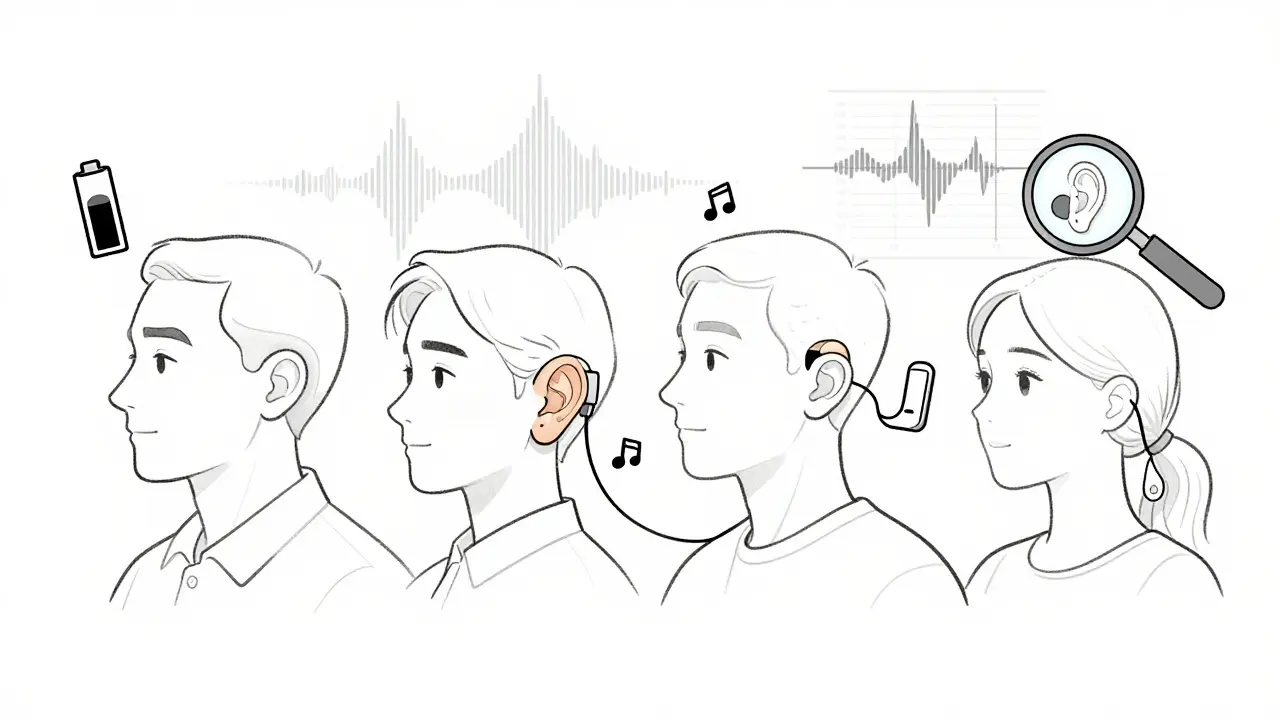
Over 1.5 billion people worldwide live with some level of hearing loss. For many, hearing aids aren’t just helpful-they’re essential. But with so many options available today, choosing the right one can feel overwhelming. Are you better off with a sleek, invisible device or a powerful behind-the-ear model? Should you buy online or see an audiologist? And what does all this talk about AI, LE Audio, and dual-chip processing actually mean for your daily life?
What Are the Main Types of Hearing Aids?
Modern hearing aids come in five main styles, each designed for different needs, lifestyles, and levels of hearing loss. The right fit isn’t just about comfort-it’s about performance.Behind-the-Ear (BTE) models sit behind the ear and connect to a custom earmold or dome that fits inside the ear canal. These are the most powerful and durable. Devices like the Phonak Naída Lumity L-UP is a high-power BTE hearing aid designed for severe to profound hearing loss with IP68 water resistance and up to three weeks of battery life are built for people who need maximum amplification. They’re also easier to handle for those with dexterity issues. The downside? They’re more visible than other styles.
Receiver-in-Canal (RIC) devices are the most popular today. The speaker sits directly in the ear canal, connected by a thin wire to a small unit behind the ear. This design reduces feedback and offers better sound quality. The Jabra Enhance Select 700 is a top-rated RIC hearing aid with LE Audio support, 24-hour battery life, and IP68 water resistance, designed for mild-to-moderate hearing loss is a great example. It’s compact, comfortable, and works well for active users. Many RIC models now support LE Audio is a new Bluetooth standard for hearing aids that improves audio quality, reduces power use, and enables direct streaming to multiple devices, which lets you stream music, calls, and even group audio from public spaces like restaurants.
In-the-Ear (ITE) hearing aids fill the outer ear bowl. They’re larger than canal styles, so they can hold bigger batteries and more features. The Signia Active Pro IX is an ITE hearing aid with 34 hours of battery life, Bluetooth 5.2, and IP68 protection, offering advanced features in a discreet form factor delivers 34 hours of use and Bluetooth connectivity in a single unit. These are ideal for people who want more control buttons and longer battery life without the bulk of BTEs.
Completely-in-Canal (CIC) and Invisible-in-Canal (IIC) styles are the smallest and most discreet. They fit deep inside the ear canal and are nearly invisible. Brands like Eargo is a popular brand offering rechargeable IIC hearing aids designed for cosmetic appeal and mild-to-moderate hearing loss specialize in these. But there’s a trade-off: smaller size means less power, shorter battery life (16-20 hours), and fewer features like manual controls or directional microphones. They’re not recommended for severe hearing loss or people with dexterity issues.
How Are Hearing Aids Fitted?
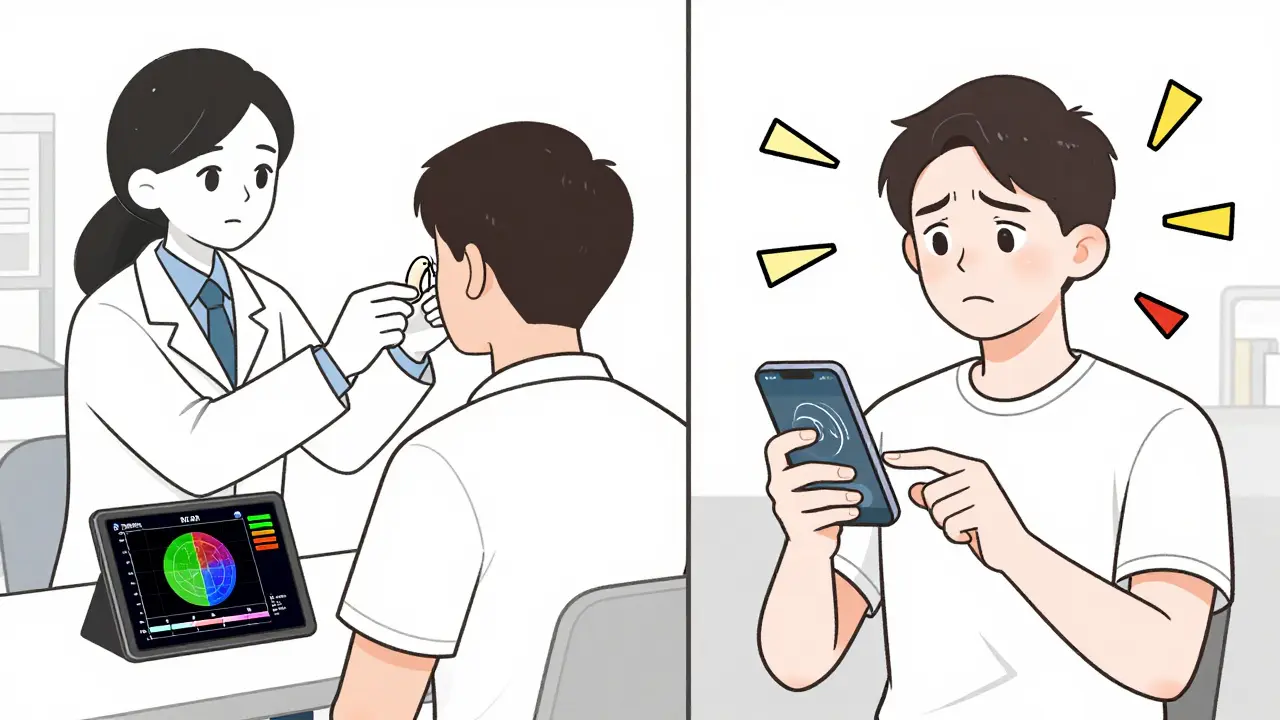
Getting the right fit isn’t just about plugging in a device. It’s a process that ensures the sound is tuned to your specific hearing loss.If you choose a prescription hearing aid through an audiologist, you’ll go through a multi-step process. First, you’ll have a full hearing test to map your hearing loss across frequencies. Then, the audiologist will select a device based on your lifestyle, ear shape, and degree of loss. After ordering, you’ll return for a fitting-this is where the device is programmed using software that matches your audiogram. You’ll spend 30-60 minutes testing how it sounds in quiet and noisy environments. Follow-up visits are common over the next few weeks as your brain adjusts to new sounds. Many clinics offer three to four appointments over two to three weeks.
Over-the-Counter (OTC) hearing aids, available since October 2022 in the U.S., are designed for adults with mild-to-moderate hearing loss. These are self-fit. You download an app, take a hearing test on your phone, and the device automatically adjusts. The Jabra Enhance Select 700 is a top-rated OTC hearing aid with a mobile app that guides users through self-fitting in about 2.5 hours is one of the most user-friendly. About 85% of users complete the setup on their first try. But here’s the catch: a 2025 NIH study found that 68% of self-fitted users end up with incorrect amplification levels because they misinterpret their own hearing test results. Without professional calibration, you might get too much or too little sound in certain frequencies.
Even with OTC devices, earwax buildup can block sound. About 42% of users report monthly issues from wax. The fix? Clean your ears weekly with the tools provided by the manufacturer. That simple step can reduce malfunctions by 67%.
What’s New in Amplification Technology?
Hearing aids today aren’t just amplifiers-they’re smart computers that process sound in real time.Modern devices use dual-chip architecture to split processing tasks: one chip handles incoming sound, the other manages output. This cuts delay from 5-7 milliseconds down to just 0.4 milliseconds, making speech sound natural. The Phonak Audéo Infinio is a premium hearing aid with dual-chip architecture that reduces sound delay to 0.4 milliseconds, setting a new standard for natural sound quality leads here.
Processing channels are another key feature. More channels mean finer control over different sound frequencies. Premium models now offer 24+ channels. That lets the device boost quiet voices in a crowd while turning down background noise-something basic models can’t do.
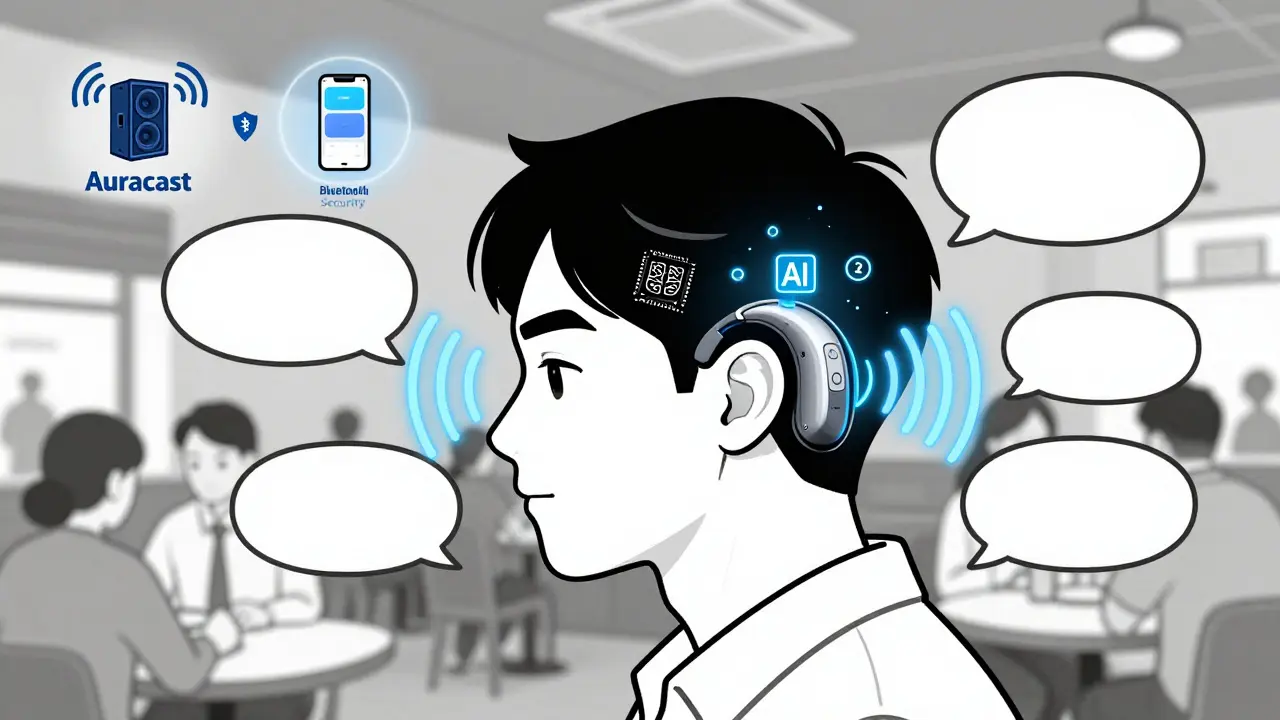
Then there’s AI-driven sound processing. The Starkey Edge AI is a hearing aid that analyzes 290 million data points per second to adapt to environments like restaurants, cars, or quiet rooms uses AI to recognize over 100 sound environments and adjusts instantly. It can even translate speech in real time. In 2025, these devices have 300% more processing power than 2020 models, while using 25% less battery.
Bluetooth has evolved too. LE Audio is a new Bluetooth standard for hearing aids that improves audio quality, reduces power use, and enables direct streaming to multiple devices replaces older Bluetooth profiles. It supports Auracast is a broadcast audio technology that allows hearing aids to pick up live audio from public venues like theaters or airports, letting you listen to announcements or live music in airports, theaters, or even restaurants without needing to pair directly with a speaker.
Price Differences: OTC vs. Prescription
Price varies wildly depending on how you buy.OTC hearing aids like Jabra Enhance Select 700 cost between $199 and $1,299 per pair. They’re affordable, easy to get, and come with app-based support. Jabra offers 24/7 chat support that resolves 92% of issues in under 15 minutes.
Telehealth models (like those sold by Audien or Eargo) range from $1,000 to $3,500. They include remote audiologist support but no in-person fitting.
Premium prescription devices from Phonak, Oticon, Widex, or Starkey cost $3,500 to $7,500+ per pair. The Phonak Audéo Infinio Sphere is a high-end prescription hearing aid with industry-leading natural sound quality, priced between $6,000 and $7,500 per pair tops the charts for sound quality but comes with a premium price. Costco’s Rexton Reach models fall in the middle at $1,399-$2,999, offering in-store support without the full clinic markup.
Market data shows Phonak holds 22.3% of the global prescription market. Jabra leads in OTC sales. The overall hearing aid market is projected to hit $14.3 billion by 2029, with OTC devices now making up 28% of all sales-up from just 8% in 2021.
What Users Actually Say
Real-world feedback tells the true story.On HearingTracker, the Jabra Enhance Select 700 has a 4.7/5 rating from over 1,200 users. Most praise the app-based setup. Reddit users love LE Audio: 73% say music streaming quality has improved dramatically compared to older Bluetooth models.
But not all is smooth. Eargo users complain about battery life. Of 318 negative Trustpilot reviews, 62% say the device lasts less than 16 hours-despite claims of 20. The Phonak Naída Lumity L-UP gets high marks for power but 34% of users say it’s too bulky for small ears.
Common tips from users: keep silica gel packets in your case to absorb moisture in humid climates like Melbourne. Enable Auracast in public venues for group listening. Use weekly cleaning tools to prevent wax buildup.
What’s Next for Hearing Aids?
The future isn’t just about better sound-it’s about health monitoring.Starkey’s 2026 roadmap includes features like blood oxygen tracking and fall detection. ReSound’s new MAV technology reduces the "occlusion effect"-that hollow, echoey feeling when you speak-by 45%. And with 2.5 billion people projected to have hearing loss by 2050, the tech will keep evolving.
But risks remain. A 2025 University of Michigan study found 12% of Bluetooth hearing aids are vulnerable to signal interception. Always update firmware and use strong passwords on companion apps.
By 2027, 41% of buyers are expected to choose telehealth options over in-clinic visits. That’s a big shift. But for severe hearing loss, professional fitting still matters. Don’t skip the audiologist if you’re struggling to understand speech in noise-even with the fanciest OTC device.
Can I use OTC hearing aids if I have severe hearing loss?
No. OTC hearing aids are only approved for mild-to-moderate hearing loss. If you struggle to follow conversations in noisy places, hear high-pitched sounds, or have trouble with phone calls, you likely need a prescription device. OTC models lack the power and fine-tuning needed for severe loss. Using one could delay proper treatment and worsen your hearing over time.
How long do hearing aid batteries last?
Battery life varies by style and usage. BTE and RIC models with rechargeable batteries last 16-34 hours per charge. Smaller CIC and IIC styles like Eargo last 16-20 hours. Premium devices like the Signia Active Pro IX offer up to 34 hours. If you use streaming features heavily, expect to drain the battery faster. Always store your aids in a dry place with silica gel to extend battery life.
Do I need to see an audiologist if I buy OTC hearing aids?
You don’t have to, but it’s strongly recommended. A professional hearing test confirms your type and degree of loss. Many people think they have mild loss when they actually have a medical condition like earwax blockage or an inner ear issue. Audiologists can also check for asymmetrical hearing loss, which could signal a neurological problem. Even if you buy OTC, a one-time consultation is worth it.
Are hearing aids covered by insurance?
Most private insurance plans in the U.S. and Australia don’t cover hearing aids. Medicare doesn’t cover them either. Some Medicaid programs offer limited benefits. A few employers offer hearing benefits through wellness programs. Check with your provider. Cost-sharing options like financing or payment plans are common with clinic-based purchases.
Can hearing aids help with tinnitus?
Yes, many modern hearing aids include tinnitus masking features. These play soft, customizable sounds-like ocean waves or white noise-to distract from ringing. Devices from Phonak, Widex, and Starkey offer this. While they don’t cure tinnitus, they significantly reduce its impact for 70% of users who combine them with counseling.
If you’re considering a hearing aid, start with a hearing test-even if you plan to buy OTC. Know your numbers. Understand your needs. And don’t rush. The right device can bring back conversations, music, and quiet moments you thought were gone forever.

Comments
Andy Heinlein
just got my jabra enhance select 700 last week and wow, i can hear my cat purring from the other room now lol
the app setup was dumb simple, like 20 mins and i was good to go. no audiologist needed for me, but hey, if you’re paranoid, go for it. i’m just glad i don’t have to yell at my wife anymore.
Ann Romine
i’ve been using a signia active pro ix for six months now. the bluetooth pairing with my airpods is seamless, but i still forget to clean the wax filter every week.
my mom in kansas says she’s been using silica gel packets since the 80s-maybe we’re all just late to the party.
Todd Nickel
the dual-chip architecture reducing latency to 0.4ms is a massive leap, but let’s be real-most people don’t need sub-millisecond precision. human speech has natural pauses, jitter, and prosody that don’t require surgical timing.
the real innovation isn’t the chips, it’s the ai environment recognition. recognizing a car engine versus a coffee shop versus a crowded subway? that’s what actually changes your life.
the fact that 68% of otc users misconfigure their own devices isn’t a flaw in the tech-it’s a failure of user education. we treat hearing like vision-we don’t buy glasses off amazon without an exam, yet we do this with hearing aids. why? because we think it’s just ‘amplification.’ it’s not. it’s neural retraining.
and the auracast feature? genius. i heard a live orchestra in a train station last month without headphones. no pairing. no app. just… sound. it felt like magic.
but let’s not pretend the $7k phonak is a ‘premium’ experience. it’s a luxury tax. the jabra does 90% of the job for 1/5th the price.
the real question isn’t ‘which device?’ it’s ‘who gets to decide what ‘good hearing’ means?’ the audiologist? the algorithm? the manufacturer? or the user themselves?
Austin Mac-Anabraba
you people are being scammed. hearing aids are a $14 billion industry built on fear and obsolescence.
the ‘ai’ is just marketing fluff-your device isn’t ‘learning,’ it’s running pre-programmed filters based on 2019 datasets.
and auracast? it’s a backdoor for corporate audio surveillance. you think your hearing aid is just streaming music? it’s also sending your location, voice patterns, and ambient noise to the cloud.
they’re not helping you hear-they’re monetizing your auditory data.
the real solution? earplugs and silence. stop feeding the machine.
Phoebe McKenzie
how is this even legal? you let people buy devices that can literally make their hearing worse?
the fact that the FDA lets otc hearing aids be sold without any real oversight is a national disgrace.
if you have hearing loss, you’re not ‘mild’-you’re damaged. and you’re being sold cheap plastic toys like they’re medical devices.
and don’t even get me started on the battery lies. eargo claims 20 hours? i got 12. they’re lying. they’re all lying.
you need a doctor. you need a real test. you need to stop trusting apps written by interns in silicon valley.
gerard najera
sound delay matters less than sound meaning.
Stephen Gikuma
why are all these hearing aids made by foreign companies? phonak is swiss, jabra is danish, starkey is american but outsources everything.
where are the american-made hearing aids? we can build fighter jets but not a decent hearing device?
this is another example of the globalist elite shipping our jobs overseas and selling us back overpriced junk.
buy american. support domestic manufacturing. or keep getting ripped off by the hearing aid cartel.
Bobby Collins
did you know the government is using hearing aids to track us?
the le audio protocol has a hidden backdoor-i read it on a forum. they’re listening through your hearing aids to detect ‘unpatriotic speech.’
my cousin’s neighbor’s dog walker’s sister said her device started playing white noise every time she mentioned ‘medicare.’
it’s not a coincidence. it’s control.
and the silica gel? that’s not for moisture. it’s a tracker. don’t touch it.
Layla Anna
i got my first hearing aids last year and honestly? i cried the first time i heard birds again 😭
the jabra app was so easy, even my grandma used it. i just wish they made them in more colors-mine is boring gray 😅
and yes, wax is the worst. i clean mine every sunday now. no more surprise silence!
Heather Josey
while affordability and accessibility are critical, the clinical validation of hearing aid fittings remains irreplaceable.
the 68% misfit rate with otc devices is not a minor oversight-it is a public health concern.
hearing loss is often the first symptom of neurological, vascular, or metabolic conditions. skipping a professional assessment risks undiagnosed pathology.
we must advocate for insurance reform and subsidized access, not just market-driven solutions.
technology should empower, not replace, clinical expertise.
the goal is not merely to amplify sound, but to restore communication, connection, and dignity.
Olukayode Oguntulu
the entire paradigm of hearing aid commodification is a postmodern farce.
we’ve reduced auditory cognition to a consumerized algorithmic output, stripping away the phenomenological richness of sonic perception.
the dual-chip architecture? merely a neoliberal solution to a bio-ontological problem.
you’re not ‘hearing better’-you’re being optimized for ambient capitalism.
auracast isn’t democratizing sound-it’s broadcasting your auditory identity into the data economy.
and the ‘tinnitus masking’ feature? a digital placebo for the neoliberal subject who has been alienated from silence itself.
we are not users-we are sonic subjects under algorithmic governance.
the real hearing aid? a return to the unmediated, unamplified, unmonetized world.
but of course, that’s not profitable. so we buy the lie. again.