
When you pick up a prescription, you might see two bottles that look completely different but have the same name on the label. One says BrandName, the other just says generic. But what if there’s a third option-something that’s exactly the same as the brand, just without the brand name on it? That’s an authorized generic. And it’s not the same as the generic you’ve probably used before.
What Exactly Is an Authorized Generic?
An authorized generic is the exact same drug as the brand-name version. Same active ingredient. Same inactive ingredients. Same pill shape, same manufacturing process, same quality control. The only difference? No brand name on the label. No fancy packaging. No logo. It’s the same medicine, just sold under a different label.
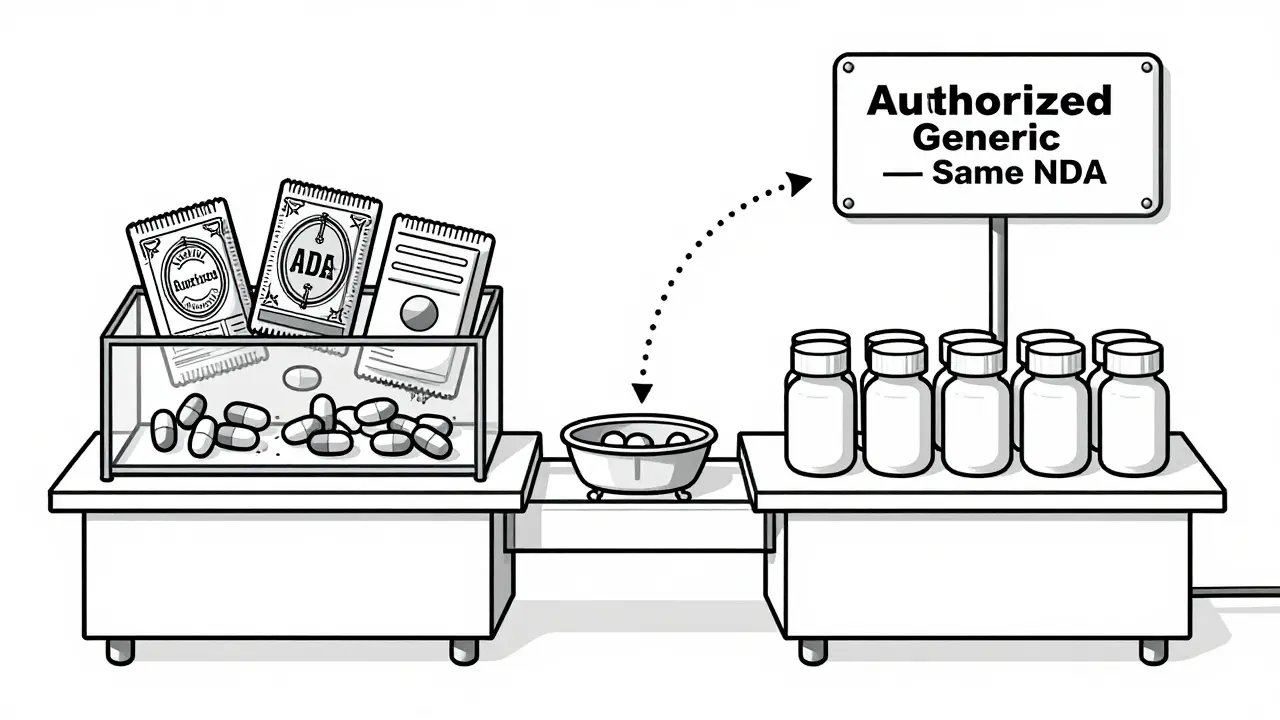
The U.S. Food and Drug Administration (FDA) defines it clearly: an authorized generic is a brand-name drug that’s marketed without the brand name. It’s produced by the original manufacturer-or by a company they’ve licensed-and sold under the same New Drug Application (NDA) the brand used. That means no extra FDA approval is needed. It’s not a copy. It’s the real thing, repackaged.
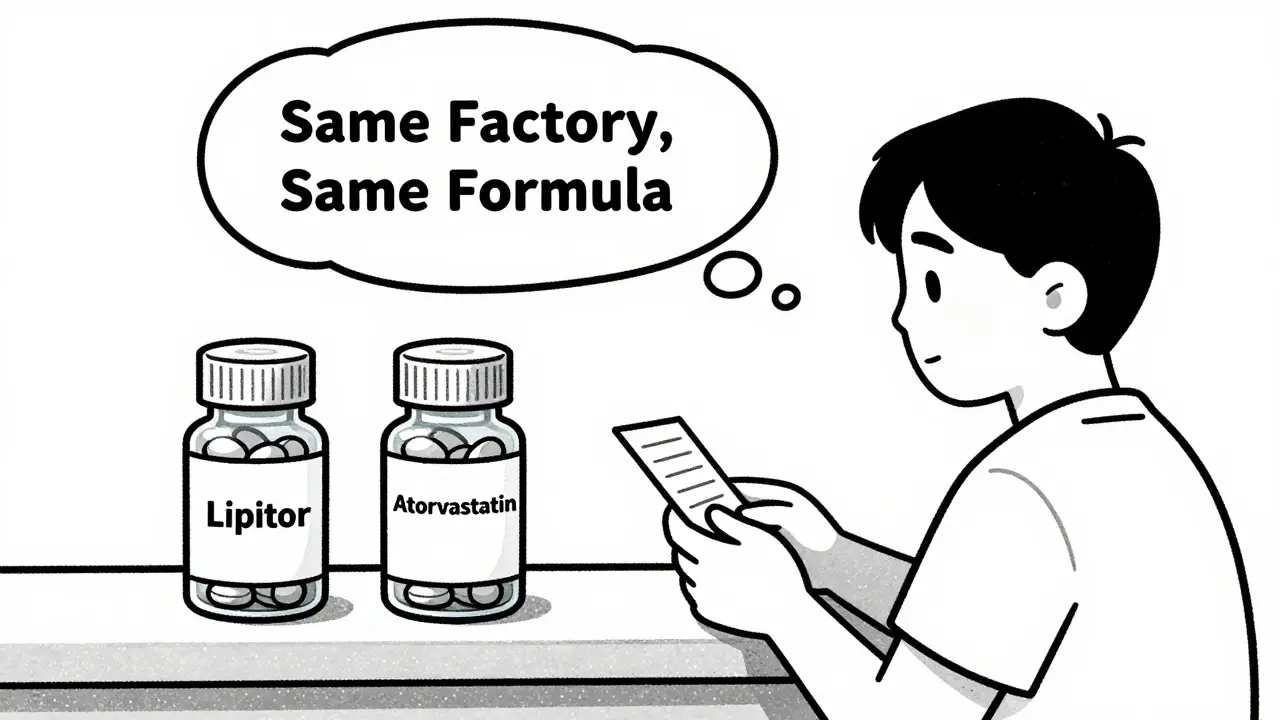
For example, if you take the brand-name drug Lipitor (atorvastatin), the authorized generic is just atorvastatin in a plain bottle. Same pills. Same factory. Same batch numbers. Only the label changes.
How Are Traditional Generics Different?
Traditional generics are different. They’re copies. And while they must contain the same active ingredient, strength, and dosage form as the brand, they’re allowed to have different inactive ingredients-things like dyes, fillers, or preservatives. These can affect how the pill looks, tastes, or even how quickly it dissolves in your body.
To get approved, traditional generics must prove they’re bioequivalent to the brand. That means they need to deliver the same amount of medicine into your bloodstream at the same speed. It’s a strict test, but it’s not the same as being identical. Two generics for the same drug can still have different fillers, which is why some people notice differences-like stomach upset or a change in how fast the medicine works.
Authorized generics skip all of that. They don’t need to prove bioequivalence because they’re not a copy. They’re the original. So if you’ve ever had a bad reaction to a generic and wondered why, it might not have been the active drug-it could’ve been the filler.
Why Do Authorized Generics Exist?
Brand-name companies don’t make authorized generics out of kindness. They do it for business.
When a brand’s patent expires, a traditional generic manufacturer can file to enter the market. If they’re the first to challenge the patent, they get 180 days of exclusive rights to sell their version. That’s a big financial incentive. But here’s the twist: the brand company can launch its own authorized generic at the same time. That means two versions of the same drug are now on the shelf-both cheaper than the brand-but only one of them (the traditional generic) gets that 180-day exclusivity.
By launching an authorized generic, the brand can undercut the first generic’s pricing, reduce their profits, and sometimes even force them out of the market. It’s a legal strategy, but it’s controversial. Some experts say it delays broader competition and keeps prices higher than they should be.
Still, for patients, it’s a win. Authorized generics often cost 15-30% less than the brand. Sometimes even less than traditional generics. And because they’re identical, there’s no guesswork about whether the medicine will work the same way.
Where Can You Find Them?
Not every brand has an authorized generic. But many do-especially for high-volume, high-cost drugs. The FDA keeps a public, updated list of all authorized generics on its website. As of September 2023, there were 1,872 authorized generic products covering 467 different active ingredients.
Three companies dominate the market: Greenstone (a Pfizer subsidiary), Prasco Laboratories, and Patriot Pharmaceuticals. Together, they make up nearly 80% of all authorized generics in the U.S. Greenstone alone handles over 40%.
If you’re prescribed a brand-name drug, ask your pharmacist: “Is there an authorized generic for this?” They can check the FDA’s list or their own database. Some pharmacies stock them automatically. Others don’t. It’s worth asking-especially if you’ve had issues with traditional generics.
Why Aren’t Authorized Generics Listed in the Orange Book?
The FDA’s Orange Book is the official guide that lists all approved drugs and their therapeutic equivalence ratings. You’ll find traditional generics there. But you won’t find authorized generics.
That’s because they’re not approved under the Abbreviated New Drug Application (ANDA) process. They’re sold under the original brand’s NDA. So they’re invisible in the Orange Book. This causes confusion for pharmacists and insurance systems. Some pharmacy benefit managers (PBMs) still treat authorized generics as “brand” drugs for pricing purposes, meaning you might pay more than you should.
That’s a problem. If you’re paying a brand co-pay for a drug that’s literally the same as the brand, you’re being overcharged. Always check your receipt. If the name on the bottle matches the brand but has no logo, and the price is low, you’re likely getting an authorized generic. Ask your insurer to reclassify it as a generic.
What Do Patients Say?
A 2022 survey by the National Community Pharmacists Association found that 67% of independent pharmacists reported patients specifically asking for authorized generics. Why? Because they’ve had bad experiences with traditional generics.
Some people report that traditional generics cause more side effects-headaches, nausea, dizziness-even when the active ingredient is the same. Often, that’s because of the inactive ingredients. An authorized generic removes that uncertainty.
One patient in Melbourne told her pharmacist: “I’ve been on this medication for 10 years. The brand worked fine. The first generic made me dizzy. The second generic gave me stomach pain. The authorized generic? It’s like I never switched.”
But here’s the catch: most people can’t tell the difference. A GoodRx survey found that 78% of patients couldn’t distinguish between an authorized generic and a traditional generic just by looking at the pill. That’s why education matters.
What Should You Do?
Here’s a simple checklist when you get a prescription:
- Ask your doctor: “Is there an authorized generic for this drug?”
- Ask your pharmacist: “Is this an authorized generic or a traditional generic?”
- Check the bottle: Does it have the brand name? If not, ask if it’s the same as the brand.
- Check your receipt: Are you paying a brand co-pay for a generic? Push back.
- Keep a record: If you’ve had reactions to generics before, note it. Bring it up next time.
If you’re on a long-term medication-like blood pressure pills, antidepressants, or cholesterol drugs-switching between different generics can be risky. Authorized generics eliminate that risk. They’re the closest thing to staying on the brand without paying the brand price.
The Bigger Picture
The pharmaceutical industry is complex. Authorized generics sit in a gray area. They’re not traditional generics. They’re not brand drugs. They’re something in between.
For patients, they’re a gift. For manufacturers, they’re a tool. For regulators, they’re a puzzle. The FDA calls them “not a typical generic,” and that’s the key.
As of 2023, authorized generics make up about 12.7% of all generic drug sales in the U.S. That number is expected to grow to 15.3% by 2027. More specialty drugs-like those for cancer, autoimmune diseases, and rare conditions-are being released as authorized generics because consistency matters more than ever.
So next time you’re handed a plain bottle with a familiar drug name, don’t assume it’s just another generic. Ask. Know what you’re getting. And don’t pay more than you have to for the exact same medicine.

Comments
RONALD Randolph
Authorized generics? Please. The FDA’s just playing nice with Big Pharma. If it’s the same pill, why isn’t it listed in the Orange Book? That’s not transparency-that’s a loophole.
Benjamin Glover
Typical American mess. We pay more for drugs than anyone, then act surprised when the system’s rigged.
Sai Nguyen
India makes better generics than this. No fancy labels needed. Just medicine.
Nupur Vimal
I switched to an authorized generic for my antidepressant and suddenly I wasn’t crying in the shower every morning
Raj Kumar
So if you're on a long-term med like metformin or lisinopril and your generic makes you feel weird, ask for the authorized one. It's literally the same pill, just no logo. No magic, just science.
John Brown
This is the kind of info that actually saves people money and stress. Seriously, pharmacists should be required to mention this at pickup. It’s not just a tip-it’s a right.
Mike Nordby
The distinction between authorized generics and traditional generics is critical for therapeutic consistency, particularly in narrow-therapeutic-index medications such as warfarin or levothyroxine. The variability in excipients can influence dissolution profiles, even when bioequivalence is demonstrated.
Lisa Davies
OMG I didn’t know this!! 🤯 I’ve been paying brand prices for years thinking I had no choice. Time to call my insurance and demand a reclassification 😍
Cassie Henriques
Authorized generics = brand drug under a different NDA. Traditional generics = ANDA pathway. PBMs still treat them as brand because their algorithms are stuck in 2010. The system’s broken, but at least we know now.
Jake Sinatra
As a pharmacist for 18 years, I’ve seen patients suffer from filler-induced side effects. Authorized generics eliminate that uncertainty. This isn’t marketing-it’s clinical precision. Everyone deserves that.
Melissa Taylor
Thank you for writing this. So many people are confused and overpaying. Knowledge is power-and in this case, it’s also savings.
John Samuel
Imagine a world where your medication didn’t come with a psychological tax-where the pill in your hand was exactly what the doctor intended, unobscured by corporate branding. That’s what an authorized generic offers: purity of purpose, unadulterated by marketing theatrics. It’s not just cheaper-it’s more honest. And in a system where profit so often eclipses patient well-being, honesty is revolutionary. 🌱