

When you take a medication, you expect it to work - not too little, not too much. But for some drugs, that balance is razor-thin. These are called narrow therapeutic index drugs, or NTI drugs. A tiny change in your dose - even 10% - can mean the difference between healing and harm. For patients, this isn’t just a technical term. It’s a daily reality that requires attention, consistency, and communication with your care team.
What makes a drug have a narrow therapeutic index?
Every drug has a range of doses that work safely. That’s the therapeutic window. For most medications, this window is wide. You can miss a dose, take it a little late, or even switch brands without much trouble. But NTI drugs are different. Their window is so narrow that even small changes in how your body absorbs or processes the drug can push you out of safety.
The FDA defines NTI drugs as those where small changes in blood concentration can lead to serious problems - like organ rejection, dangerous bleeding, seizures, or heart rhythm issues. The difference between the lowest dose that works and the lowest dose that causes harm is often less than double. For example:
- Warfarin: Your INR (a blood test) needs to stay between 2.0 and 3.0. Go above 3.5, and your risk of bleeding skyrockets.
- Lithium: The safe range is 0.6 to 1.2 mmol/L. Above 1.5, you risk confusion, tremors, or even kidney damage.
- Digoxin: Therapeutic level is 0.5-0.9 ng/mL. Above 2.0, you can get life-threatening heart arrhythmias.
- Levothyroxine: Even small changes in dose can flip your TSH from normal to severely high or low - causing fatigue, weight gain, or heart strain.
These aren’t rare edge cases. These are common, life-saving drugs. And they demand precision.
Why does this matter for you as a patient?
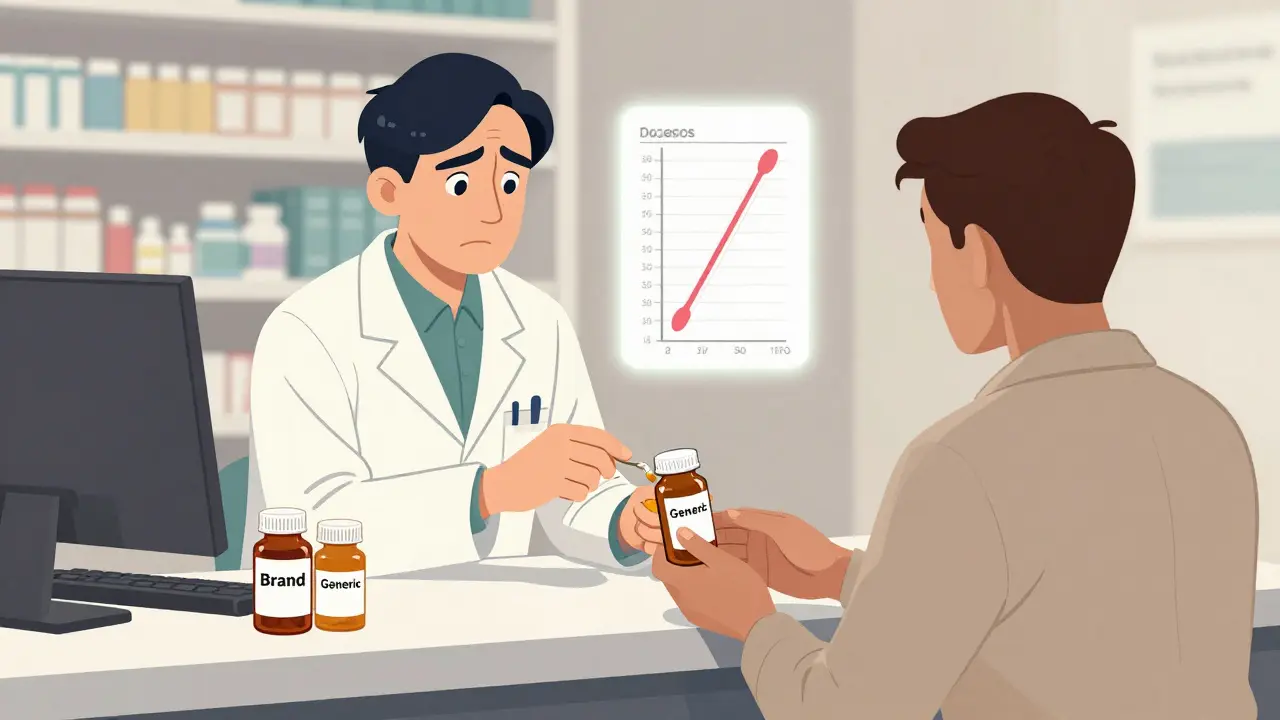
Many people assume all generic drugs are the same. That’s true for most medications. But with NTI drugs, even minor differences in how a generic is made - the fillers, the coating, the release rate - can change how much of the drug enters your bloodstream. A 2021 study found that patients who switched between different generic versions of NTI drugs had 2.3 times higher hospitalization rates than those who stayed on the same product.
One patient on PatientsLikeMe shared: “I switched from brand Coumadin to a generic. My INR jumped from 2.5 to 4.1 in a week. I nearly bled out.” That’s not an outlier. A GoodRx survey of 1,200 NTI drug users found that 63% needed a dose adjustment within three months, and 31% had at least one episode of dangerous under- or over-dosing.
It’s not just about switching brands. Even switching pharmacies, or buying from different manufacturers, can cause shifts. That’s why some states - like North Carolina - require pharmacists to get your doctor’s approval before substituting a generic for an NTI drug.
What are the most common NTI drugs?
You might already be taking one without realizing it. Here are the most frequently prescribed NTI drugs:
- Warfarin (Coumadin, Jantoven) - Blood thinner for clots, atrial fibrillation
- Lithium (Lithobid) - Mood stabilizer for bipolar disorder
- Levothyroxine (Synthroid, generic) - Thyroid hormone replacement
- Digoxin (Lanoxin) - Heart failure and irregular heartbeat
- Tacrolimus (Prograf) - Immunosuppressant after organ transplants
- Phenytoin (Dilantin) - Seizure control
- Carbamazepine (Tegretol) - Seizures and nerve pain
- Methotrexate (Trexall) - Autoimmune conditions and some cancers
Each of these requires regular blood tests. Skipping them isn’t an option. Your doctor isn’t being overly cautious - they’re preventing emergencies.
How do you stay safe on an NTI drug?
There’s no magic trick. Safety comes down to three things: consistency, monitoring, and communication.
- Stay on the same brand or generic - If your doctor prescribes a specific version, ask your pharmacist not to switch it. If you must switch, your doctor should recheck your blood levels within 1-2 weeks.
- Never skip your lab tests - Warfarin patients often need INR checks every 1-4 weeks. Lithium levels are checked every 3-6 months. Tacrolimus is monitored twice a week right after transplant. These aren’t suggestions - they’re lifelines.
- Know the warning signs - For warfarin: unusual bruising, nosebleeds, dark urine. For lithium: hand tremors, nausea, dizziness. For levothyroxine: sudden fatigue, weight gain, or racing heart. Don’t wait. Call your provider.
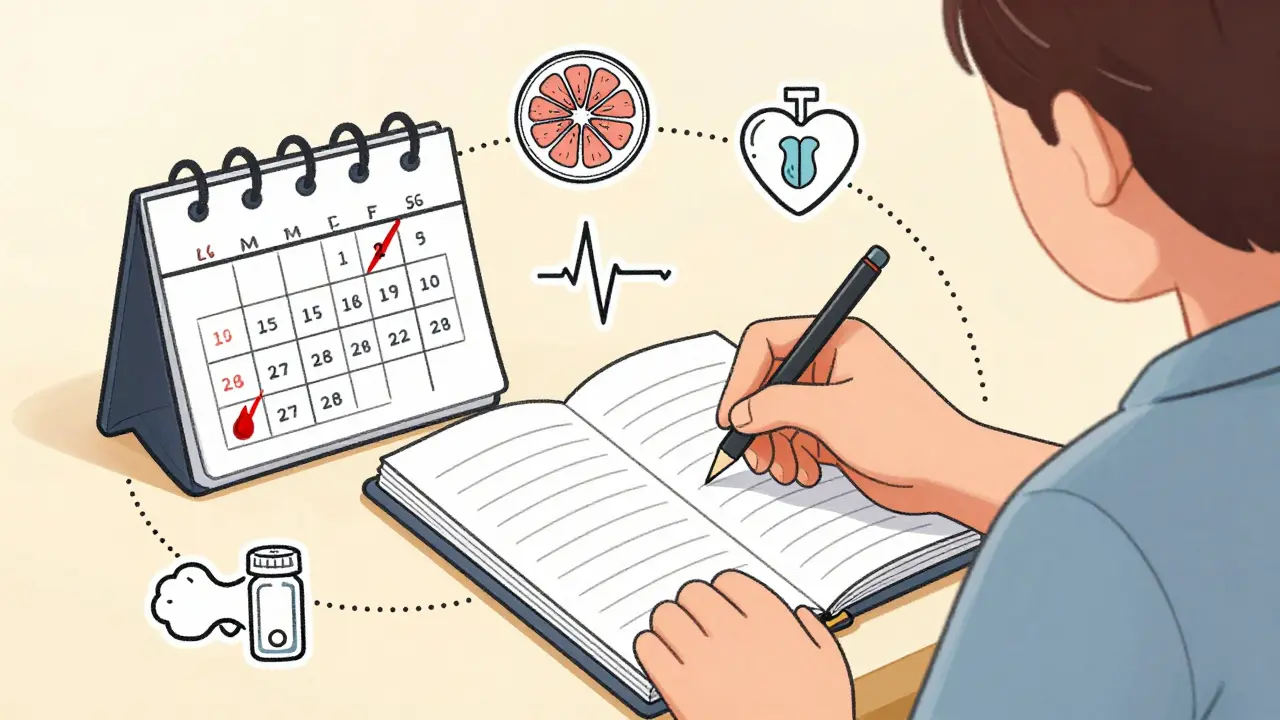
- Track your symptoms - Keep a simple log: date, dose, how you feel, any new symptoms. Patients who track their symptoms have 32% fewer adverse events, according to the American College of Clinical Pharmacy.
- Watch for interactions - Grapefruit juice, certain antibiotics, even high-fiber diets can affect absorption. Tell every new provider you’re on an NTI drug.
What’s changing in NTI drug care?
The system is slowly catching up. The FDA now requires stricter bioequivalence testing for NTI generics - not the standard 80-125% range, but 90-111%. That’s a huge shift. It means generics for drugs like levothyroxine and digoxin must now match the brand much more closely.
Hospitals are using barcode scanning to prevent dosing errors with high-risk NTI drugs. Mobile apps approved by the FDA now help patients track doses, symptoms, and lab results. And research is moving toward personalized dosing based on genetics. Studies show that for warfarin, two genes (CYP2C9 and VKORC1) explain up to 60% of why people need different doses. By 2026, genetic testing before starting some NTI drugs could become routine.
This isn’t about fear. It’s about control. You’re not helpless. You’re part of a team - and your role matters more than you think.
What should you ask your doctor?
If you’re on an NTI drug, here are five essential questions:
- Is this drug on the narrow therapeutic index list?
- What lab tests do I need, and how often?
- Can I switch to a different generic, and if so, what should I watch for?
- Are there any foods, supplements, or other meds I need to avoid?
- What symptoms mean I need to call you right away?
Don’t assume they’ll bring it up. If you’re taking one of these drugs, you’re in a higher-risk group. Make sure your care team knows you’re aware of it.
Are all generic drugs dangerous for NTI medications?
No. Not all generics are risky. But for NTI drugs, even small differences in how they’re made can matter. Some generic versions are just as safe as the brand. The key is consistency. If you’ve been stable on a specific generic, don’t switch unless your doctor approves it. If you’re switched, ask for a blood test within two weeks to make sure you’re still in the safe range.
Can I stop taking my NTI drug if I feel fine?
Never stop without talking to your doctor. NTI drugs often treat serious conditions - like heart rhythm problems, thyroid failure, or organ rejection. Stopping suddenly can be dangerous. Even if you feel fine, your blood levels might be dropping below what’s needed. That’s why regular testing exists - to catch changes before you feel them.
Why do I need so many blood tests?
Because your body doesn’t process these drugs the same way every day. Factors like diet, stress, other medications, even changes in weather can affect absorption. Blood tests are the only way to know if you’re getting the right amount. For example, a single meal high in vitamin K can make warfarin less effective. Without testing, you wouldn’t know until you started bleeding.
Is there a list of all NTI drugs?
The FDA doesn’t publish an official public list. But experts agree on a core group based on clinical evidence, monitoring requirements, and safety data. The most commonly recognized NTI drugs include warfarin, lithium, levothyroxine, digoxin, tacrolimus, phenytoin, carbamazepine, and methotrexate. If your drug requires regular blood tests or has a very small dosing range, it’s likely an NTI drug.
Can pharmacists substitute my NTI drug without telling me?
In most states, yes - unless your doctor writes “dispense as written” or “no substitution.” But for NTI drugs, this can be risky. Some states, like North Carolina, require pharmacist approval from the prescriber before switching. Always ask: “Is this the same brand/generic I’ve been taking?” If it’s different, request a blood test within two weeks.
What’s next for you?
If you’re on an NTI drug, you’re not alone. Millions of people manage these medications safely every day. But it takes work. Start by reviewing your current meds with your pharmacist. Ask which ones are NTI. Check your last lab results. Write down your symptoms. Set reminders for your blood tests. Keep your medication list updated - and share it with every new doctor.
These drugs aren’t meant to scare you. They’re meant to save you. And with the right habits, they can do exactly that - safely, reliably, and for years to come.

Comments
Chris Beckman
so i took my generic levothyroxine and switched pharmacies last month. didn't think twice. woke up one morning feeling like a zombie. turned out my TSH was through the roof. doc said i was basically hypothyroid again. why do they let pharmacists just swap this stuff? i'm lucky i didn't have a heart attack. #facepalm
Milad Jawabra
bro this is why you don't play roulette with your meds 🤯 i've been on warfarin for 7 years. same brand. same pharmacy. same blood draw day every Tuesday. if you're switching generics without testing? you're not being smart - you're being a statistic. i've seen people end up in the ER over this. don't be that guy. stay consistent. your life isn't a cost-cutting experiment.
Levi Viloria
interesting. i didn't realize so many common meds fall into this category. i'm on lithium and honestly never thought about the brand. my doc just said 'take it.' maybe i should ask if mine's a generic. i mean, it's not like i'm going to check the bottle every time... but now i'm kinda paranoid. lol
Dean Jones
The fundamental epistemological dilemma inherent in pharmaceutical substitution lies not in the chemical equivalence of molecules, but in the ontological instability of biological systems. The human body is not a closed system; it is a dynamic, context-sensitive organism whose homeostatic equilibrium is perpetually disrupted by dietary intake, circadian rhythms, psychosocial stressors, and environmental variables. When we reduce therapeutic efficacy to a binary notion of 'generic = safe,' we commit a category error - mistaking pharmaceutical identity for physiological identity. The FDA's 90-111% bioequivalence standard, while statistically rigorous, ignores the nonlinear pharmacokinetics of NTI drugs. A 5% deviation in absorption may be negligible for an antibiotic, but for tacrolimus, it is the difference between graft survival and catastrophic rejection. This is not a regulatory issue - it is a phenomenological one.
Betsy Silverman
I’ve been on levothyroxine for 12 years. I stick with the same pharmacy. I write down my symptoms. I get my TSH checked every 6 months. It’s not hard. It’s just... consistent. I know it seems like overkill, but if you want to feel normal, this is the price. Don’t make it harder than it needs to be.
Ivan Viktor
so let me get this straight - we’ve got people taking life-saving drugs, and the system lets some guy in a pharmacy in Nebraska swap out the pills without telling them? and we call this healthcare? 🤡 next they’ll substitute insulin with ‘generic glucose’.
Zacharia Reda
i used to think this was all hype. then my buddy went from 0.8 to 1.7 lithium in 10 days after switching generics. ended up in psych. he’s fine now, but dude - he didn’t even know he’d been switched. that’s wild. if you’re on one of these, don’t just trust the system. be the detective. check your bottle. ask. test. track. it’s not paranoia - it’s survival.
Jeff Card
i read this whole thing and just felt so much calmer. like, i’m on warfarin and i’ve been terrified to change anything. but now i know why. it’s not that i’m being overly cautious - it’s that the science is actually really clear. i’m gonna print this out and give it to my mom. she’s on digoxin and doesn’t even know what 'NTI' means. she needs to see this.
Matt Alexander
if you’re on one of these drugs, here’s what to do: 1. Keep the same pill. 2. Get your blood tested. 3. Tell every new doctor you’re on it. 4. Write down how you feel. That’s it. No magic. Just do the boring stuff.
Gretchen Rivas
I’ve been on lithium for 8 years. I’ve never switched brands. I get my levels checked every 3 months. I don’t eat grapefruit. I tell every new provider. It’s not hard. It’s not scary. It’s just... non-negotiable.
Richard Elric5111
The modern pharmacopeia operates under a paradigm of commodification, wherein therapeutic agents are reduced to interchangeable units of economic exchange. This is a profound moral failure. When a patient’s neurological stability, cardiac rhythm, or transplant viability hinges upon the precise molecular architecture of a tablet - and when that tablet is subject to the whims of supply chains, corporate mergers, and profit-driven substitution - we have abandoned the Hippocratic oath in favor of the balance sheet. The FDA’s revised bioequivalence standards are a step forward, but they remain insufficient. True safety requires not just regulatory rigor, but a cultural recommitment to the sanctity of individual biological integrity. Until then, we are not treating patients - we are administering variables.