
Antihistamine Safety Risk Calculator
Assess Your Work Safety Risk
See how your antihistamine choice impacts your ability to work safely. First-gen antihistamines can cause hidden impairment even when you don't feel sleepy.
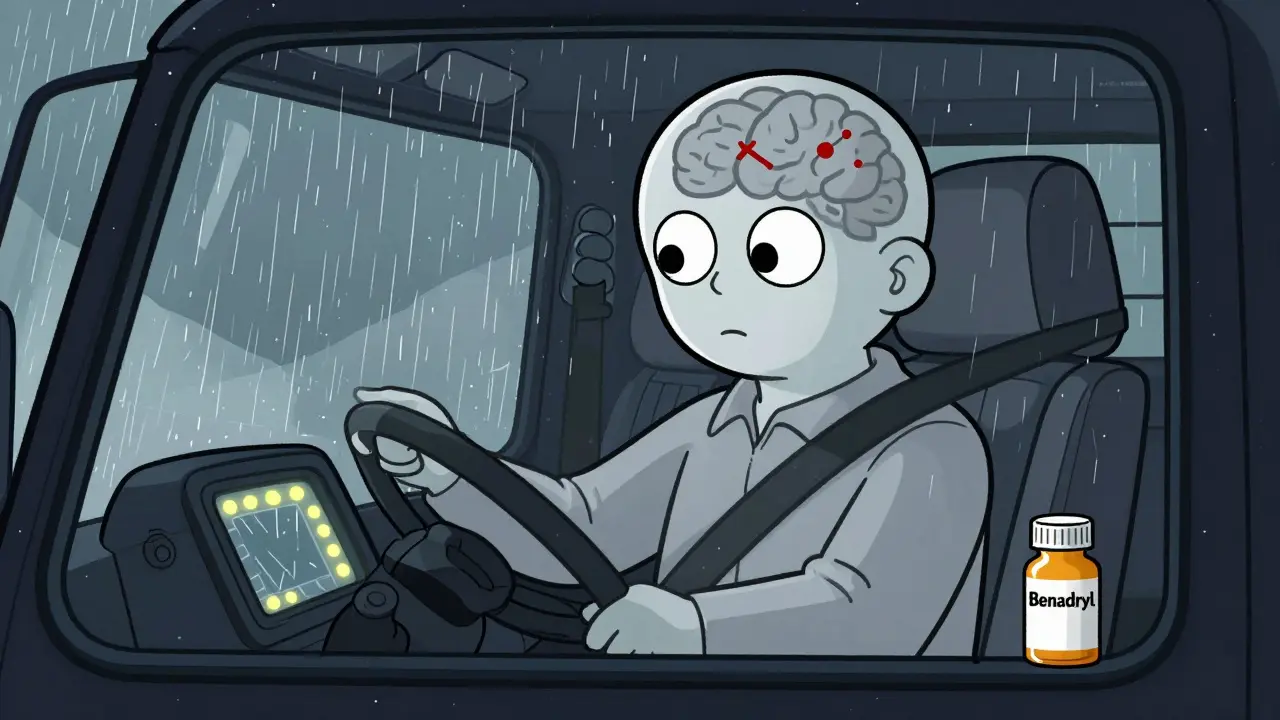
Many people take antihistamines without thinking twice. A quick pill for sneezing, itchy eyes, or a runny nose seems harmless-until it’s not. For workers behind the wheel, on a construction site, or operating heavy machinery, what feels like a minor allergy fix can become a serious safety risk. The problem isn’t just feeling sleepy. It’s that you don’t feel sleepy… but your brain and body are still impaired.
Why Some Antihistamines Are More Dangerous Than Others
Not all antihistamines are created equal. There are two main types: first-generation and second-generation. First-generation ones-like diphenhydramine (Benadryl), chlorpheniramine (Chlor-Trimeton), and hydroxyzine (Atarax)-were developed in the 1940s. They work well for allergies, but they also cross the blood-brain barrier easily. Why? Because they’re lipophilic, meaning they dissolve in fat and slip into the brain without much resistance. Once there, they block histamine, a chemical your brain uses to stay alert. The result? Slowed reaction time, fuzzy thinking, and poor coordination-all without the warning sign of obvious sleepiness. Second-generation antihistamines, like loratadine (Claritin), cetirizine (Zyrtec), and fexofenadine (Allegra), were designed differently. They’re built to avoid the brain. Thanks to their affinity for P-glycoprotein transporters, these drugs get pumped back out before they can cause drowsiness. Studies show their impairment levels are nearly identical to placebo. In driving simulators, people on first-gen antihistamines showed up to a 30% drop in reaction time and 50% more lane drifting. Second-gen users? Almost no change.The Hidden Danger: You Don’t Feel It, But You’re Still Impaired
This is the scariest part. Many people swear they don’t feel drowsy after taking Benadryl. They’re alert. They’re fine. But objective tests say otherwise. A truck driver in Australia reported failing a roadside cognitive test after taking diphenhydramine. He said, "I didn’t feel sleepy at all, but I couldn’t touch my nose with my finger." That’s not a joke-it’s a real test used to measure psychomotor control. When your brain can’t coordinate simple movements, it can’t handle complex ones like braking suddenly or reading a traffic sign in heavy rain. The U.S. National Highway Traffic Safety Administration estimates 100,000 car crashes each year are caused by drowsy driving. Many involve sedating antihistamines. And that’s just the ones reported. Unreported incidents? Nobody knows. Pilots who’ve crashed? First-gen antihistamines are the most common medication found in their systems. It’s not a coincidence. It’s pharmacology.Who’s at Risk? It’s Not Just Drivers
You might think this only matters for truckers or pilots. But think again. Construction workers using power tools. Factory operators monitoring machinery. Nurses working night shifts. Warehouse staff lifting heavy loads. Even office workers operating forklifts or driving company vehicles during errands-all are at risk. The CDC reports over 25% of older adults fall each year. First-gen antihistamines are a major contributor. Dizziness, slow reflexes, and blurred vision don’t just cause car crashes. They cause broken hips, head injuries, and long-term disability. A nurse in Melbourne shared her story: "I used to take Benadryl at night for allergies. But I’d wake up groggy, and sometimes I’d still feel off during my 3 p.m. shift. I switched to loratadine. No more fog. No more mistakes." That’s the difference.
How Long Does the Risk Last?
First-gen antihistamines have long half-lives. Diphenhydramine stays in your system for 15 to 30 hours. Peak impairment hits 2 to 4 hours after taking it-but the effects linger. That means if you take it at 8 a.m., you could still be impaired at 10 p.m. And if you take it twice a day? The effects build up. You don’t just feel tired. Your brain is literally running on low power. Second-gen options? Half-lives are 8 to 12 hours. Most clear out by the next day. That’s why they’re safer for shift workers, emergency responders, and anyone who needs to stay sharp on demand.What About Alcohol? Mixing Is a Recipe for Disaster
FDA labels warn: "Alcohol and other CNS depressants may increase drowsiness." That’s not just a footnote. It’s a red flag. One drink with diphenhydramine? Your reaction time can drop by 50% or more. Combine it with painkillers, sleeping pills, or even some antidepressants, and you’re playing Russian roulette with your job-and your life. A 2022 study of workplace incidents in Australia found that 17% of medication-related accidents involved sedating antihistamines paired with alcohol or opioids. These aren’t rare cases. They’re predictable.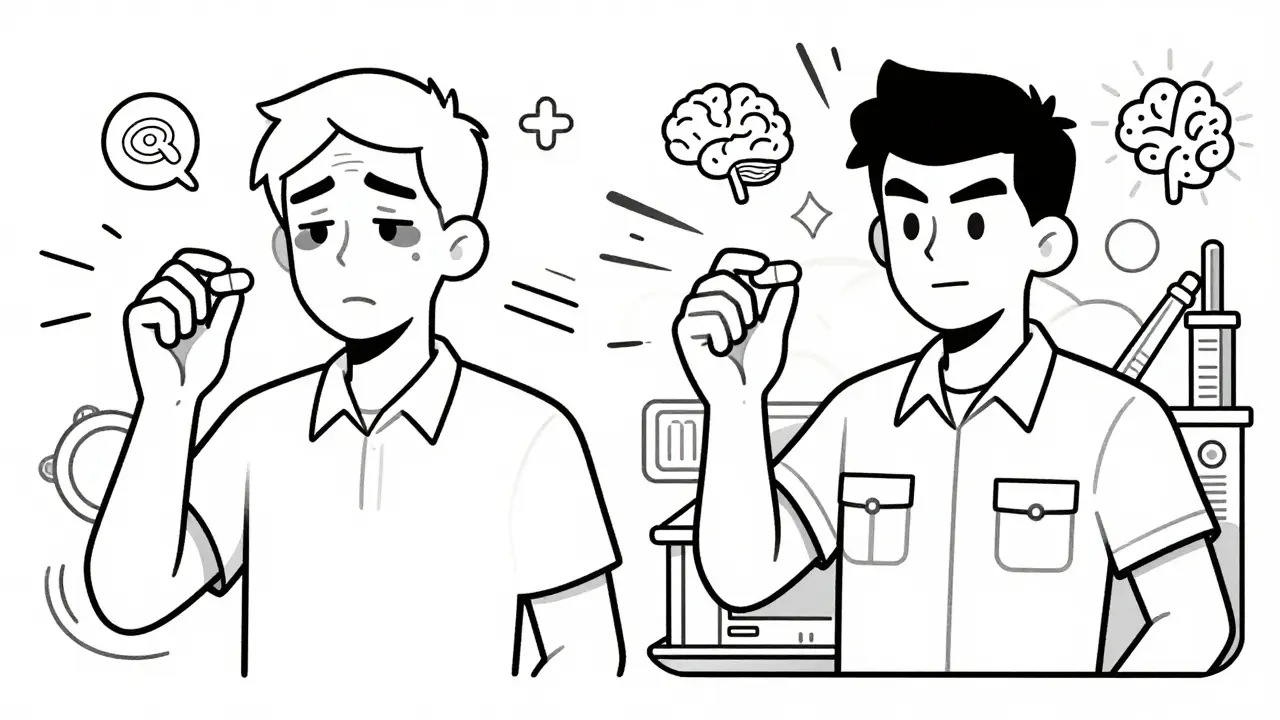
What Should You Do? Practical Steps for Safer Use
- Switch to second-generation antihistamines. If you take antihistamines regularly, choose loratadine, cetirizine, or fexofenadine. They work just as well for allergies-with far less risk.
- Don’t assume you’re fine. Even if you don’t feel drowsy, your performance is still affected. Test yourself at home before returning to work. Can you walk a straight line? Can you catch a ball thrown at you from 10 feet? If you struggle, you’re not ready.
- Take sedating antihistamines at bedtime. If you must use diphenhydramine or similar drugs, take them only when you’re not working. Even then, wait at least 18 hours before operating machinery or driving.
- Read labels carefully. Look for "may cause drowsiness" or "avoid driving or operating machinery." If it’s not there, ask your pharmacist. Many first-gen products still don’t make the risk clear enough.
- Talk to your employer. If you work in safety-sensitive roles, your company should have a policy on medication use. If they don’t, push for one. The National Safety Council reports 41% of Fortune 500 companies now include antihistamine guidance in their safety protocols. You’re not alone.
Employers and Regulators Are Catching Up
The FAA bans first-gen antihistamines for pilots. The U.S. Department of Transportation requires employers to include them in drug safety programs. The European Medicines Agency issued safety alerts for transport workers in 2019. In 2023, the FDA updated labeling rules to make warnings clearer. NIOSH launched a 2024 initiative to create workplace guidelines. This isn’t theoretical anymore. It’s policy. The market is shifting too. Second-generation antihistamines now make up 68% of global sales. Nurses? 73% use non-sedating versions exclusively. Workers are voting with their choices. And companies are starting to follow.What’s Next?
The American College of Occupational and Environmental Medicine predicts that within the next five years, employers will require safety-sensitive workers to use only non-sedating antihistamines. That could affect 23 million workers in the U.S. alone. The science is clear. The data is overwhelming. The risk isn’t worth it. If you rely on antihistamines to manage allergies, don’t wait for an accident to change your habits. Make the switch now. Your brain, your job, and the people around you will thank you.Do all antihistamines make you drowsy?
No. First-generation antihistamines like diphenhydramine and chlorpheniramine commonly cause drowsiness because they enter the brain. Second-generation antihistamines like loratadine, cetirizine, and fexofenadine are designed to avoid the brain and typically cause little to no drowsiness. Choose second-gen options if you need to stay alert.
Can I drive after taking Benadryl if I don’t feel sleepy?
No. Even if you don’t feel sleepy, Benadryl can still impair your reaction time, coordination, and decision-making. Studies show it reduces driving performance by up to 30%. You may feel fine, but your brain isn’t operating at full capacity. Never drive after taking first-gen antihistamines.
How long does drowsiness from antihistamines last?
First-generation antihistamines like diphenhydramine have a half-life of 15-30 hours. Peak impairment occurs 2-4 hours after dosing, but effects can last up to 18 hours or longer. Second-generation options like Claritin or Allegra typically last 8-12 hours and clear from your system faster, making them safer for daytime use.
Are there laws against driving on antihistamines?
Yes. In the U.S., all 50 states prohibit driving under the influence of any drug that impairs your ability to operate a vehicle safely-including sedating antihistamines. The Department of Transportation considers them controlled impairing substances. A positive drug test or accident involving these drugs can lead to fines, license suspension, or criminal charges.
Can antihistamines affect my job performance if I’m not driving?
Absolutely. Sedating antihistamines can slow reaction time, reduce focus, and increase errors in tasks requiring attention, coordination, or quick decisions. This includes operating machinery, working at heights, handling tools, or even managing equipment in warehouses or hospitals. The risk isn’t limited to roads-it’s everywhere you need to be alert.
What’s the safest antihistamine for shift workers?
Loratadine (Claritin) and fexofenadine (Allegra) are among the safest for shift workers. They’re non-sedating, have short half-lives, and don’t interfere with alertness. Cetirizine (Zyrtec) can cause mild drowsiness in some people, so it’s less ideal for critical roles. Always test a new medication at home before using it during work hours.

Comments
George Vou
i swear to god the government is letting big pharma slip sedating antihistamines into everything just so we all get dumber and easier to control. they dont want us driving or operating anything... they want us sitting on the couch scrolling tiktok while they print more money. benadryl? more like bena-dumb.
and dont tell me "it works better"-i dont care if it cures your sneezes if it turns your brain into mashed potatoes.
Scott Easterling
I mean... come on. People take Benadryl like it's candy. I saw a guy at the gas station buy three bottles last week. He was holding a coffee cup and a pack of gummy vitamins. He looked like a walking zombie. And now we're surprised when someone crashes? No. We're just surprised they didn't crash sooner.
Mantooth Lehto
I used to take Zyrtec... then I switched to Benadryl because "it works better"... and I almost ran into a tree on my way to work. I was crying in the parking lot because I didn't even feel dizzy. I thought I was fine. I was NOT fine. 😭 I switched back. No more "I'm fine" lies. My brain is not a lab rat.
Melba Miller
This is why America is falling apart. We let corporations sell poison labeled as "harmless" and then we blame the worker when they fall off a ladder. We don't train people. We don't test them. We just say "read the label" like that's enough. Meanwhile, the guy who designed the drug is sipping champagne in Switzerland. I'm sick of it.
Katy Shamitz
I just want to say thank you to whoever wrote this. I'm a nurse and I used to take Benadryl every night. I didn't realize how much I was messing up my shifts until I started having trouble reading IV labels. I switched to Claritin. My hands stopped shaking. My mind stopped fogging. I'm so much more present now. You're not crazy for feeling off-you're just taking the wrong pill. ❤️
Nicholas Gama
The data is clear. The science is settled. The FDA is slow. The NHTSA is understaffed. The WHO is irrelevant. The only thing that matters is that first-gen antihistamines are neurotoxic to workers. Period. No debate. No exceptions.
Mary Beth Brook
P-glycoprotein efflux kinetics are the key differentiator. First-gen compounds lack sufficient substrate specificity, resulting in CNS penetration. Second-gen exhibit optimized logP and molecular weight thresholds, reducing blood-brain barrier permeability. This is not anecdotal-it's pharmacokinetic fact. Stop conflating perception with performance.
Neeti Rustagi
I am from India, and here, many people use antihistamines without prescription. We do not have awareness about the risks. This article is very important. I will share it with my colleagues in the hospital. We must educate more. Thank you for writing this with such clarity and care.
Dan Mayer
i read this whole thing and i still think benadryl is fine if you dont drink alcohol. i mean, i take it before work and i drive just fine. maybe im just lucky? or maybe its in my genes? 🤷♂️
Jazminn Jones
The study design here lacks ecological validity. Driving simulators do not replicate real-world cognitive load. Furthermore, self-reported impairment metrics are statistically insignificant. The correlation between antihistamine use and crash rates is confounded by sleep deprivation, age, and socioeconomic factors. This is fearmongering dressed as public health.
Ray Foret Jr.
I was a forklift operator for 12 years. I used to take Benadryl for my allergies. One day, I dropped a pallet on my coworker’s foot. I didn’t even realize I was slow until the hospital called. I switched to Claritin. No more accidents. No more guilt. Just peace. 🙏 If you’re reading this and still using first-gen? Please. Just switch. You’re worth more than a sneeze.
Samantha Fierro
This is one of the most important pieces of workplace safety information I’ve read in years. As someone who trains emergency responders, I can tell you-this isn't about allergies. It's about readiness. It's about duty. It's about protecting the person next to you. If your medication makes you a liability, it’s not worth it. Thank you for shining a light on this silent epidemic.
Peter Kovac
The 30% reaction time decline cited is from a 2016 study with n=47. The lane drifting metric was derived from a single simulator model with unverified calibration. The CDC's 100,000 crash estimate is extrapolated from police reports that rarely test for antihistamines. This article is not evidence-it is a narrative. And narratives are dangerous when they inform policy.