

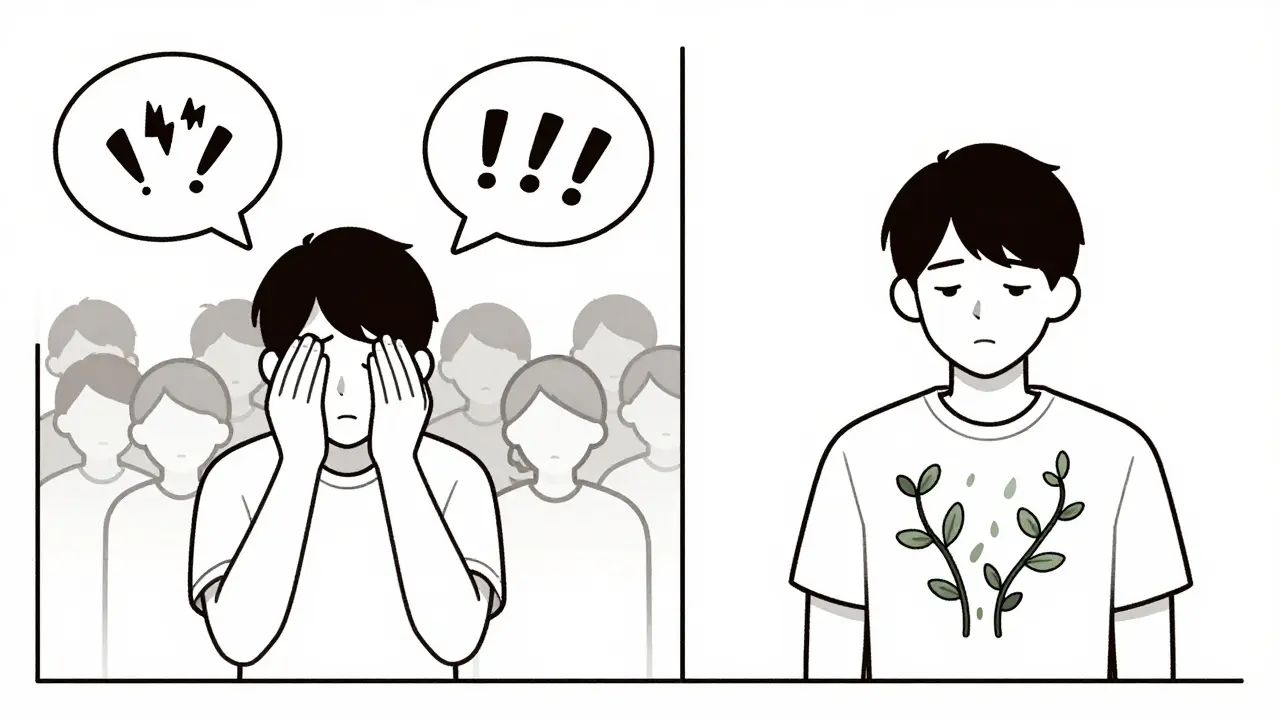
Imagine standing backstage before giving a speech. Your heart pounds. Your hands shake. Your voice cracks. You know what you want to say-but your body won’t let you say it. This isn’t just nerves. For more than 12% of adults in the U.S., this is everyday life with social anxiety disorder. It’s not about being shy. It’s about a deep, persistent fear of being judged, embarrassed, or humiliated in ordinary social situations. And while many turn to medication, the most effective path often doesn’t come from a pill at all-it comes from a combination of two very different tools: beta-blockers and behavioral therapy.
What Beta-Blockers Actually Do (And What They Don’t)
Beta-blockers like propranolol were never designed to treat anxiety. They were made for high blood pressure and heart conditions. But in the 1970s, doctors noticed something strange: musicians taking propranolol before performances stopped trembling. Their hearts didn’t race. Their voices stayed steady. The drug wasn’t calming their minds-it was calming their bodies.
Here’s how it works: when you’re anxious, your body floods with adrenaline. Your heart speeds up. Your palms sweat. Your hands shake. Propranolol blocks the receptors that adrenaline binds to. It doesn’t touch your thoughts. It doesn’t make you feel relaxed or happy. It just takes the physical symptoms off the table. In controlled studies, it reduces heart rate by 15-25 beats per minute and cuts hand tremors by 30-40%. For someone about to give a presentation, that’s game-changing.
But here’s the catch: beta-blockers do nothing for the fear itself. If you’re thinking, “Everyone’s going to think I’m stupid,” or “I’m going to freeze up,” propranolol won’t touch those thoughts. A 2023 meta-analysis confirmed this-no improvement in cognitive anxiety. It’s like putting a mute button on your body’s alarm system while the fire alarm in your brain keeps blaring.
When Beta-Blockers Actually Help
Beta-blockers aren’t for every kind of social anxiety. They’re not for the person who avoids parties, dreads small talk, or skips work meetings because they’re terrified of being watched. Those are chronic, pervasive symptoms. For those, beta-blockers barely work better than a placebo.
But for performance anxiety? The kind that shows up before a speech, a job interview, a musical recital, or a wedding toast? That’s where they shine. Studies show 65-70% of people report major improvement in physical symptoms when using propranolol for these specific, time-limited events. One violinist, after three failed auditions, used 20mg of propranolol 90 minutes before her next try. Her tremors dropped by 40%. She got the job.
Users on Reddit and health forums echo this. One person wrote: “40mg before my TEDx talk turned my shaking hands into steady ones.” Another said: “I could finally look people in the eye during my presentation-my body didn’t betray me.” These aren’t anecdotes. They’re consistent patterns across hundreds of reports.
But side effects? Real. About 35% report fatigue. 28% get dizzy. 22% feel cold hands or feet. For musicians, that’s a problem-fingers need to be nimble. For athletes, it’s a dealbreaker. And if you have asthma or diabetes, beta-blockers can be dangerous. They can mask low blood sugar symptoms, which is life-threatening.
Why Behavioral Therapy Is the Real Game-Changer
Now imagine a different approach. Instead of silencing your body’s reaction, you learn to face the fear head-on. That’s cognitive behavioral therapy-or CBT. It’s not talk therapy where you just vent. It’s structured, skill-based, and backed by decades of research.
CBT for social anxiety works in two parts. First, it teaches you to spot distorted thoughts: “They’re all judging me,” “I’ll look ridiculous,” “If I stumble, they’ll think I’m incompetent.” Then, it helps you challenge them with evidence. “Have they ever reacted this way before? What’s the actual worst that could happen?”
The second part is exposure. You don’t avoid social situations-you walk into them, slowly and safely. Start with saying hello to a cashier. Then ask a question in a meeting. Then give a short presentation to a friend. Each time, you learn: the disaster you imagined? It rarely happens. And even if it does, you survive it.
The results? After 12-16 weekly sessions, 50-60% of people with social anxiety disorder go into remission. That means they no longer meet the clinical criteria for the disorder. That’s not symptom management. That’s recovery.
And it lasts. Unlike beta-blockers, which wear off in a few hours, the skills from CBT stick around for years. A 2023 study on digital CBT platforms showed 52% remission rates-comparable to in-person therapy, and way more accessible.
Why They Work Better Together
Here’s the truth most people miss: beta-blockers aren’t meant to replace therapy. They’re meant to make therapy possible.
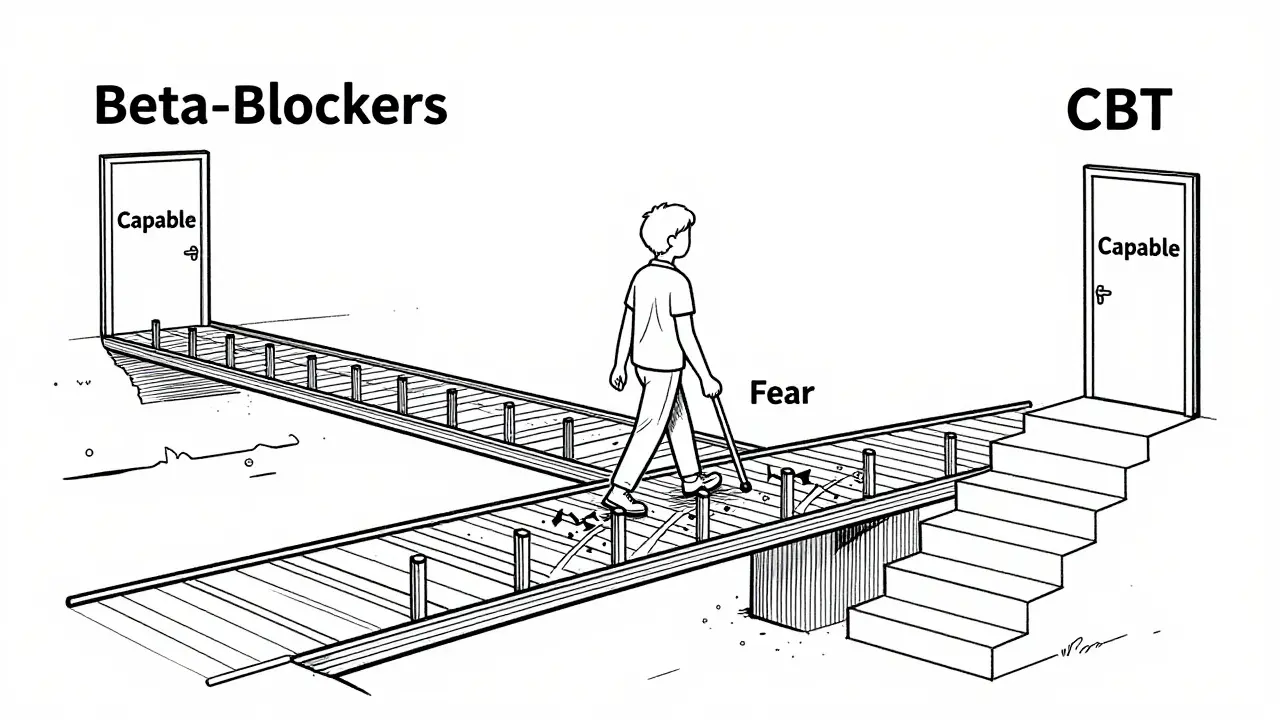
Think of it this way: if your fear is a locked door, CBT gives you the key. But if your heart is pounding so hard you can’t focus, you’re too overwhelmed to turn it. Beta-blockers lower the volume on the panic. They take the physical panic out of the equation so you can actually hear the therapist, practice the skills, and walk through the exposure without your body screaming at you to run.
Dr. Ellen Vora, a psychiatrist, puts it simply: “Beta-blockers give patients the physical stability to attend feared social situations, facilitating the cognitive restructuring that occurs in behavioral therapy.”
One patient I spoke with-a marketing manager with crippling fear of team meetings-tried CBT for months. She couldn’t get past the physical symptoms. Her hands shook so badly she couldn’t hold her notes. She started taking 20mg propranolol 90 minutes before meetings. Within two weeks, she could sit through a full hour without fleeing. Within three months, she was leading meetings. The therapy did the heavy lifting. The beta-blocker just gave her the space to do it.
What Doesn’t Work
Beta-blockers are not a substitute for SSRIs like sertraline or fluoxetine. Those take 4-6 weeks to work but target the brain’s chemistry over time. They’re first-line for chronic social anxiety. Beta-blockers? They’re second-line-for specific events.
And they’re not benzodiazepines. Drugs like alprazolam (Xanax) work faster and affect both body and mind. But they’re addictive. About 1 in 4 people who use them regularly develop dependence. Beta-blockers? Zero addiction risk. No withdrawal. No tolerance. That’s why they’re safer for occasional use.
But here’s the biggest mistake people make: taking beta-blockers every day because they’re scared of social life in general. That doesn’t work. It doesn’t build resilience. It just hides the problem. And over time, you get worse-not better-because you never learn to cope without the pill.
Practical Tips for Using Beta-Blockers Wisely
- Take propranolol 60-90 minutes before the event. Peak effect hits around 90 minutes.
- Dosage? Usually 10-40mg. Start low. Don’t assume more is better.
- Use it only for planned events. Not for random anxiety. Not for daily life.
- Don’t use it if you have asthma, low blood pressure, or uncontrolled diabetes.
- It’s cheap-$4-$10 for a dose with insurance. No need to overpay.
- Always talk to a doctor first. Not a friend. Not a Reddit post. A licensed clinician.
The Bigger Picture
Why are beta-blockers prescribed so often if the evidence is mixed? Because access to therapy is broken. In 43% of U.S. counties, there aren’t enough mental health providers. CBT costs $100-$200 a session. Many people can’t wait months for an appointment. Beta-blockers are fast, cheap, and available.
But here’s the irony: the very thing that makes beta-blockers appealing-speed and ease-is also what makes them dangerous if misused. They’re a Band-Aid. Therapy is the cure.
The National Institute of Mental Health is now funding a $2.3 million trial to finally settle the debate: does propranolol truly help performance anxiety? Results won’t come until 2025. But the pattern is already clear: when used correctly, beta-blockers are a powerful tool. But only when paired with therapy.
For social anxiety disorder, the goal isn’t to feel calm all the time. The goal is to feel capable-even when you’re scared. Beta-blockers can help you walk into the room. CBT can help you stay there, speak up, and realize: you’re not broken. You’re human. And you can learn to be okay with that.
Can beta-blockers cure social anxiety disorder?
No. Beta-blockers only reduce physical symptoms like shaking, racing heart, and sweating. They don’t change the thoughts, fears, or avoidance patterns that define social anxiety disorder. Only therapies like CBT address the root causes. Beta-blockers are a temporary aid, not a cure.
Is propranolol addictive?
No. Unlike benzodiazepines such as Xanax, propranolol has no potential for dependence or addiction. It doesn’t alter mood or produce euphoria. Stopping it suddenly won’t cause withdrawal symptoms. That’s why it’s considered safer for occasional use in anxiety.
How long does propranolol last for anxiety?
Propranolol typically lasts 3-4 hours after taking it. It starts working within 30-60 minutes, peaks around 90 minutes, and wears off by the 4-hour mark. This makes it ideal for short-term events like speeches, interviews, or performances-but useless for ongoing social anxiety throughout the day.
Can I take beta-blockers every day for social anxiety?
Not recommended. Taking beta-blockers daily doesn’t help you build coping skills. It can actually make your anxiety worse over time because you never learn to handle fear without the drug. They’re designed for as-needed use in specific situations, not as daily medication for generalized anxiety.
What’s better: beta-blockers or CBT?
CBT is better for long-term recovery. It leads to remission in 50-60% of cases. Beta-blockers are better for short-term symptom control during specific events. The best approach? Use beta-blockers to reduce physical panic so you can fully engage in CBT. They’re not competitors-they’re partners.
Are beta-blockers safe for everyone?
No. They’re not safe for people with asthma, certain heart conditions, or uncontrolled diabetes. They can mask signs of low blood sugar and worsen breathing problems. Always consult a doctor before starting. Your medical history matters more than your anxiety symptoms.
What to Do Next
If you’re struggling with social anxiety, here’s your next step: stop looking for a magic pill. Start looking for a therapist trained in CBT. If cost or access is an issue, try digital platforms like Woebot or Moodfit-they’ve shown real results. If you need help getting through a specific event, talk to your doctor about propranolol. But only as a temporary bridge-not a permanent crutch.
The goal isn’t to never feel nervous. The goal is to feel nervous-and still show up. Beta-blockers can help you walk in. CBT can help you find your voice. Together, they’re stronger than either one alone.

Comments
Kelly Beck
Okay but can we talk about how insane it is that we need a beta-blocker just to give a presentation? Like, we’re in 2025 and our entire work culture is built on performance anxiety as a feature, not a bug. I used to take propranolol before team calls-just 10mg-and suddenly I could breathe. Not because I wasn’t scared, but because my hands stopped looking like I was holding a live wire. CBT helped me rewire the fear, but without that pill, I never would’ve made it to the first exposure exercise. It’s not cheating. It’s scaffolding.
Wesley Pereira
lol so beta-blockers are just ‘anxiety training wheels’? Cute. Meanwhile, in the real world, people take Xanax like candy and call it ‘self-care’. At least propranolol doesn’t turn you into a drooling zombie who forgets their own name. Also, CBT costs $150/hour where I live. You think I’m gonna wait 6 months for a therapist when I got a Zoom pitch in 3 days? This isn’t a luxury debate. It’s survival.
Isaac Jules
Stop glorifying band-aids. You people act like beta-blockers are some magical cure-all. You take them, you still have the same broken brain-you’re just numb. And now you think you’re ‘fixed’ because your hands don’t shake? That’s not recovery. That’s chemical denial. And don’t get me started on how lazy this is. You’d rather drug yourself than learn to sit with discomfort? Pathetic.
Venkataramanan Viswanathan
In India, we don’t have access to therapy like this. Many of us rely on online forums, friends, or Google. Beta-blockers are available over the counter in some pharmacies here-no prescription needed. I’ve seen people use them for exams, interviews, even public speaking in village meetings. It’s not ideal, but it’s practical. We don’t have the luxury of waiting for perfect systems. Sometimes, the best we can do is take the tool we have, and use it wisely.
Pavan Vora
Interesting... but... have you considered... the possibility... that... beta-blockers... might... interfere... with... autonomic... regulation... over... time?... I... mean... if... you... suppress... the... physiological... response... repeatedly... without... addressing... the... cognitive... component... could... that... not... lead... to... maladaptive... conditioning?... Also... what... about... the... placebo... effect... in... self-reported... tremor... reduction?... Just... a... thought...
Susan Arlene
i just take a deep breath and say 'fuck it' before i speak. no pills, no therapy. my hands still shake. my voice cracks. but i do it anyway. and that’s the real win. not the steady hands. the shaky hands showing up anyway. you don’t need to be calm. you just need to be there.
Joann Absi
AMERICA IS SO WEAK. We used to just push through fear. Now we need a pill to give a toast? In my country, we didn’t have beta-blockers-we had discipline. And respect. And grit. This is why the West is collapsing. You medicate every emotion instead of building character. CBT? Sounds like a fancy word for ‘talking to a stranger about your feelings’. I’d rather just get punched in the face and learn to stand up.
Mukesh Pareek
Propranolol is not a treatment-it’s a tactical intervention. The term 'social anxiety disorder' is overdiagnosed. Most people are just introverted or unprepared. You don’t need CBT-you need public speaking courses. Beta-blockers are for elite performers, not people who get nervous before Zoom calls. Stop pathologizing normal human reactions.
Ashley S
So you’re saying it’s okay to take a pill to lie to your body? That’s not bravery. That’s lying to yourself. And why do we even need to give speeches? Why can’t we just email? This whole 'performative confidence' thing is toxic. I don’t care if my hands shake. I’m not doing it for you.
Rachel Wermager
Let’s be clear: beta-blockers are pharmacological adjuncts, not monotherapies. The neurobiological mechanism involves beta-adrenergic receptor antagonism, which attenuates sympathetic outflow via the locus coeruleus-norepinephrine pathway. But the real therapeutic synergy emerges when paired with exposure-based cognitive restructuring-specifically, extinction learning during fear conditioning paradigms. Without the behavioral component, you’re just modulating peripheral symptoms while central fear circuits remain intact. That’s not treatment. That’s suppression.
Tom Swinton
I just want to say-this post saved me. I’ve been stuck in this loop for years. I’d avoid meetings, make excuses, cry in the bathroom before calls. I started CBT last year. It was brutal. I almost quit. Then I talked to my doctor about propranolol. Just 20mg before my first team presentation. I didn’t feel ‘calm’-I felt like myself. Just... without the shaking. I cried after. Not from fear-from relief. I didn’t need to be perfect. I just needed to be heard. Thank you for saying this out loud.
Leonard Shit
my friend took propranolol for her wedding toast… and she forgot to tell her mom. so her mom was like ‘oh honey you’re so calm!’ and she just smiled and said ‘yeah, i’m a robot now’… and then cried in the car. it’s not about being fearless. it’s about being brave enough to take the pill and still feel everything.
Brian Anaz
Why is everyone so obsessed with fixing anxiety? Why not fix the systems that create it? Why do we force people to perform? Why do jobs require speeches? Why is vulnerability seen as weakness? Beta-blockers and CBT are bandaids on a bullet wound. The real problem is a culture that rewards performative confidence and punishes quiet people. But hey, at least we can medicate the symptoms while the system stays broken.
Kelly Beck
Wow. This is the first time I’ve seen someone say it like that. I’ve been using beta-blockers for a year now, and I thought I was just being weak. But reading this? I realized-I’m not avoiding fear. I’m using every tool I have to survive in a world that doesn’t make space for quiet people. And that’s not weakness. That’s strategy. Thank you. I needed to hear that.