
Clozapine Dose Adjustment Calculator
Clozapine levels are significantly affected by smoking. This calculator helps estimate the appropriate dose adjustment based on smoking status.
When someone takes clozapine for treatment-resistant schizophrenia, their body is walking a tightrope. Too little of the drug, and symptoms like hallucinations or paranoia return. Too much, and they risk seizures, heart problems, or even life-threatening drops in white blood cells. Now imagine that every time they light a cigarette, their body starts breaking down the medication faster - sometimes by half. This isn’t theoretical. It’s happening to tens of thousands of people right now, and most don’t realize why their symptoms are worsening or why they suddenly feel drugged out after quitting smoking.
Why Smoking Changes Clozapine Levels
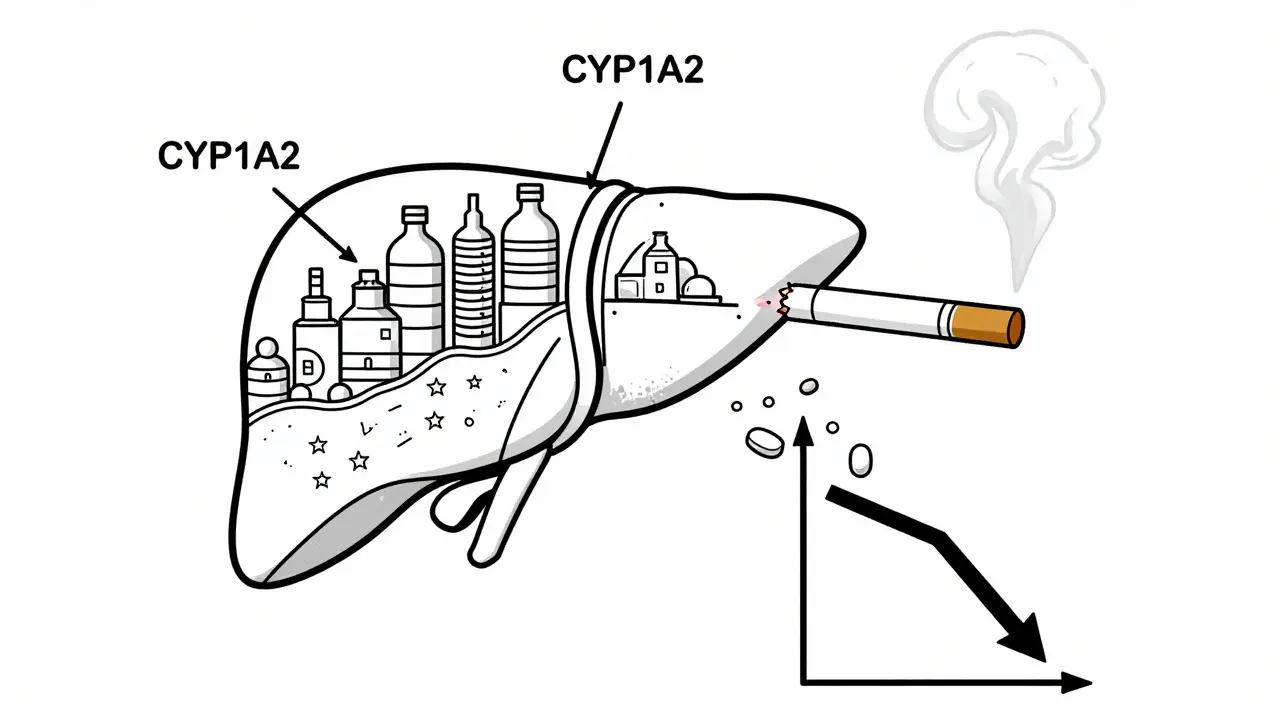
Clozapine is broken down in the liver by an enzyme called CYP1A2. This enzyme is like a factory worker: it processes the drug, turns it into inactive pieces, and gets it out of the system. But tobacco smoke doesn’t just passively sit there - it rewires that factory. The chemicals in cigarette smoke, especially polycyclic aromatic hydrocarbons, bind to a receptor in liver cells called AhR. This triggers the cell to produce way more CYP1A2 enzyme - sometimes doubling or tripling its output.
The result? Clozapine gets cleared from the bloodstream much faster. Studies show that on average, smokers have 30% lower clozapine levels than non-smokers. For some heavy smokers, the drop is as high as 50%. That means a person taking 400 mg a day might as well be taking 200 mg. Their symptoms come back. Their doctor thinks the medication isn’t working. So they increase the dose - and miss the real cause.
The Real-World Impact: Stories from the Clinic
One patient, a 34-year-old man in Melbourne, had been stable on 350 mg of clozapine for two years. Then he started smoking again after a stressful breakup. Within three weeks, he was having auditory hallucinations again. His blood level dropped from 420 ng/mL to 180 ng/mL - below the therapeutic range. His psychiatrist had to bump his dose to 550 mg. He didn’t know why it happened until his nurse pulled up his chart and asked, “Have you been smoking?”
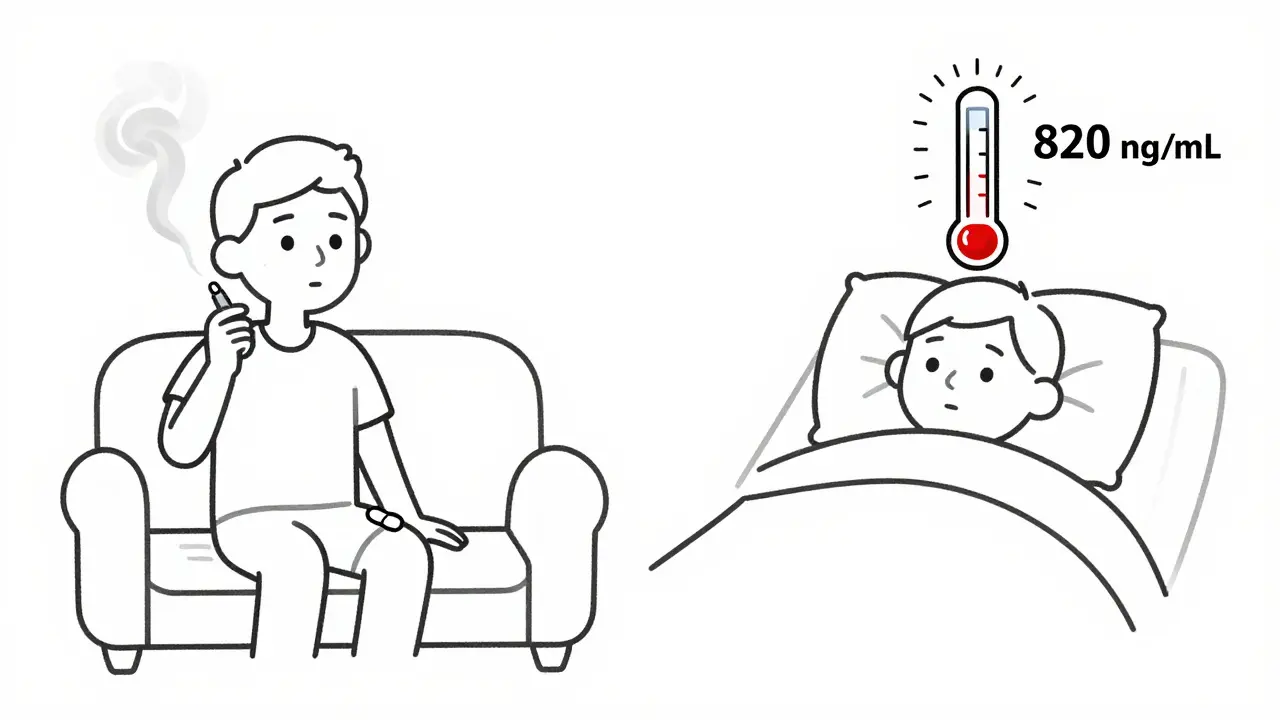
On the flip side, a 42-year-old woman quit smoking cold turkey after her doctor advised it. She was on 500 mg of clozapine. Two weeks later, she was so sedated she couldn’t get out of bed. Her clozapine level had spiked to 820 ng/mL - dangerously high. She had no idea quitting smoking could make her medication toxic. She ended up in the hospital.
These aren’t rare cases. A 2023 survey of psychiatrists found that 82% routinely adjust clozapine doses when patients start or stop smoking. And yet, many patients still don’t get warned.
Why Clozapine Is Different from Other Antipsychotics
Not all antipsychotics behave this way. Olanzapine is also processed by CYP1A2, but it’s not as sensitive. Risperidone? It’s handled mostly by CYP2D6 - smoking barely touches it. Quetiapine? Mostly CYP3A4. Aripiprazole? CYP2D6 and CYP3A4 again.
Clozapine is unique because 60-70% of its clearance depends on CYP1A2. That’s far more than any other antipsychotic. Plus, its therapeutic window is narrow: between 350 and 500 ng/mL. A 30% drop can push you below 300 ng/mL - where the drug stops working. A 30% rise after quitting can push you past 700 ng/mL - where toxicity kicks in.
This is why doctors treat clozapine differently. It’s not just “take your pill.” It’s “take your pill - but watch what you smoke.”
Genetics Play a Role Too
Not everyone responds the same way. Some people naturally have more CYP1A2 activity. Others have a genetic variant called CYP1A2 *1F/*1F. This doesn’t make them fast metabolizers on its own - but when they smoke, their enzyme production goes into overdrive. They’re the ones who go from stable to crashing in days.
Genetic testing for CYP1A2 isn’t routine yet - but in specialized clinics, it’s becoming more common. If you’re on clozapine and your levels keep fluctuating for no obvious reason, asking for a pharmacogenetic test might help explain why.
What Happens When You Quit Smoking?
Many patients think quitting smoking is a win - and it is. But if you’re on clozapine, it’s also a medical emergency waiting to happen.
CYP1A2 enzyme levels don’t drop overnight. It takes 1 to 2 weeks for the body to stop overproducing the enzyme. During that time, clozapine builds up. Your dose hasn’t changed. Your metabolism has. Toxicity can sneak up on you.
Signs of clozapine toxicity include:
- Extreme drowsiness
- Confusion or slurred speech
- Fast heartbeat or dizziness
- Nausea or vomiting
- Seizures (in severe cases)
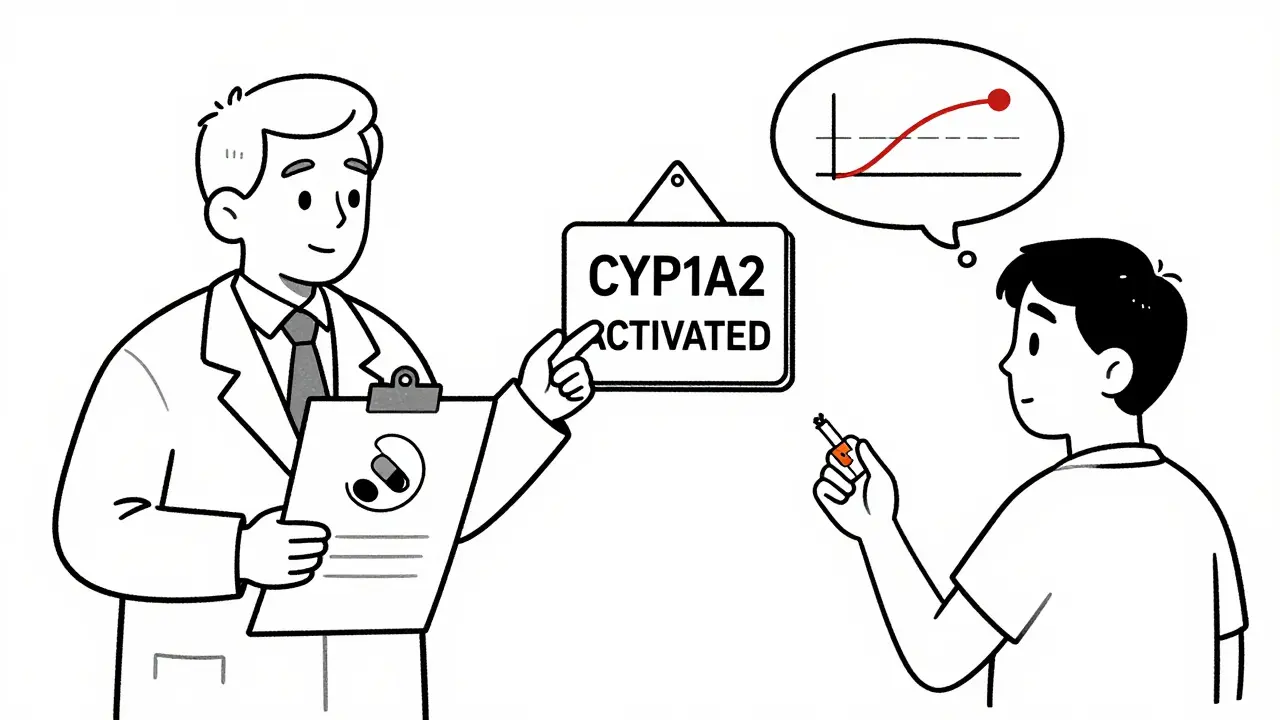
If you’re trying to quit smoking while on clozapine, your doctor needs to know before you stop. Dose reductions of 30-50% are often needed. Levels should be checked 7-10 days after quitting. Waiting for symptoms to appear is too late.
What About Vaping or Nicotine Patches?
A common myth is that vaping is safe. It’s not. A 2024 study from the University of Toronto found that e-cigarettes induce CYP1A2 almost as strongly as traditional cigarettes - just 15-20% less. So if you think switching to vaping will protect your clozapine levels, you’re mistaken.
Nicotine patches? They don’t induce CYP1A2. The chemicals that trigger enzyme production come from burning tobacco - not nicotine itself. So patches, gum, or lozenges won’t interfere with your clozapine levels. That’s why some doctors recommend switching to nicotine replacement therapy if you’re trying to quit smoking.
What Should You Do?
If you’re on clozapine, here’s what you need to do:
- Always tell your prescriber if you smoke - even if you only smoke once in a while.
- Never start smoking without telling your doctor. If you do, your dose will likely need to go up by 40-60%.
- Never quit smoking without telling your doctor. If you do, your dose will likely need to go down by 30-50%.
- Get your blood levels checked before any change - and again 7-10 days after.
- Ask about nicotine replacement if you want to quit. It’s safer than vaping or quitting cold turkey.
Electronic health systems now have alerts built in. If your doctor uses Epic or similar software, they should get a warning if you’re on clozapine and your chart says you smoke. But not all clinics use these tools. You have to be your own advocate.
The Bigger Picture
About 70% of people taking clozapine smoke. That’s five times the rate of the general population. It’s not because they’re “noncompliant.” It’s because smoking is often a coping mechanism for the stress, anxiety, and side effects of severe mental illness. Quitting isn’t easy - especially without support.
But ignoring the interaction doesn’t help. It just makes treatment harder. The good news? With proper monitoring, clozapine remains the most effective treatment for treatment-resistant schizophrenia. When the dose is right, patients often go from being unable to leave their homes to holding jobs, reconnecting with family, and living full lives.
The key isn’t to stop smoking - it’s to manage the interaction. Your body isn’t broken. The system just needs to adapt.

Comments
Alexander Erb
This is one of those posts that makes you go 'holy crap, I didn't know this.' I work in psych nursing and we see this all the time. Someone's doing great, then boom - symptoms return. Doctor ups the dose. Patient gets worse. Then someone asks, 'So... you started smoking again?' It's wild how often it's missed. Thanks for laying this out so clearly.
Also - vaping isn't a loophole. I've had patients switch to vapes thinking they're 'safe' and then crash just like the smokers. The chemicals are still there. Just less tar. Not less CYP1A2 activation.
Donnie DeMarco
bro i swear i thought i was just gettin’ super tired after i quit smokin’ last year. turns out my doc had no clue. i was on 450mg and after 2 weeks i could barely walk to the fridge. thought i was depresso’d again. turns out my clozapine was basically in my bloodstream like a bad house party. they had to slash my dose by like 40%. wild. nobody warned me. not even my counselor. why is this not on the pill bottle??
Miranda Varn-Harper
While the clinical observations presented are empirically valid, one must consider the broader ethical implications of conflating behavioral modification with pharmacological management. The assumption that smoking cessation requires dose adjustment presupposes a medicalized model of addiction, rather than addressing the psychosocial underpinnings of substance use in populations with severe mental illness. This approach risks pathologizing coping mechanisms without offering sustainable alternatives.
Tom Bolt
This is the most important thing I’ve read this year. I’ve seen three patients die because their doctors didn’t know this. One was 28. Had a job. Had a dog. Had a future. Then he quit smoking. No warning. No blood test. Just ‘you’re feeling weird? Try therapy.’ Three days later - seizures. ICU. Gone. This isn’t medical advice. It’s a public health emergency. Why isn’t this mandatory training for every psychiatrist in the country?
Shourya Tanay
The pharmacokinetic dynamics of CYP1A2 induction via AhR agonism is a compelling case study in personalized medicine. However, the absence of routine genotyping for CYP1A2*1F/*1F polymorphisms in routine psychiatric practice represents a significant therapeutic gap. The interindividual variability in enzyme induction potential - particularly in populations with high smoking prevalence - necessitates a paradigm shift from reactive dose adjustment to preemptive pharmacogenomic stratification. Without this, we are managing symptoms, not mechanisms.
LiV Beau
I’m so glad someone finally said this. My brother’s on clozapine and he’s been smoking for 12 years. We tried to get him to quit so many times - but no one told us about the toxicity risk. He ended up in the hospital last winter. Now he’s on patches and his levels are stable. He says he feels like himself again for the first time in years.
You’re not weak for smoking. You’re not broken for needing help. But you DO need to talk to your doctor before you change anything. Seriously. It could save your life. 🙏
Adam Kleinberg
They don’t want you to know this because if you did you’d realize they’re just profit-driven pharma puppets. The FDA knows. The AMA knows. They let Big Tobacco and Big Pharma collude. Why? Because if you quit smoking and your dose drops - they lose billions. Vaping? Same thing. Nicotine patches? Too cheap. They need you dependent. On the drug. On the smoke. On the system. Wake up. This isn’t science. It’s control.
Denise Jordan
Okay but like… why is this even a thing? Why does smoking do this? Why not just give people different meds? This feels like a weird loophole in medicine.
Gene Forte
Every human deserves to live without fear - fear of symptoms returning, fear of toxicity, fear of being misunderstood. This isn’t just about clozapine. It’s about dignity. It’s about listening. It’s about seeing the person, not just the lab value. If we can teach one doctor to ask about smoking before adjusting a dose, we’ve changed a life. And that’s worth more than any study.