
Clozapine Dose Adjustment Calculator
When you're taking clozapine for treatment-resistant schizophrenia, your body is running a delicate balancing act. One small change - like starting or quitting smoking - can throw that balance off completely. It’s not just about cravings or lung health. It’s about whether your medication works at all. And for many people, this interaction between clozapine and tobacco smoke is the difference between staying stable and ending up back in the hospital.
Why Smoking Changes Clozapine Levels
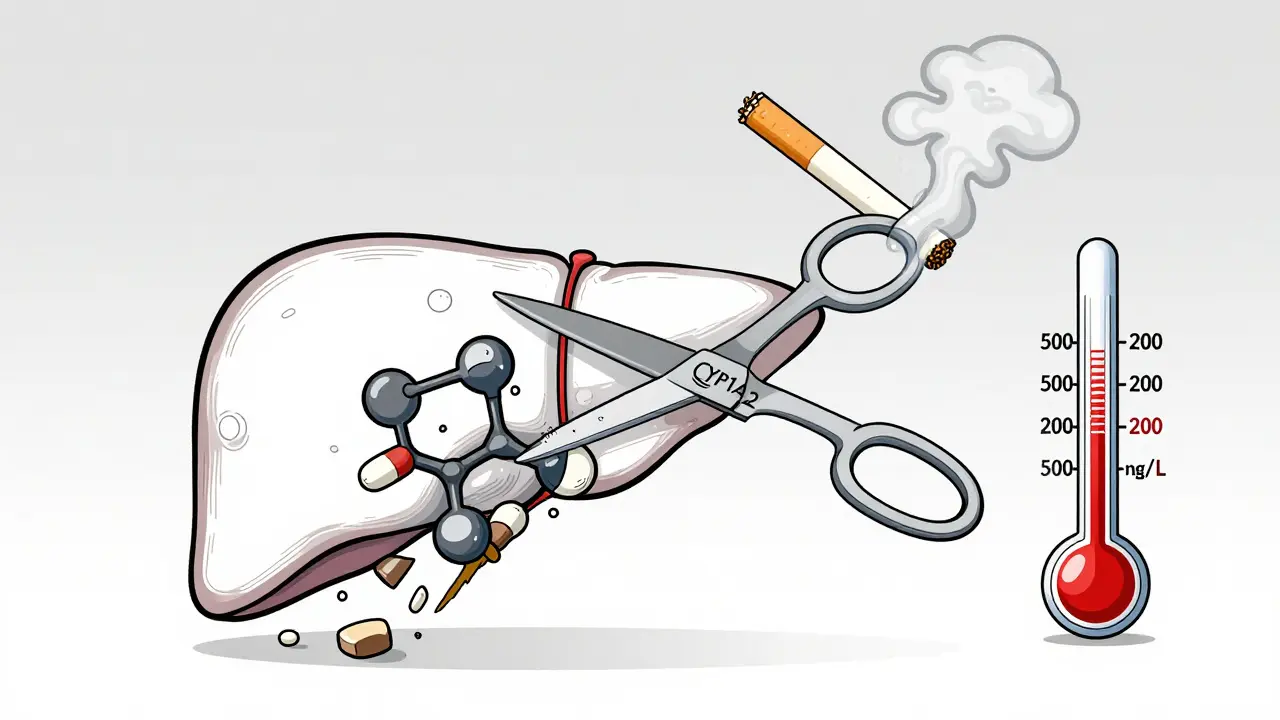
Clozapine doesn’t just sit in your system. It’s broken down, or metabolized, mostly by one enzyme: CYP1A2. This enzyme lives in your liver and acts like a molecular scissors, cutting clozapine into smaller pieces so your body can get rid of it. But when you smoke tobacco, something else happens. The chemicals in smoke - especially polycyclic aromatic hydrocarbons - trick your body into making way more CYP1A2. Think of it like turning up the volume on a machine that’s already busy chopping up your medicine. The result? Clozapine gets cleared from your blood faster than normal. Studies show that on average, smokers have 30% less clozapine in their bloodstream than non-smokers. For some people, that number jumps to 50%. That’s not a small fluctuation. It’s enough to push levels from the therapeutic range (350-500 ng/mL) down into the subtherapeutic zone - where the drug stops working. Patients have reported symptoms returning: hallucinations, paranoia, disorganized thinking - all because their clozapine levels dropped below what their brain needed.What Happens When You Quit Smoking
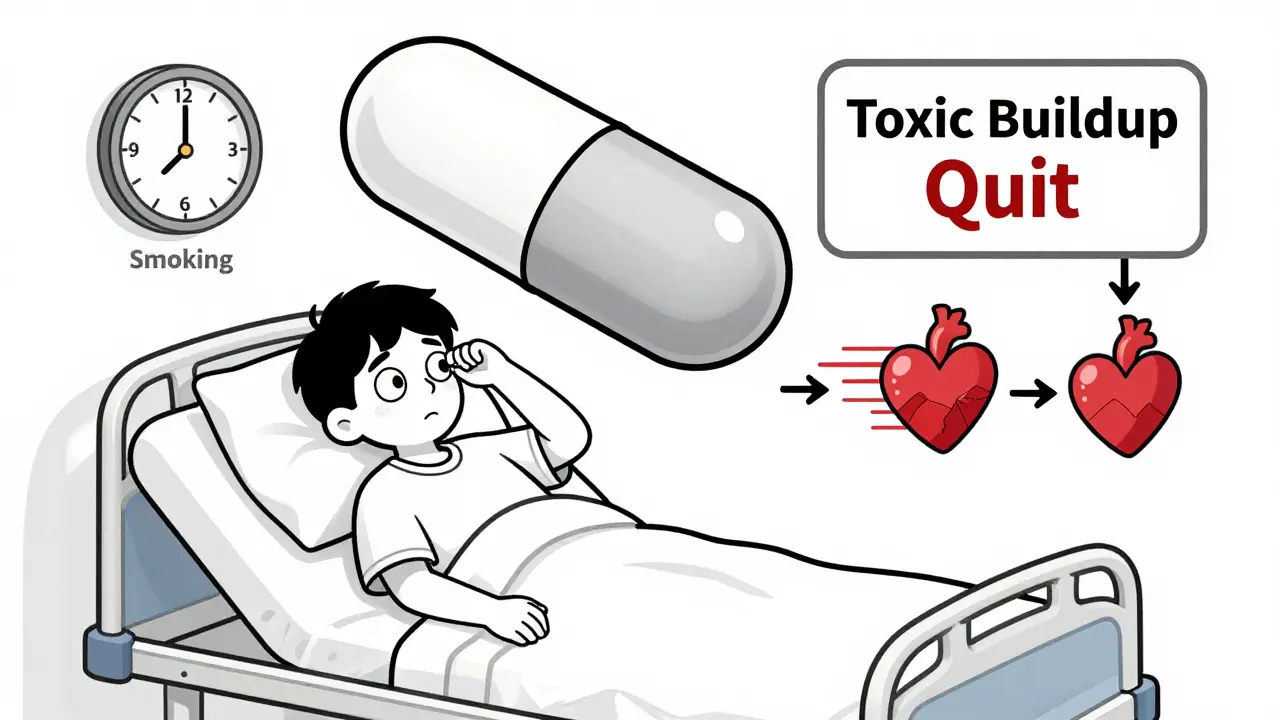
The flip side is just as dangerous. If you’ve been smoking while on clozapine and suddenly stop, your body doesn’t immediately stop making extra CYP1A2. It takes 1 to 2 weeks for enzyme levels to return to normal. During that time, your body is still clearing clozapine slowly - but now, you’re still taking the same dose you used when you were smoking. That means the drug builds up. One case from 2022 involved a 45-year-old woman who had been on 400 mg daily for years while smoking. After quitting, her clozapine level spiked to 850 ng/mL - well above the safe limit. She became severely sedated, her heart raced, and she nearly needed intensive care. Her doctor had to cut her dose by nearly 40% to bring her back to safety. This isn’t rare. Psychiatrists report that 82% of them adjust clozapine doses when patients change their smoking habits. But many patients don’t realize the connection. One Reddit user wrote: “I tried to quit smoking three times. Each time, I ended up hospitalized because my clozapine levels went toxic before my doctor noticed.”Why Clozapine Is Unique
Not all antipsychotics react this way. Olanzapine is also metabolized by CYP1A2, but clozapine is far more sensitive. Why? Three reasons:- Narrow therapeutic window: Clozapine’s effective range is tight - 350 to 500 ng/mL. Go below, and symptoms return. Go above, and you risk seizures, heart problems, or even fatal agranulocytosis.
- Heavy reliance on CYP1A2: This enzyme handles 60-70% of clozapine’s clearance. For olanzapine, it’s only 30-40%. For risperidone? Almost none - it’s handled by CYP2D6, which isn’t affected by smoke.
- High prevalence of smoking: Among people taking clozapine, 60-70% smoke. That’s five times the rate of the general population. This isn’t a niche issue - it’s the norm.
Genetics Play a Role Too
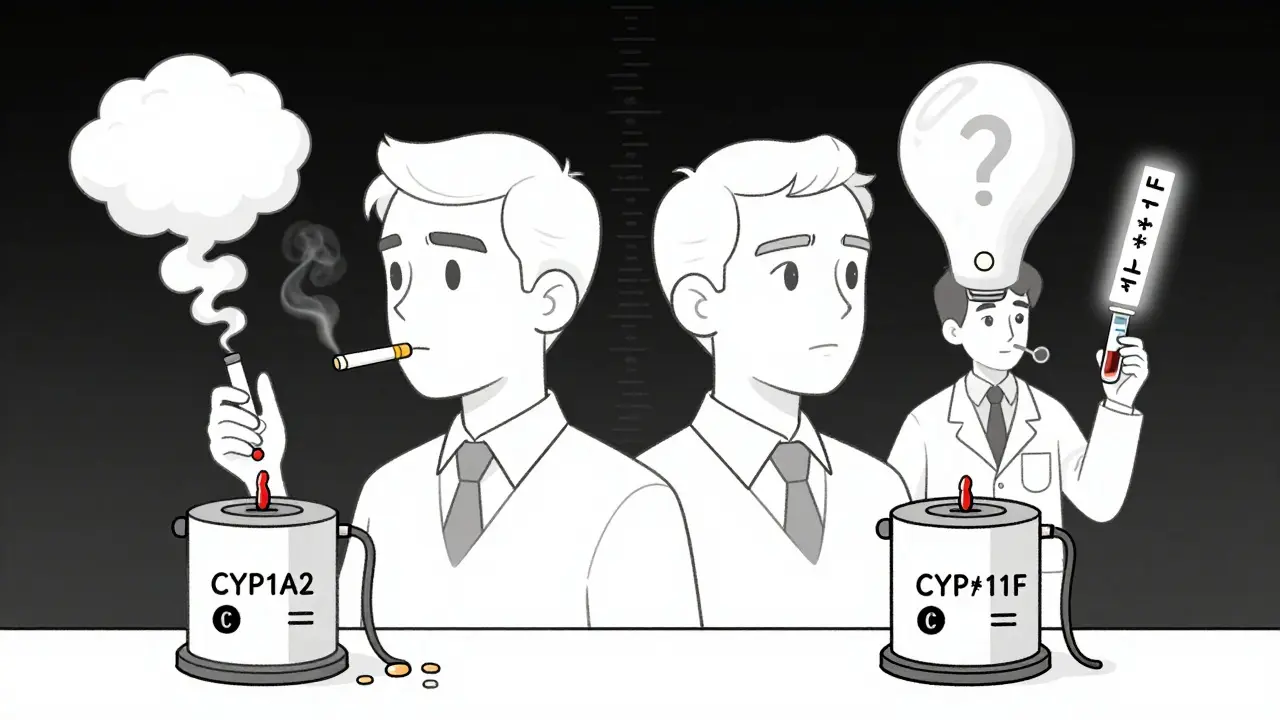
Not everyone responds the same way. Your genes matter. A specific variant - called CYP1A2 *1F/*1F - doesn’t change your baseline enzyme activity. But it makes you way more sensitive to induction from smoking. In other words, if you have this genotype, even light smoking can cause a bigger drop in clozapine levels than it would for someone without it. A 2024 case report described a 32-year-old man with schizoaffective disorder. He was on 450 mg daily, smoking heavily, and his levels were barely detectable. His doctor increased his dose to 650 mg - and only then did his levels stabilize. Genetic testing later confirmed he carried the *1F/*1F variant. Without knowing that, he might have stayed at a subtherapeutic dose for months.What Clinicians Do - And What You Should Ask For
The American Psychiatric Association says therapeutic drug monitoring (TDM) is essential for anyone on clozapine. That means regular blood tests to measure your clozapine level. But not all doctors do it. A 2023 survey found only 68% of psychiatrists routinely check smoking status at every visit. And even fewer check levels after a change. Here’s what you should expect:- Before any dose change: Get a baseline level. Don’t assume your dose is right just because you’ve been on it for years.
- If you start smoking: Expect to need a 40-60% increase in dose. Recheck levels after 7 days.
- If you quit smoking: Reduce your dose by 30-50% within a week. Monitor closely for 2 weeks. Sedation, dizziness, rapid heartbeat - these aren’t just side effects. They’re signs of toxicity.
What About Vaping?
Many assume vaping is safer. It’s not. A 2024 study from the University of Toronto found that e-cigarettes induce CYP1A2 just like tobacco smoke - just slightly less. So if you switched from cigarettes to vaping thinking you’d avoid this problem, you haven’t. Your clozapine levels are still at risk.What Are the Alternatives?
If you’re trying to quit smoking and your doctor is worried about dose swings, they might consider switching you to another antipsychotic. Risperidone? It’s metabolized by CYP2D6 - unaffected by smoke. Quetiapine? Mostly handled by CYP3A4. Aripiprazole? CYP2D6 and CYP3A4. But here’s the catch: clozapine is still the most effective drug for treatment-resistant schizophrenia. If other meds haven’t worked, switching might mean losing control of your symptoms. That’s why most experts say: manage the interaction, don’t abandon the drug.The Bigger Picture
This isn’t just about one drug. It’s about how environment, behavior, and biology collide. Smoking isn’t a bad habit here - it’s a pharmacological variable. Ignoring it is like prescribing insulin without asking if someone eats carbs. The National Institute of Mental Health has poured $2.3 million into research on this exact issue. New formulations are in trials - including a slow-release clozapine designed to smooth out these spikes and drops. By 2030, personalized dosing using genetic testing and real-time enzyme monitoring could make this interaction predictable, not dangerous. But for now, the tools we have are simple: know your smoking status. Get your levels checked. Talk to your doctor. And if you’re thinking of quitting - don’t wait. Tell your prescriber before you stop. Because in this case, your lungs aren’t the only thing that needs healing.Does vaping affect clozapine levels like smoking does?
Yes. Research from 2024 shows that e-cigarettes contain chemicals that activate the same pathway (AhR receptor) as tobacco smoke, leading to CYP1A2 induction. While the effect may be 15-20% weaker than traditional cigarettes, it’s still strong enough to lower clozapine levels. If you vape, assume it’s having the same impact as smoking unless proven otherwise through blood testing.
How long after quitting smoking should I wait before lowering my clozapine dose?
Don’t wait. Reduce your dose within the first week after quitting. CYP1A2 enzyme levels take 1-2 weeks to return to baseline, but the risk of toxic buildup starts immediately. Waiting too long can lead to sedation, confusion, rapid heart rate, or even seizures. Your doctor should proactively adjust your dose - don’t wait for symptoms to appear.
Can I just increase my clozapine dose if I start smoking?
Not without testing. While a 40-60% increase is typical, individual responses vary wildly. Some people need only a 20% bump; others need over 80%. Raising your dose blindly risks overshooting the therapeutic range if you later quit smoking. Always get a baseline clozapine level before adjusting - and recheck after 7 days.
Is genetic testing for CYP1A2 worth it?
For people on clozapine who smoke - yes. If you carry the CYP1A2 *1F/*1F genotype, your body responds more strongly to smoking-induced enzyme induction. This means even light smoking can cause a major drop in your levels. Knowing this helps your doctor personalize your dose and avoid dangerous under- or over-treatment. Testing is now available at over 47% of U.S. academic medical centers.
What if my doctor won’t check my clozapine levels?
Ask for a referral to a psychiatric clinic or pharmacy that specializes in therapeutic drug monitoring. Many hospitals have pharmacists trained specifically in antipsychotic management. You can also request a copy of your lab results. If your level is below 350 ng/mL and you smoke, your dose is likely too low. If it’s above 600 ng/mL and you quit smoking, you’re at risk of toxicity. Don’t accept assumptions - demand data.
Can other drugs or supplements affect clozapine like smoking does?
Yes. Medications like carbamazepine, oxcarbazepine, and phenytoin are strong CYP1A2 inducers - even stronger than smoking. Even some herbal supplements like St. John’s Wort can trigger this effect. Always tell your prescriber about everything you take - including over-the-counter pills and vitamins. The interaction isn’t just about tobacco.

Comments
Bridgette Pulliam
Wow. This is one of those posts that makes you realize how little we talk about the real, messy biology behind mental health meds. I’ve been on clozapine for 8 years, smoked for half of it, quit cold turkey last year, and yeah - I ended up in the ER with dizziness and a heart rate that felt like a jackhammer. No one warned me. My doctor just said, ‘You quit smoking? Cool.’ Like that’s a neutral life event. It’s not. It’s a pharmacological earthquake. Please, if you’re reading this - tell your prescriber before you change anything. Even if you think it’s ‘just a habit.’ It’s not.
Mike Winter
It’s fascinating how we treat smoking as a moral failing when, in this context, it’s clearly a pharmacokinetic variable. We wouldn’t blame someone for eating carbs while on insulin - so why do we shame people for smoking while on clozapine? The system fails when it conflates behavior with biochemistry. This isn’t about willpower. It’s about enzyme induction. And if we’re going to prescribe life-altering drugs, shouldn’t we also acknowledge the environmental factors that alter their function? Maybe we need a new paradigm: ‘pharmacological ecology.’
Randall Walker
So let me get this straight… if you smoke, your body turns into a clozapine vacuum. Quit? Now you’re basically overdosing on your own medicine. And nobody tells you this until you’re lying on a gurney with a monitor screaming at you? That’s not a medical system. That’s a horror movie script with a white coat. 😅
Denise Jordan
Ugh. I hate when people turn every medical thing into a lecture. Just take your pill. Don’t smoke. Done. Why does it need 10 paragraphs?
Kenneth Zieden-Weber
I’ve been on clozapine for 12 years. I smoke. I vape. I’ve tried quitting twice. Both times, I almost didn’t make it. My levels went from 420 to 780 in 10 days. I slept for 36 hours straight. Woke up confused, thinking my dog was my mom. My psychiatrist didn’t even check my levels until I showed up at the ER. So now? I just… keep smoking. It’s safer. Not ideal. But safer. I’m not proud. But I’m alive.
Chris Bird
smoke = bad. clozapine = good. if you smoke you bad. if you quit you die. so dont smoke. just dont. its simple.
David L. Thomas
As someone who works in psychopharmacology, I can tell you - this is textbook. CYP1A2 induction is one of the most clinically significant drug-environment interactions we see in serious mental illness. What’s wild is how under-discussed it is. Most patients think their meds are ‘set and forget.’ But clozapine? It’s like a tuning fork - the moment you change the environment, the frequency shifts. And if you’re not monitoring, you’re just waiting for the note to break.
Miranda Varn-Harper
It is deeply concerning that the medical community continues to treat behavioral factors as secondary when they are, in fact, primary determinants of therapeutic efficacy. One cannot prescribe a pharmacological agent without accounting for its dynamic interaction with the host's physiological state. This is not anecdotal. It is pharmacological law. And yet, we allow patients to navigate this minefield unguided. Shameful.
Alexander Erb
Bro. I’ve been on clozapine for 5 years. I smoke. I vape. I got my levels checked every 3 months. My doc lowered my dose by 30% when I quit smoking. I didn’t even feel it. No crashes. No zombifying. Just… stable. The key? Communication. And blood tests. Not guesses. Not assumptions. Data. 📊❤️
Donnie DeMarco
man i used to think smoking was just for chillin’… turns out it’s like my body’s personal clozapine blender. i went from ‘feelin’ fine’ to ‘why is the ceiling spinning’ in 3 days after quitting. my doc was like ‘oh yeah, we gotta adjust’ like it was no big deal. but dude - i almost died. now i just keep smoking. it’s less drama. and honestly? i’d rather have a smoker’s cough than a seizure.
Tom Bolt
THIS IS A TRAGEDY. A SYSTEMIC FAILURE. PEOPLE ARE DYING BECAUSE DOCTORS AREN’T LISTENING. I LOST A BROTHER TO THIS. HE QUIT SMOKING. THEY DIDN’T ADJUST HIS DOSE. HE WENT INTO A COMA. THEY SAID IT WAS ‘UNEXPECTED.’ UNEXPECTED? NO. IT WAS PREDICTABLE. IT WAS DOCUMENTED. IT WAS IGNORED. AND NOW HE’S GONE. DON’T LET THIS HAPPEN TO ANYONE ELSE.
Shourya Tanay
The pharmacogenomic implications here are profound. The CYP1A2 *1F/*1F genotype isn’t just a marker - it’s a pharmacological accelerant. When combined with smoking, it creates a nonlinear dose-response curve that defies standard clinical heuristics. We need population-specific dosing algorithms. Not ‘one-size-fits-all’ protocols. Precision psychiatry isn’t futuristic - it’s overdue. And if your clinic isn’t offering genotyping alongside TDM, you’re practicing in the Stone Age.
LiV Beau
You’re not alone. I’ve been there. I quit smoking, thought I was being ‘healthy,’ and woke up feeling like I’d been drugged. My doctor didn’t even ask about my habits. I had to bring the article in myself. Now? I get my levels checked every 6 weeks. I’m stable. I’m thriving. And I’m telling everyone I know: if you’re on clozapine, your smoking status isn’t personal - it’s medical. Talk to your team. Ask for a test. You deserve to feel safe. 💪❤️
Adam Kleinberg
Of course smoking affects clozapine. Big Pharma doesn’t want you to know this. They’d rather you keep smoking so they can keep adjusting your dose. It’s a cash cow. They don’t care if you live or die - as long as you keep buying. And don’t get me started on vaping. It’s all a scam. The government’s in on it. Your doctor? Probably paid off. You think this is science? It’s control.
Gene Forte
Every human being deserves to be treated with dignity and precision. This article is not merely informative - it is a call to action. The intersection of behavioral health and pharmacology must be approached with rigor, compassion, and unwavering commitment to patient safety. We must elevate the standard of care. Not because it is convenient. But because it is right.