
When it comes to losing weight or keeping it off, most people focus on cutting calories, counting macros, or trying the latest diet trend. But one of the most effective, science-backed tools is sitting right on your plate - fiber. Not all fiber is the same, though. Two main types - soluble and insoluble - work in completely different ways to influence your hunger, digestion, and body weight. If you're trying to control your weight, knowing which kind does what can make all the difference.
What soluble fiber actually does for weight control
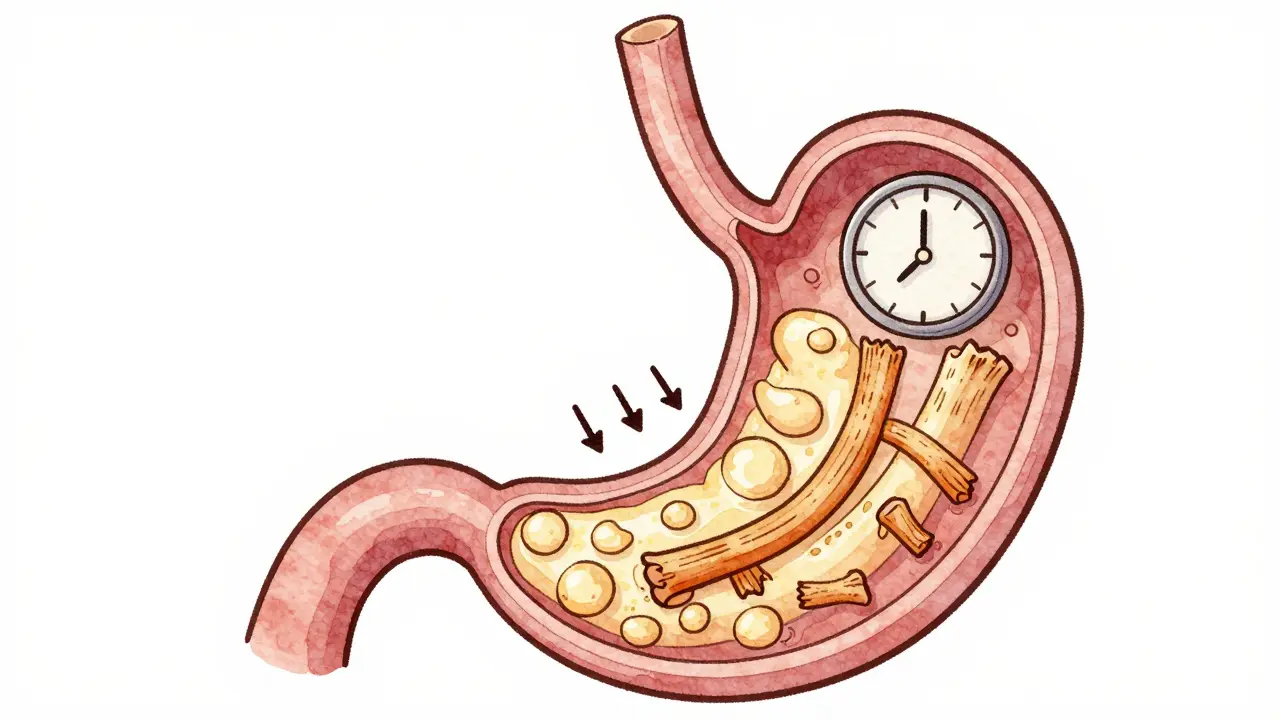
Soluble fiber doesn’t just pass through your system. It dissolves in water and turns into a thick, gel-like substance. This isn’t just a fun science experiment - it’s a powerful tool for managing hunger. Think of it like a sponge in your stomach. It swells up, slows down how fast your food leaves your stomach, and keeps you feeling full longer. Studies show this gel can delay gastric emptying by 25-30%. That means if you eat a meal with enough soluble fiber, you’re less likely to snack an hour later.
But it doesn’t stop there. This gel also interferes with how your body absorbs fat. Research from Medical News Today (2023) found that soluble fiber can block about 15-20% of dietary fat from being absorbed. That’s not magic - it’s physics. The gel wraps around fat molecules, making them harder for your intestines to grab onto.
And here’s the real kicker: soluble fiber feeds your gut bacteria. These microbes turn fiber into short-chain fatty acids that signal your brain to reduce hunger. A 2023 study in PMC10253086 showed that viscous soluble fibers like psyllium and beta-glucans directly lower ghrelin (the hunger hormone) and boost peptide YY (the fullness hormone). People who took psyllium husk daily for 8 weeks lost an average of 3.2% of their body weight - more than triple the placebo group’s 1.1% loss.
What foods pack the most soluble fiber? Oats, beans, lentils, apples, chia seeds, and psyllium husk. One medium apple gives you 2.4 grams of fiber - 71% of it soluble. A half-cup of cooked lentils? About 7.5 grams, mostly soluble. These aren’t just fiber sources - they’re natural appetite regulators.
Insoluble fiber: the unsung hero of digestion
Insoluble fiber doesn’t dissolve in water. It stays rigid and travels through your gut mostly unchanged. Its job? Keep things moving. It adds bulk to stool - about 3-5 grams of bulk for every 10 grams you eat - and speeds up transit time by 24-48 hours. That’s why it’s so good for preventing constipation.
But does it help you lose weight? Not directly. Insoluble fiber doesn’t trigger satiety hormones or slow digestion like soluble fiber does. It doesn’t block fat absorption. It doesn’t reduce blood sugar spikes. What it does do is support overall digestive health, which indirectly helps weight management. If your gut is sluggish or inflamed, your metabolism suffers. Regular bowel movements reduce bloating and discomfort, making it easier to stick to healthy eating habits.
Good sources? Whole wheat bread, brown rice, nuts, seeds, and the skins of vegetables like potatoes and cucumbers. One slice of whole wheat bread has about 2 grams of fiber - 75% of it insoluble. It’s not the star of weight loss, but it’s the reliable backup that keeps your system running smoothly.
Why soluble fiber wins for weight loss
A 2023 analysis of 62 studies by the American Institute for Cancer Research found that people who ate about 7 grams of viscous soluble fiber daily lost an average of 0.75 pounds and shrank their waist by 0.25 inches over 10 weeks. That might sound small, but when you’re trying to lose 10-20 pounds, those small changes add up. And the effect is cumulative. Every meal with soluble fiber chips away at your hunger.
Compare that to insoluble fiber. No study has shown it leads to measurable weight loss on its own. Its impact is structural - not metabolic. You need it, but you don’t rely on it to feel full or burn fat.
Here’s what the data says about specific soluble fibers:
- Psyllium husk: Most effective supplement for weight loss. Absorbs up to 50 times its weight in water. In one study, participants lost 4.3% more visceral fat than the placebo group.
- Beta-glucans (from oats and barley): Reduce post-meal blood sugar spikes by 12-15%. Stable blood sugar = fewer cravings.
- Glucomannan (from konjac root): Expands in the stomach, creating volume that tricks your brain into thinking you’ve eaten more.
- Inulin: Less effective for weight loss. Better for gut health and lowering triglycerides.
Supplements like psyllium work - but whole foods work better. Why? Because they come with vitamins, minerals, antioxidants, and other compounds that work together. A bowl of oatmeal isn’t just beta-glucans. It’s magnesium, zinc, B vitamins, and polyphenols - all helping your body process food more efficiently.

How to use fiber to control weight - the right way
Just eating more fiber won’t help if you do it wrong. Most people make the same mistakes:
- Going too fast: Jumping from 10g to 30g of fiber in a week? 78% of people get bloated, gassy, or constipated. The fix? Add 5 grams per week until you hit your target.
- Not drinking enough water: Soluble fiber needs water to work. If you don’t drink enough, it hardens in your gut and causes blockages. The rule: 16-24 ounces of water for every 5 grams of supplemental fiber.
- Only taking supplements: A Healthline survey of 1,245 people found that 63% who successfully lost weight did so by eating more whole foods - not pills. Beans, oats, and apples are cheaper, more satisfying, and more effective.
- Timing it wrong: Taking fiber at breakfast? Fine. But taking it 15-30 minutes before your main meals? Better. That’s when the gel forms right before food enters your stomach, maximizing fullness signals.
Try this simple routine: Start your day with oatmeal (soluble fiber), snack on an apple with peanut butter, have lentil soup for lunch, and finish with a salad full of veggies (insoluble fiber). Add 1 teaspoon of psyllium husk in water 20 minutes before dinner. That’s about 15g of soluble fiber and 10g of insoluble - right in the sweet spot.
The 3:1 ratio rule for balance
Experts recommend a 3:1 ratio of insoluble to soluble fiber for optimal digestion and weight control. Why? Too much soluble fiber without enough bulk can cause loose stools. Too much insoluble without enough gel can lead to discomfort. The balance keeps things moving smoothly.
Here’s how to hit that ratio daily:
- Insoluble (3 parts): Whole grains, vegetables, nuts, seeds, skins of fruits.
- Soluble (1 part): Oats, legumes, apples, chia, psyllium.
For example: 2 slices of whole wheat bread (insoluble), 1 cup of broccoli (insoluble), 1/2 cup of lentils (soluble), 1 apple (soluble), and 1 tablespoon of chia seeds (soluble). That’s roughly 18g insoluble, 8g soluble - close to 3:1.

What the research says about long-term results
Fiber isn’t a magic bullet. A 2023 study concluded that fiber supplements only work well when paired with reduced calorie intake. If you’re eating junk food and popping psyllium pills, you won’t lose weight. But if you’re eating whole foods, cutting sugary drinks, and adding fiber? The numbers speak for themselves.
NHANES data shows people who eat at least 25 grams of fiber daily have 27% lower obesity rates than those eating less than 15 grams - even after adjusting for activity, sleep, and other factors. That’s not coincidence. It’s biology.
And here’s the reality check: Only 5% of Americans meet daily fiber recommendations. That’s not because fiber is hard to find. It’s because we’ve replaced whole foods with processed ones. The solution isn’t a supplement. It’s a plate.
Common mistakes and how to fix them
Reddit’s r/loseit community has over 1,200 comments from people trying fiber for weight loss. The top complaints? Bloating, gas, and constipation. The fix? Slow down. Drink water. Eat real food.
Amazon reviews for fiber supplements show a pattern: psyllium-based products have 4.2-star ratings, with 76% of 5-star reviews saying “I stopped snacking.” Inulin products? 3.8 stars, with 34% of negative reviews blaming “severe bloating.” Why? Inulin ferments quickly in the gut and can cause gas in sensitive people. Psyllium? Slower, gentler, and more predictable.
If you’re new to fiber:
- Start with 5g soluble fiber per day (1 tsp psyllium or 1/2 cup oats).
- Drink 2 liters of water daily.
- Add one high-fiber food every 3 days.
- Wait 2 weeks before increasing.
Most people feel better after 10 days. And within 3 weeks, hunger pangs between meals start to fade.
Final takeaway: Fiber isn’t about quantity - it’s about type
You don’t need 50 grams of fiber. You need the right kind. Focus on soluble, viscous fibers from whole foods. Use supplements only if you’re struggling to hit your numbers. Pair fiber with protein and healthy fats. Stay hydrated. Move your body. That’s the real formula.
Weight control isn’t about willpower. It’s about biology. And fiber - the right kind - is one of the most powerful biological tools we have.
Which type of fiber is best for weight loss - soluble or insoluble?
Soluble fiber is far more effective for weight loss. It forms a gel in your gut that slows digestion, increases fullness, blocks some fat absorption, and feeds good gut bacteria. Insoluble fiber helps with regular bowel movements but doesn’t directly reduce hunger or calorie intake.
How much soluble fiber should I eat daily to lose weight?
Aim for at least 10-15 grams of soluble fiber per day, especially viscous types like psyllium, beta-glucans, or glucomannan. Studies show that 7 grams daily can lead to noticeable weight loss and waist reduction after 10 weeks. Most people get less than 5 grams from food alone, so supplements or strategic food choices help.
Can I just take fiber supplements instead of eating high-fiber foods?
Supplements like psyllium can help, but whole foods are better. Foods like oats, beans, and apples come with vitamins, antioxidants, and other nutrients that work with fiber to improve metabolism and reduce inflammation. Supplements lack this synergy. Plus, people are more likely to stick with eating real food than taking pills long-term.
Why do I get bloated when I start eating more fiber?
Your gut bacteria need time to adjust. If you suddenly increase fiber, especially insoluble or fermentable types like inulin, your bacteria produce more gas. The fix? Increase fiber slowly - add 5 grams per week - and drink plenty of water. Most bloating fades within 1-2 weeks.
Is psyllium husk safe for daily use?
Yes, psyllium husk is safe for daily use and is one of the most researched fiber supplements for weight control. Studies show it reduces appetite, lowers BMI, and improves cholesterol. Start with 1 teaspoon (5g) mixed in water, 20 minutes before meals. Always drink at least 8 ounces of water with it to prevent blockages.

Comments
Scott Smith
Soluble fiber is the real MVP for weight control. I started adding psyllium husk before dinner last year and noticed my midnight snacking vanished. No magic, just science. My stomach feels fuller longer, and I’m not reaching for chips out of habit anymore. It’s not about willpower-it’s about biology, like the post said.
Sally Lloyd
They don’t tell you this, but fiber supplements are secretly funded by Big Pharma. The real reason they push psyllium is because it replaces expensive appetite suppressants. Look at the studies-always funded by supplement companies. I’ve seen people get worse after taking it. Your gut needs time, but also, what’s the long-term data? They’re hiding something.
Kathy Leslie
I tried this after reading the post and honestly? It worked. Started with oatmeal every morning, added an apple midday, and did the psyllium thing before dinner. Didn’t even feel like I was dieting. Just felt less hungry. Took me two weeks to adjust, but now I don’t even think about snacks. My partner asked if I started working out. Nope. Just fiber.
Amisha Patel
I’ve been eating lentils and chia every day for months and noticed my cravings dropped. No drama, no supplements. Just food. I used to think fiber was boring but now I see it as my quiet ally. Also, water is non-negotiable. I drink 3 liters now. No more bloating. Just calm digestion.
Elsa Rodriguez
OMG I’m so mad. I tried psyllium and felt like a balloon. I thought I was doing everything right. I drank water. I ate veggies. But then I realized-I had a slice of whole wheat toast before bed. That’s insoluble. I think that’s what did it. Now I avoid it like the plague. This is why people hate fiber. They don’t warn you enough.
Serena Petrie
Just eat less sugar. Fiber won’t fix a junk food diet.
Buddy Nataatmadja
In Indonesia, we eat a lot of whole grains and legumes naturally. No supplements. Just rice, beans, and banana stems. People here don’t obsess over fiber, but they’re leaner than in the U.S. Maybe the answer isn’t science-it’s culture. Food isn’t a problem to solve. It’s part of life.
mir yasir
The empirical validity of the claims presented is commendable, yet the reliance on anecdotal evidence from Reddit and Amazon reviews undermines the scholarly rigor expected in nutritional discourse. A meta-analysis of randomized controlled trials would provide more robust conclusions than mass-market testimonials. One must not confuse popularity with efficacy.
Stephanie Paluch
I went from 0 to 15g of fiber in 3 days and cried. Not because I was sad-because my stomach was doing backflips. But then I slowed down. Now I’m at 20g daily and I’m glowing. My skin cleared up. My mood stabilized. I didn’t even know fiber could do that. Thank you for this. 🙏
Hugh Breen
This is the most practical, no-BS guide to fiber I’ve ever read. I’ve been preaching this to my friends for years. Soluble fiber is the silent hero. Psyllium? Game changer. But here’s the thing-most people don’t know how to use it. They take it dry. Or they think a fiber bar counts. No. It’s about the gel. The slow release. The biological whisper that says ‘you’re full.’ I’ve lost 18 pounds in 6 months. Not from exercise. Not from fasting. Just from eating like a human who’s been around for 10,000 years. Whole foods. Water. Patience. That’s it. 🙌