
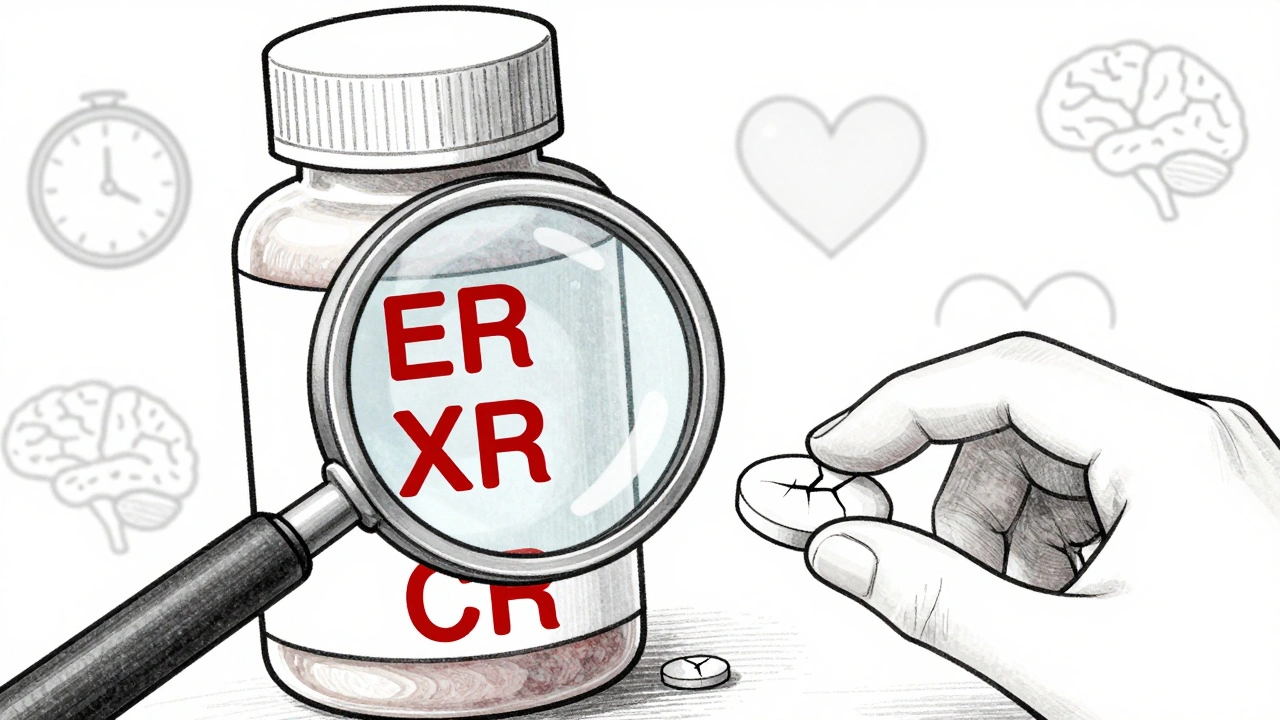
Every year, thousands of people accidentally take extended-release medications the wrong way - crushing them, splitting them, or taking them at the wrong time. And it’s not because they’re careless. It’s because the labels are confusing. If you’ve ever stared at a pill bottle wondering what ER, XR, or CR actually means, you’re not alone. These aren’t just fancy abbreviations. They’re safety instructions written in code. Get it wrong, and you could end up with too much medicine all at once - or none at all.
What Extended-Release Really Means
Extended-release medications are designed to let the drug leave your body slowly, over hours instead of minutes. That’s different from immediate-release pills, which dump all the medicine into your system right away. Think of it like this: an immediate-release pill is a sprint. An extended-release pill is a marathon. The goal? Keep your blood levels steady. For conditions like high blood pressure, depression, or ADHD, that means fewer spikes and crashes. You take it once or twice a day instead of four or five. That’s why nearly 70% of Medicare Part D prescriptions now include extended-release versions - especially for chronic conditions like hypertension and diabetes. But here’s the catch: the way the drug is released depends on the technology used. Some use a polymer matrix - the medicine is mixed into a slow-dissolving shell. Others have a coating that peels away over time. Some use osmotic pumps, like Concerta, which slowly push the drug out like a tiny water-powered engine. These different methods mean two pills with the same name and same label can behave completely differently in your body.Decoding the Letters on the Bottle
The letters after the drug name aren’t random. They tell you exactly how the pill works. Here’s what they mean:- ER = Extended Release
- XR = eXtended Release
- SR = Sustained Release
- CR = Controlled Release
- CD = Continuous Delivery
- XT = Extended Release (brand-specific, like Cartia XT)
The Warnings You Can’t Ignore
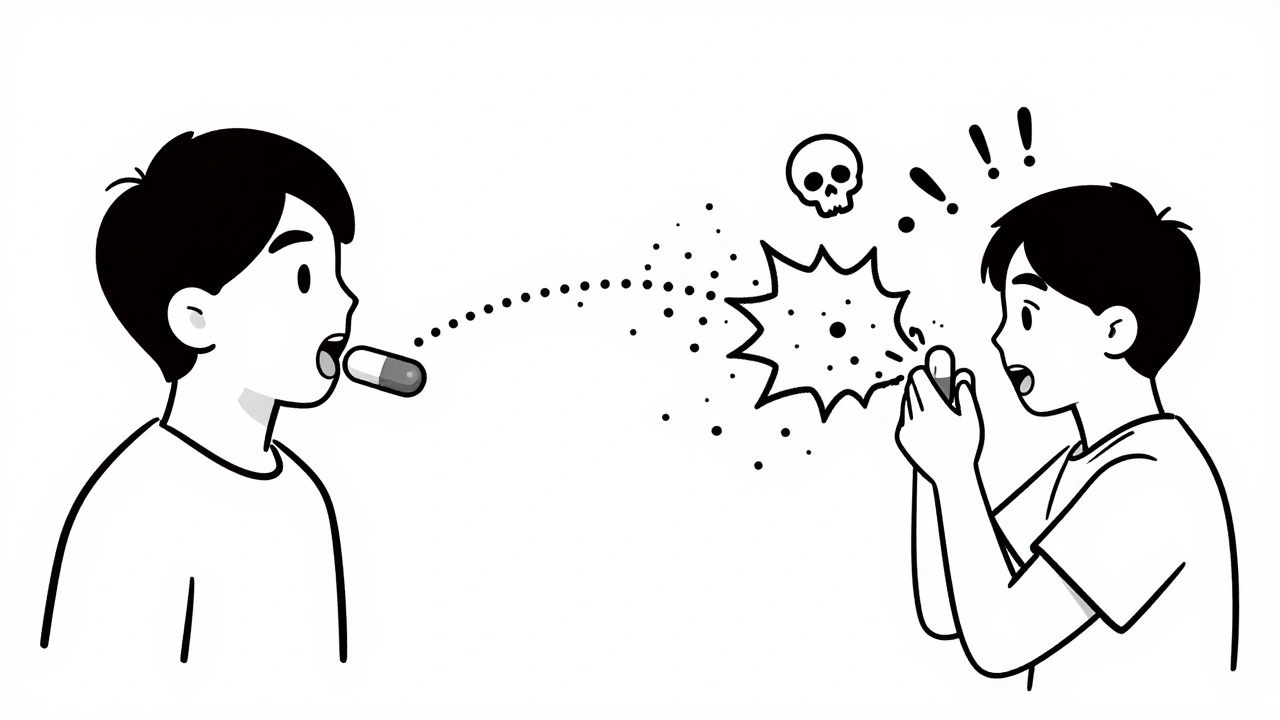
If you see these words on your label, stop. Don’t touch the pill.- DO NOT CRUSH
- DO NOT SPLIT
- DO NOT CHEW
Timing Matters More Than You Think
When you take the pill is just as important as how you take it. Some extended-release medications are designed to work best at night. Niaspan (niacin ER) causes flushing - that hot, red feeling on your face. Taking it at bedtime means you’re asleep when it happens. Taking it in the morning? You’ll be stuck at work feeling like you’re having a panic attack. Others need to be taken with food. Metformin ER works better and causes fewer stomach issues if you take it with your evening meal. Take it on an empty stomach? You might end up vomiting or dizzy. And then there’s the big one: Adderall XR. It’s a stimulant. If you take it at night, you won’t sleep for 36 hours. People do this all the time - thinking “it’s extended release, so it’ll wear off by morning.” Nope. It lasts 10-12 hours. Take it at 8 p.m.? You’re awake until 8 a.m. the next day. And then you crash. Always check the directions. If it says “take once daily in the morning,” that’s not a suggestion. That’s the science talking.What’s on the Label - And What’s Missing
The FDA requires all OTC and prescription labels to include four key sections:- Uses - What the medicine treats
- Warnings - Do not crush, split, or chew. Also, interactions with alcohol or other drugs
- Directions - Exact timing, with or without food, how often
- Inactive Ingredients - Fillers and coatings that don’t treat your condition but help the pill work
What to Do If You’re Still Confused
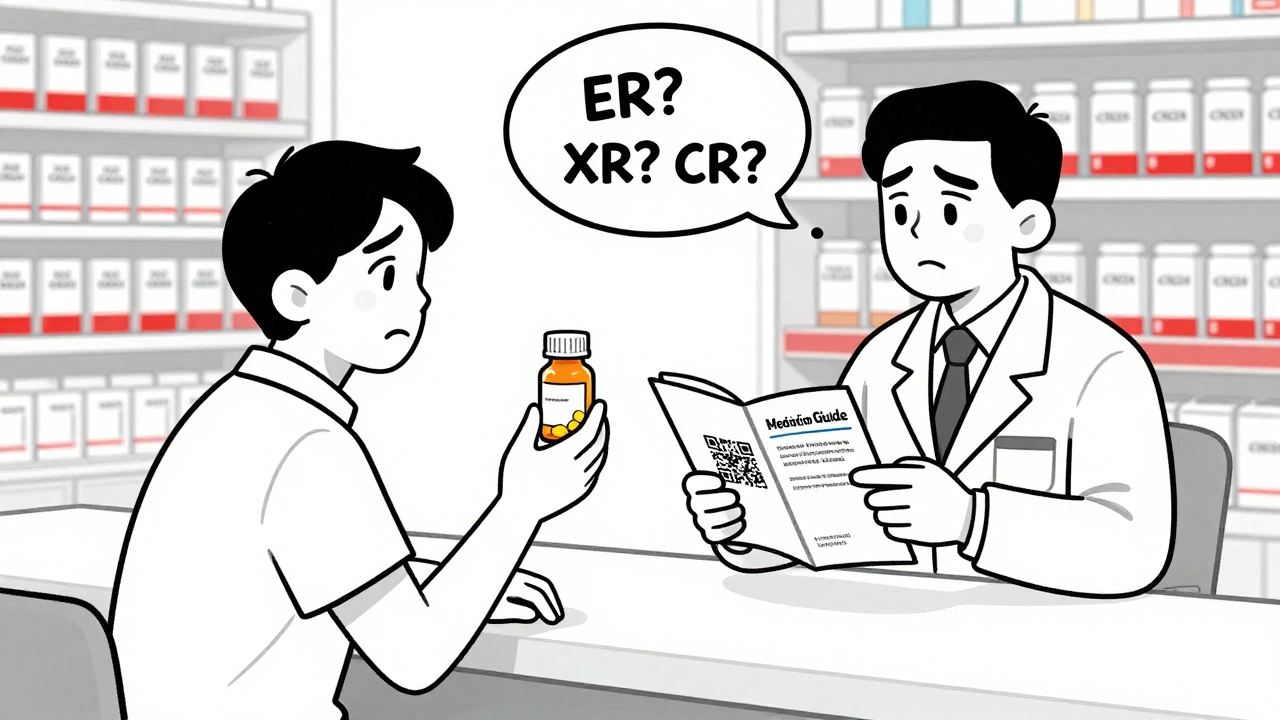
You don’t have to guess. There are three simple steps:- Ask your pharmacist - Not “what’s this for?” but “how does this pill work? Does it need to be taken with food? Can I split it?”
- Use the teach-back method - After they explain, say, “So if I take this once a day, I can’t crush it, and I should take it in the morning?” If they nod, you got it right.
- Scan the QR code - Newer labels have them. Scanning one might take you to a 30-second video showing how to swallow the pill, what to avoid, and what side effects to watch for.
What’s Changing in 2025
The system is slowly getting better. Starting in January 2024, all new extended-release medications must have a high-contrast “DO NOT CRUSH” warning in bold red letters. Digital prescriptions now must say “24-hour extended release” instead of just “ER” - so doctors and pharmacists don’t mix up 12-hour and 24-hour versions. New technologies are coming too. Some pills in development use GI-retention systems that can hold the drug in your stomach for 48-72 hours. That’s a game-changer for people who forget pills. But it also means labels will get even more complex. The FDA admits current labeling isn’t good enough. “Extended release” doesn’t tell you how it works. That’s why they’re testing new formats - like icons, color-coded bands, or even QR codes that link to audio instructions in multiple languages. Until then, your best tool is still you. Read the label. Ask questions. Don’t assume. And never crush a pill unless your doctor specifically says it’s safe.Common Mistakes and Real Consequences
Here are three real mistakes people make - and what happened:- Mistake: Splitting a 24-hour metoprolol tablet because it was too big. Result: Blood pressure dropped too fast. Fainted at work. ER visit.
- Mistake: Taking tramadol ER at night for pain. Result: Couldn’t sleep. Next day, felt like a zombie. Took another dose - overdose. Hospitalized.
- Mistake: Thought “SR” meant “slow and safe to chew.” Crushed 300mg of sustained-release niacin. Result: Liver enzymes spiked. Needed treatment for drug-induced hepatitis.
Final Checklist Before You Take Any Extended-Release Pill
Before you swallow:- Is the word “ER,” “XR,” “SR,” or “CR” on the label? If yes, don’t crush or split.
- Does it say “take once daily” or “take twice daily”? Stick to that schedule.
- Is there a time of day mentioned? Morning? Night? With food? Follow it.
- Did you get a Medication Guide? If not, ask for it.
- Do you know the difference between your brand and the generic? If not, ask your pharmacist.
Can I split an extended-release pill if it’s scored?
No. Even if a pill looks like it’s meant to be split, extended-release formulations are designed to release medication slowly using coatings or matrices. Splitting it destroys that system and can cause the full dose to be released at once. Always check the Medication Guide or ask your pharmacist - never assume.
What’s the difference between ER, XR, and SR?
In practice, ER (Extended Release), XR (eXtended Release), and SR (Sustained Release) are often used interchangeably by manufacturers. All mean the drug is released slowly over time. But technically, SR sometimes refers to a slower, more consistent release, while ER/XR may allow for slight spikes. The key is not the letter - it’s the “24 hour” or “12 hour” designation and the specific drug. Always treat them the same: don’t crush, follow timing instructions.
Why do some extended-release pills cost more?
Extended-release versions usually cost 20-35% more than immediate-release versions because of complex manufacturing, patent protections, and specialized delivery systems. But they can save money long-term by reducing hospital visits and improving adherence. For chronic conditions, taking one pill a day instead of four makes a big difference in health outcomes.
Can I switch from a brand-name extended-release pill to a generic?
Not always. Even if two pills have the same active ingredient and say “ER,” they may use different release technologies. For example, there are three different 24-hour diltiazem products that are not interchangeable. Always ask your pharmacist if the generic is “AB rated” - meaning it’s proven to work the same way. Never switch without checking.
What should I do if I accidentally crush or split an extended-release pill?
Call your pharmacist or doctor immediately. Don’t wait for symptoms. You may have taken a full dose all at once. Symptoms of overdose include rapid heartbeat, dizziness, confusion, vomiting, or fainting. If you’re taking an opioid or stimulant, seek emergency help right away. Even if you feel fine, the effects can be delayed.
If you take extended-release medications regularly, keep a small card in your wallet with the names of your pills and the words: “DO NOT CRUSH.” Show it to any new doctor or pharmacist. It’s a simple habit - but it could save your life.

Comments
Larry Lieberman
Just read this and immediately checked my meds. Turns out I’ve been taking my metformin ER on an empty stomach for 8 months. 😳 Thanks for the wake-up call. Going to call my pharmacist tomorrow.
iswarya bala
thx for this!! i always thought er meant 'easy to swallow' 😅 now i know its 'emergency risk' if i mess up
Angela R. Cartes
Ugh. Another ‘educational’ post from someone who clearly doesn’t understand that most people can’t afford to ask their pharmacist 17 questions before breakfast. 🙄
Carina M
It is, without question, a profound failure of public health communication that patients are expected to decode pharmaceutical nomenclature like ancient hieroglyphs. The FDA’s reliance on ambiguous abbreviations-ER, XR, CR-is not merely negligent; it is an affront to the dignity of informed consent. One cannot reasonably expect laypersons to discern the nuanced pharmacokinetic differences between osmotic pumps and polymer matrices when the labeling system itself is fundamentally incoherent. This is not a matter of patient education-it is a systemic collapse of linguistic and regulatory responsibility.
Lisa Whitesel
Crushing pills is dumb. But so is paying $200 for a 24-hour version when the 12-hour works fine if you take it twice. Pharma’s just milking the system. And yes, I’ve done both. I’m not proud.
Tim Tinh
big respect for writing this out so clearly. i used to think 'sr' meant 'slow release so i can chew it like a gummy'... yeah no. learned the hard way after a 3-hour panic attack from niacin. now i keep the med guide in my wallet next to my insurance card. best habit i ever picked up 🙏
Raja Herbal
So the FDA wants to add color-coded bands and QR codes... but they still can't fix the fact that 40% of Americans can't read above a 6th-grade level? 😂
Asset Finance Komrade
One might argue that the entire paradigm of extended-release pharmacology is a capitalist construct designed to maximize adherence through psychological manipulation-reducing dosing frequency to create the illusion of control. The pill, in this light, becomes not a tool of healing but a symbol of modern alienation: a tiny, engineered monument to our inability to simply remember to take medicine.
Ajit Kumar Singh
in india we have this problem too but worse because pharmacists give you generic without telling you the difference and if you ask they say 'bhaiya its same no?' and you believe them because you dont want to argue with 10 people behind you in line. i once took a 'CR' tablet thinking it was regular and ended up in ER with heart palpitations. now i take photo of label and send to my cousin who is med student. you guys are lucky you have pharmacists
Ryan Brady
Wow. Another one of these 'read the label' lectures. Meanwhile, the real problem is that Big Pharma hides the truth behind 20-page inserts written in Latin. You think this post helps? Nah. It just makes people feel guilty for being too poor or too tired to decode corporate jargon.
Courtney Black
There’s a deeper truth here. We’ve outsourced our bodily autonomy to institutions that don’t speak our language. We swallow pills like sacraments, blind to the mechanics, trusting in the ritual. But the pill doesn’t care if you understand it. It only cares if you break it. And we’ve been breaking it-not with our hands, but with our silence. We don’t ask. We don’t push. We assume. And so the system persists. Not because it’s efficient. But because it’s convenient. For them.