
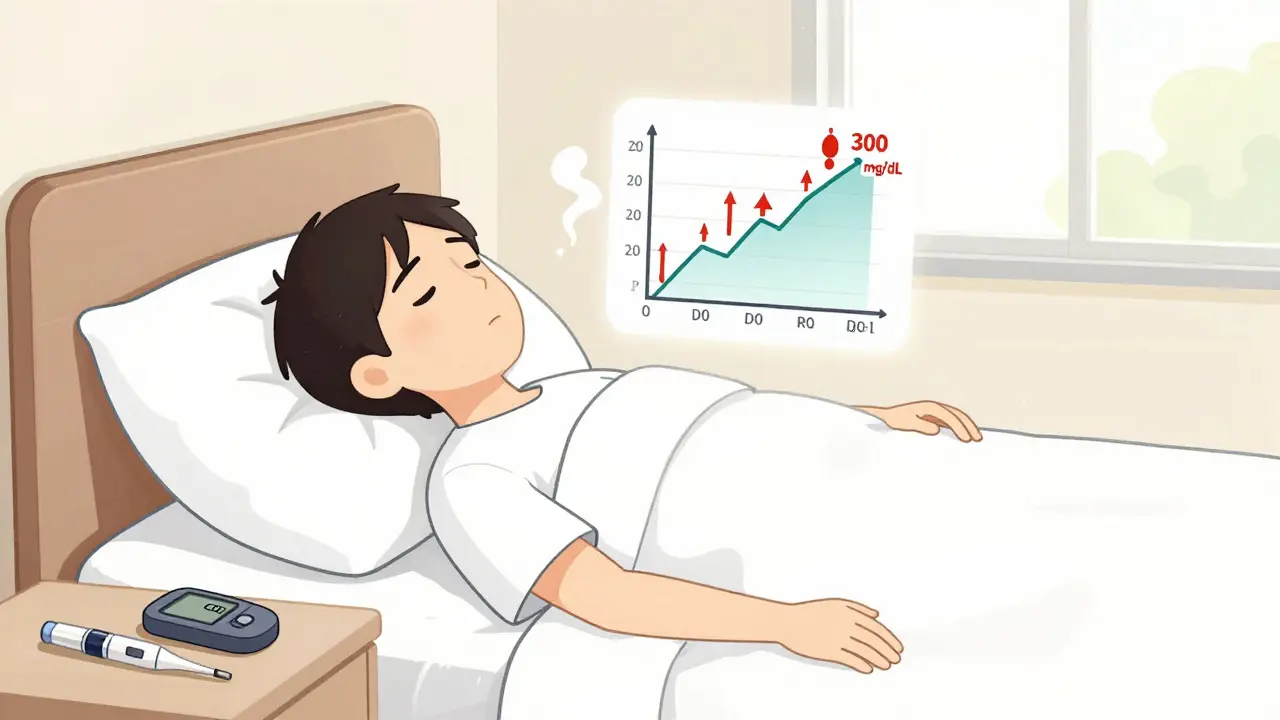
When you’re sick, your body isn’t just fighting a cold or the flu-it’s fighting a war with your blood sugar. For people with diabetes, illness triggers a surge in stress hormones like cortisol and adrenaline. These hormones make your body resist insulin, even if you’re not eating. Blood glucose can spike to dangerous levels-sometimes over 300 mg/dL-even when you’re too nauseous to keep food down. That’s why diabetes sick day rules aren’t optional. They’re life-saving. Many assume that if you’re not eating, you should skip your insulin. That’s one of the most dangerous myths out there. Skipping insulin during illness is the leading cause of diabetic ketoacidosis (DKA), a condition that sends over 27% of diabetes-related hospitalizations to the ER. DKA can kill. And it doesn’t just happen to Type 1 diabetics. Type 2 diabetics on insulin are just as vulnerable. Here’s what actually works when you’re sick: consistent insulin, careful hydration, and regular ketone checks. No guesswork. No skipping. No hoping it’ll pass on its own.
Never Stop Your Insulin-Even If You’re Fasting
Your body still needs insulin when you’re sick. Even if you’re vomiting or can’t eat, your liver keeps pumping out glucose. Without insulin, that glucose has nowhere to go. It builds up. Your body starts breaking down fat for energy. That’s when ketones rise. Long-acting insulin-like Lantus, Levemir, or Basaglar-must keep going. The American Diabetes Association and International Diabetes Federation both say: never reduce basal insulin below 80% of your usual dose during illness. For Type 1 diabetics, this is non-negotiable. For Type 2 diabetics on insulin, the same rule applies. If you use an insulin pump, don’t turn it off. Instead, increase your basal rate by 20% for 12 hours if your blood ketones hit 1.0 mmol/L or higher. This isn’t a suggestion-it’s a standard protocol backed by decades of clinical observation. One study in the Journal of Diabetes Science and Technology found that patients who followed this rule cut their DKA risk by over 60% during viral infections. If you’re on multiple daily injections, you still need to take your basal insulin. You may also need extra correction doses if your blood sugar stays above 240 mg/dL. Don’t wait. Give the correction. Then check again in 2-3 hours.Hydration: The Silent Lifesaver
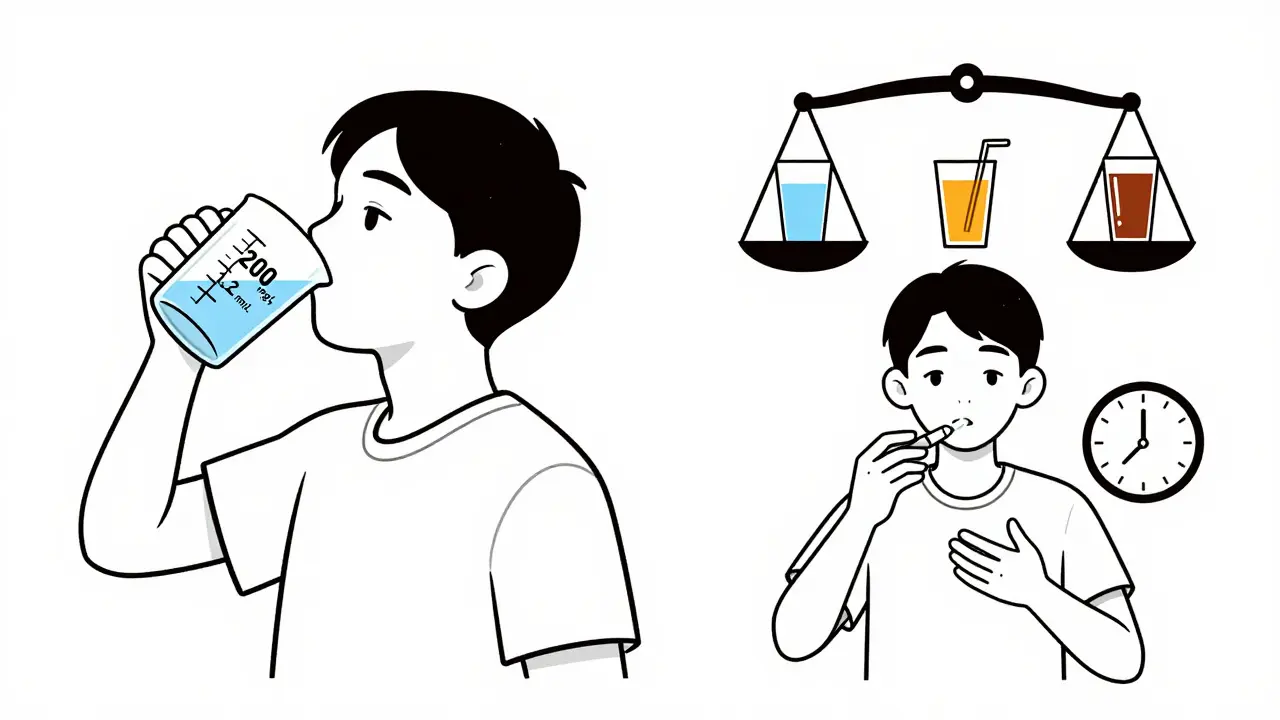
Dehydration makes everything worse. High blood sugar pulls water out of your cells. Vomiting or fever makes it worse. Without enough fluids, your kidneys can’t flush out ketones. That’s how DKA creeps in. The rules for hydration aren’t vague. They’re precise:- For adults: Drink 6-8 ounces of fluid every hour. That’s about one standard glass.
- For children: Drink your age in ounces per hour (a 10-year-old drinks 10 ounces per hour).
- If your blood sugar is below 100 mg/dL: Choose sugary fluids like regular soda, juice, or Gatorade. You need carbs to prevent low blood sugar.
- If your blood sugar is between 100-180 mg/dL: Alternate between sugar-free fluids (water, diet soda) and fluids with 15 grams of carbs (like 4 oz of juice or half a regular soda).
- If your blood sugar is above 180 mg/dL: Stick to sugar-free fluids. Water, unsweetened tea, or broth are best.
Ketone Checks: When to Worry and When to Act
Ketones are your body’s emergency fuel. But too many mean you’re in danger. Test for ketones when your blood sugar hits 240 mg/dL or higher. Do it every 4-6 hours during illness. If you have a blood ketone meter, use it. Urine strips are outdated-they lag behind real-time changes. A blood ketone level above 1.0 mmol/L means you need to act. Above 1.5 mmol/L? You’re in danger zone. Here’s what to do:- 1.0-1.5 mmol/L: Increase insulin (basal +20%, correction doses), drink fluids, and retest in 2 hours.
- 1.6-3.0 mmol/L: Call your doctor. You may need IV fluids or hospital care.
- Above 3.0 mmol/L: Go to the ER. This is a medical emergency.
Type 1 vs. Type 2: Key Differences
Not all diabetes sick day rules are the same. For Type 1 diabetics: Ketone checks are mandatory. Insulin is non-negotiable. Even if you’re not eating, you still need insulin. Your body doesn’t produce it. You’re entirely dependent. For Type 2 diabetics: It’s more complex. If you’re on oral meds only (like metformin), you may not need ketone checks unless your blood sugar stays above 240 mg/dL for more than 12 hours. But if you’re on insulin-even once a day-you treat it like Type 1. No exceptions. Also, your blood sugar target during illness is looser. The CDC recommends keeping it between 110-180 mg/dL. That’s higher than your normal target. Why? Because pushing too hard for normal levels can cause lows, and lows during illness are dangerous.What’s in Your Sick Day Kit?
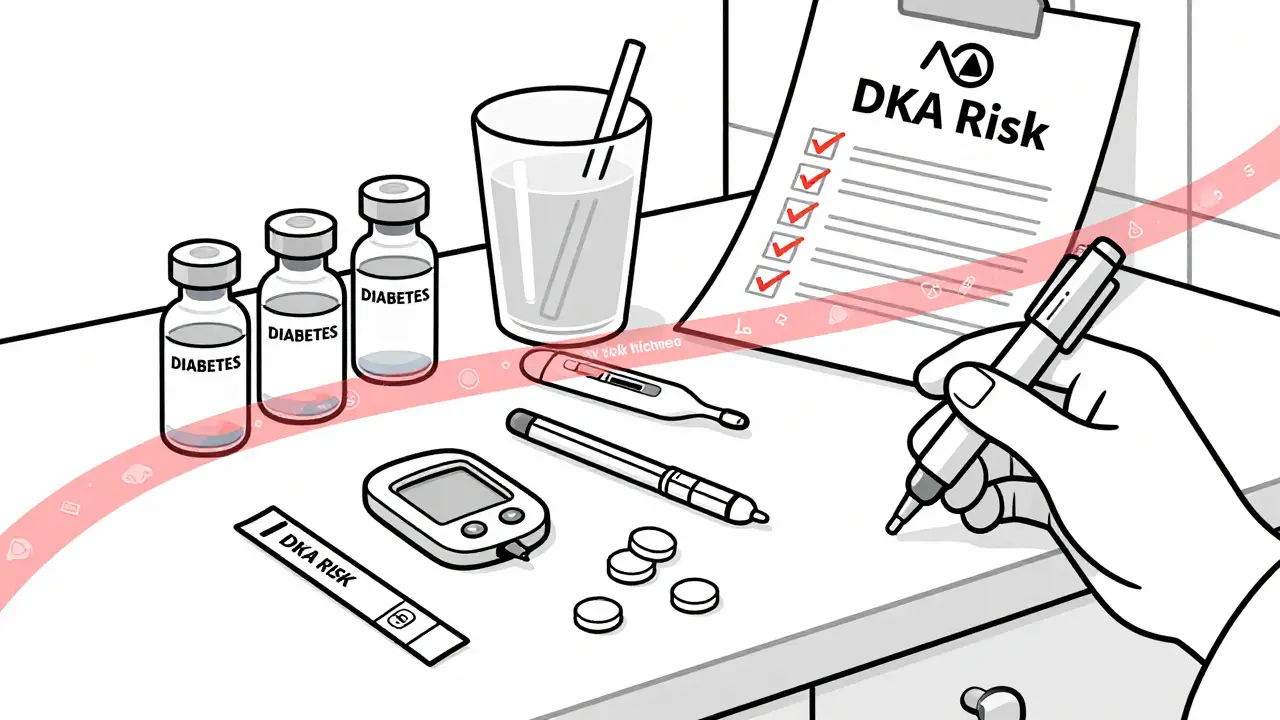
Don’t wait until you’re sick to prepare. Build a kit now.- Unexpired blood ketone test strips (they lose accuracy after 6 months of opening)
- Extra insulin (at least a 7-day supply)
- Insulin syringes or pens (in case your pump fails)
- Glucose tablets or juice boxes (for lows)
- Sugar-free and sugary fluids (water, diet soda, juice)
- Measuring cup (for accurate hourly intake)
- Thermometer, pain relievers (like acetaminophen-avoid ibuprofen if you have kidney issues)
- Emergency contact list: doctor, endocrinologist, pharmacy, and 24/7 ADA helpline (1-800-DIABETES)
What to Avoid
There are traps everywhere.- Over-the-counter cold meds: Many contain sugar, alcohol, or decongestants that raise blood sugar. Check labels. Look for “sugar-free” versions.
- Skipping insulin: Even if you’re vomiting. Even if you’re scared. Even if your doctor says “take it easy.” Your body needs insulin. Period.
- Waiting too long to test ketones: Don’t wait until you feel awful. Test when your blood sugar hits 240 mg/dL.
- Drinking only water when high: That can make insulin less effective. Balance fluids with carbs when needed.
When to Call for Help
You don’t have to power through this alone. Call your doctor or go to the ER if:- Your ketones are above 1.6 mmol/L and rising
- You’ve been vomiting for more than 4 hours and can’t keep fluids down
- Your blood sugar stays above 300 mg/dL for more than 6 hours, even with extra insulin
- You’re confused, breathing fast, or smell fruity (like nail polish remover)-signs of DKA
- You’ve lost 5 pounds or more in a few days
What’s Changing in 2025
New tech is coming. Continuous glucose monitors (CGMs) now have alerts for rising ketones. Some pumps can auto-adjust basal rates during illness. But here’s the problem: most people don’t know how to use these features. The ADA updated its 2023 guidelines to include CGM interpretation: if more than half your readings are above 250 mg/dL for 12 hours, treat it like a high blood sugar emergency. Also, viral infections like RSV and flu cause 37% more insulin resistance than bacterial infections. That means you might need more insulin during flu season than you think. A new AI tool is in development to predict sick-day complications based on early symptoms. It’s not out yet-but it’s coming. For now, stick to the basics: insulin, fluids, ketones.Final Reminder
Sick day rules for diabetes aren’t about perfection. They’re about prevention. You won’t always hit your target numbers. But if you follow the rules-keep insulin going, drink hourly, test ketones-you’ll avoid the ER. This isn’t theoretical. It’s survival. Every year, thousands of people end up in the hospital because they thought they could skip insulin or wait it out. You don’t have to be one of them. Start today. Make your kit. Print the rules. Stick them on your fridge. Practice the fluid rotation. Know your numbers. When you’re sick, you’re not just fighting a virus. You’re fighting your own body’s chemistry. And you’ve got the tools to win.Should I stop my insulin if I’m not eating when I’m sick?
No. Never stop insulin during illness, even if you’re fasting or vomiting. Your body still needs insulin to prevent ketone buildup and diabetic ketoacidosis (DKA). Basal insulin (like Lantus or Levemir) must continue at 80-100% of your normal dose. Skipping insulin is the most common cause of DKA during illness.
How often should I check my blood sugar and ketones when sick?
Check your blood sugar every 2-3 hours if you’re a child, or every 3-4 hours if you’re an adult. Test for ketones whenever your blood sugar is above 240 mg/dL, and repeat every 4-6 hours if ketones are present. Use a blood ketone meter if possible-it’s more accurate than urine strips.
What fluids should I drink when my blood sugar is high?
If your blood sugar is above 180 mg/dL, drink sugar-free fluids like water, unsweetened tea, or broth. If it’s between 100-180 mg/dL, alternate between sugar-free fluids and fluids with 15 grams of carbs (like 4 oz of juice or half a regular soda). Avoid sugary drinks if your sugar is high-they’ll push it higher.
Can Type 2 diabetics on pills skip ketone checks?
If you’re on oral medications only (like metformin) and not insulin, you typically don’t need to check ketones unless your blood sugar stays above 240 mg/dL for more than 12 hours. But if you’re on insulin-even once a day-you must check ketones the same way as Type 1 diabetics. Always consult your doctor for your personal plan.
What should I do if I can’t keep fluids down?
If you’ve been vomiting for more than 4 hours and can’t keep any liquids down, go to the emergency room. Dehydration and high ketones can lead to DKA quickly. You may need IV fluids and insulin. Don’t wait. Call your doctor or 911 if you feel dizzy, confused, or have rapid breathing.
Are over-the-counter cold medicines safe for diabetics?
Not all are. Many cold and flu remedies contain sugar, alcohol, or decongestants like pseudoephedrine, which can spike blood sugar. Always choose sugar-free versions and check labels for hidden carbs. Ask your pharmacist for diabetes-safe options. Avoid products with high-fructose corn syrup or alcohol as a solvent.
Is it normal to lose weight when I’m sick with diabetes?
No. Losing 5 pounds or more in a few days during illness is a warning sign of severe hyperglycemia and fat breakdown. This means your body is using fat for fuel because it lacks insulin. Contact your doctor immediately. Unintended weight loss during sickness is a red flag for DKA.

Comments
Lu Jelonek
When I got the flu last winter, I almost skipped my Lantus because I wasn’t eating. I’m lucky I checked this post before making that mistake. I followed the 80% basal rule, drank water with a splash of juice every hour, and tested ketones every 4 hours. My sugars stayed under 250. No ER visit. Just tired, but alive.
Don’t underestimate how much hydration matters. I didn’t realize how dehydrated I was until I started measuring. A measuring cup sounds silly, but it saved me.
Ademola Madehin
Bro this is wild. I skipped insulin once when I had food poisoning and woke up smelling like nail polish. My cousin had to drag me to the hospital. They gave me IV fluids and looked at me like I was an idiot. I’m not even diabetic but I learned the hard way - don’t mess with insulin. This post is a public service.
Jillian Angus
Used to think ketones were just a buzzword. Then I got sick and my CGM went off. Blood ketones at 1.9. I didn’t know what to do. Found this guide by accident. Did the +20% basal, drank broth hourly, retested in 2. Down to 0.7 by morning. No drama. Just quiet survival.
Also, sugar-free Gatorade is a lie. Stick to water and juice. No more ‘electrolyte drinks’ with artificial junk.
Payson Mattes
Okay but have you considered that the ADA and IDF are influenced by Big Pharma? I mean, why do they push insulin so hard? What if your body just needs rest and fasting? I’ve seen studies - not the ones they cite - where ketosis during illness actually helps the immune system. Maybe we’re being conditioned to fear our own biology.
Also, why do they assume everyone has a blood ketone meter? Most people can’t afford those. Urine strips are fine if you know how to read them. ‘LARGE’ means emergency. End of story.
Isaac Bonillo Alcaina
There is a critical error in the hydration guidelines. You state that children should drink their age in ounces per hour. That is medically unsound. The American Academy of Pediatrics recommends 1-2 mL/kg/hour for maintenance hydration, not age-based fluid intake. A 10-year-old weighing 30kg requires approximately 60-120 mL/hour - not 10 oz (~300 mL). This could lead to iatrogenic hyponatremia.
Furthermore, the phrase ‘stick to sugar-free fluids’ when BG >180 is dangerously oversimplified. Without any carbohydrate, insulin efficacy plummets due to lack of glucose transport stimulation. The protocol should specify a minimum carb intake even in hyperglycemia - perhaps 10-15g/hour via glucose tabs or clear broth.
Also, ‘diabetes-safe’ cold meds don’t exist. All decongestants are contraindicated in uncontrolled hyperglycemia. Period.
Bhargav Patel
The underlying principle here is not merely medical, but ontological: the body, in illness, becomes a site of internal contradiction - a self at war with itself. Insulin, in this context, is not merely a hormone but a metaphysical bridge between the body’s demand for energy and its inability to metabolize it.
When we speak of ketones, we are not merely discussing biochemical byproducts; we are witnessing the body’s desperate attempt to sustain life in the absence of its primary regulatory mechanism. To deny insulin under such conditions is to deny the body’s own logic.
Hydration, too, becomes a ritual of reintegration - a conscious reconnection with the physiological order that illness has disrupted. Each sip, measured, deliberate, is an act of reclaiming autonomy.
And yet - the most profound insight lies not in the protocol, but in the humility it demands. We are not masters of our biology. We are its stewards. The sick-day rules are not rules of control, but of surrender - to the body’s wisdom, and to the necessity of vigilance.
One does not ‘beat’ diabetes in illness. One endures it - with precision, with care, and with quiet reverence for the fragile equilibrium that sustains life.
Steven Mayer
Basal insulin resistance during viral infection is mediated by IL-6 and TNF-alpha upregulation, not just cortisol. The +20% basal adjustment is empirically valid but not mechanistically optimal. A more precise approach would be to titrate based on C-peptide levels or insulin sensitivity index derived from CGM trends - but that’s not feasible outside of research settings.
Also, urine ketone strips have a 2-4 hour lag due to renal excretion kinetics. Blood ketones reflect real-time lipolysis. The 1.0 mmol/L threshold correlates with a 30% increase in hepatic gluconeogenesis. At 1.5, gluconeogenesis becomes uncontrolled - hence the ER threshold.
And yes, RSV causes greater insulin resistance than influenza due to higher viral load in respiratory epithelium and systemic cytokine spillover. That’s why flu season is the real killer - not just the infection, but the metabolic chaos it triggers.
Joe Jeter
Everyone’s acting like this is some sacred text. I’ve been diabetic for 20 years. I’ve been sick dozens of times. I skip insulin sometimes when I’m vomiting and I’ve never had DKA. Maybe your body doesn’t need it. Maybe the whole ‘never skip’ rule is fear-mongering.
Also, why are we all supposed to have a blood ketone meter? My meter cost $80 and the strips are $3 each. I’m not rich. I use the $10 urine strips. They work fine. Stop gatekeeping diabetes care.
Sidra Khan
Y’all are overcomplicating this. I just drink water and take my insulin. If I feel like crap, I call my doctor. Done.
Also, I use emoji to express myself: 🥵💧🩸💉
And yes, I did skip insulin once. I’m still here. Maybe I’m just lucky. Or maybe the rules are flexible. 🤷♀️
suhani mathur
Oh honey, you think you’re the first person to write this? I’ve been teaching this to my patients in Mumbai for 12 years. The only thing new here is the $3 ketone strips and the ‘sugar-free Gatorade’ myth.
Here’s what actually works: if you’re sick, take insulin like your life depends on it - because it does. Drink water. Test. Repeat. No fancy charts needed. And if you’re in India, skip the imported ‘diabetes-safe’ meds - just ask for paracetamol and water. We’ve survived without corporate guidelines for centuries.
But hey, if you need a 2000-word essay to feel safe taking your insulin… go ahead. I’ll be here, quietly saving lives without the PowerPoint.
Isaac Bonillo Alcaina
Regarding the comment by u/6191: Your anecdote does not refute clinical evidence. DKA can be subclinical until it isn’t. You may have avoided hospitalization, but you may have sustained subacute organ damage - renal, neurological, or endothelial - from repeated hyperketonemic episodes. That’s not luck. That’s statistical variance. And statistically, you’re the outlier, not the norm.
And for the record: urine strips are not ‘fine.’ They’re unreliable, delayed, and prone to false negatives. A ‘large’ result on a strip is equivalent to 3.0 mmol/L - that’s ER territory. But you won’t know that until you’re already in respiratory distress. Blood ketones give you time to act. That’s not gatekeeping. That’s science.