
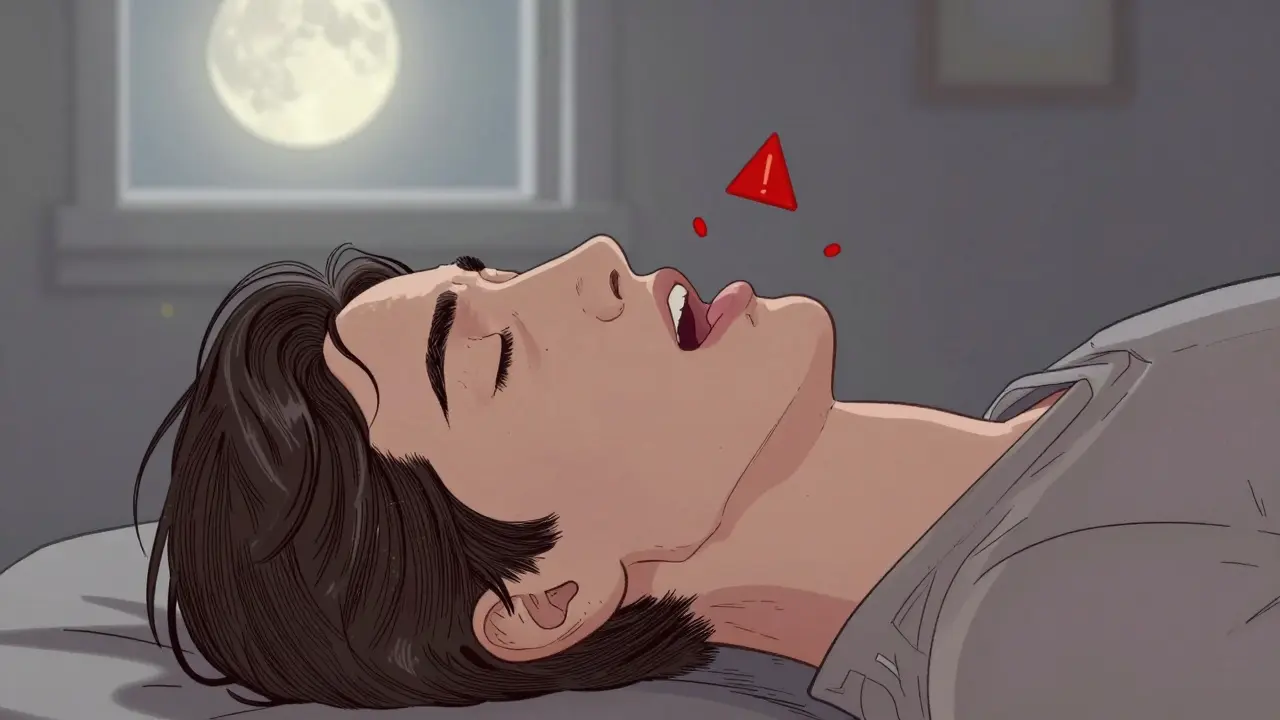
When you lie down to sleep, the position you choose can make a huge difference in how well you breathe - and whether you wake up feeling rested. For people with obstructive sleep apnea (OSA), sleeping on your back (supine) can turn a quiet night into a series of gasping interruptions. But switching to side sleeping? That simple change can cut breathing problems in half - sometimes even eliminate them.
Why Back Sleeping Makes Sleep Apnea Worse
Sleeping on your back lets gravity pull your tongue and soft tissues backward into your throat. This isn’t just annoying - it physically blocks airflow. Studies show that when you lie flat on your back, your upper airway shrinks by 30-40% compared to lying on your side. For someone with OSA, that small drop in space means more frequent and more severe breathing pauses.A sleep study measuring apnea-hypopnea index (AHI) - the number of breathing interruptions per hour - often reveals a clear pattern: AHI might be 8 when sleeping on the side, but jump to 28 when on the back. That’s not just a number. That’s hours of low oxygen, heart rate spikes, and fragmented sleep. People with this pattern have what’s called positional obstructive sleep apnea (POSA). About half of all OSA patients fall into this category, and for them, changing sleep position isn’t a lifestyle tweak - it’s medical treatment.
How Side Sleeping Helps
Sleeping on your side keeps your airway open. The weight of your body doesn’t pull your tongue backward. Your throat stays more open, and airflow stays steady. Research from the Sleep Foundation confirms side sleeping reduces snoring and improves oxygen levels more than any other position. It’s not magic - it’s physics. And it works fast. Many users report their partner’s snoring stops within seconds of turning onto their side.But here’s the catch: most people don’t stay on their side all night. We roll over. A lot. That’s why positional therapy exists - not just to encourage side sleeping, but to prevent back sleeping entirely.
What Is Positional Therapy?
Positional therapy is any method that stops you from sleeping on your back. It’s not about willpower. It’s about creating conditions where back sleeping becomes uncomfortable or impossible. The goal? Reduce supine time to near zero.There are two main approaches: low-tech and high-tech.
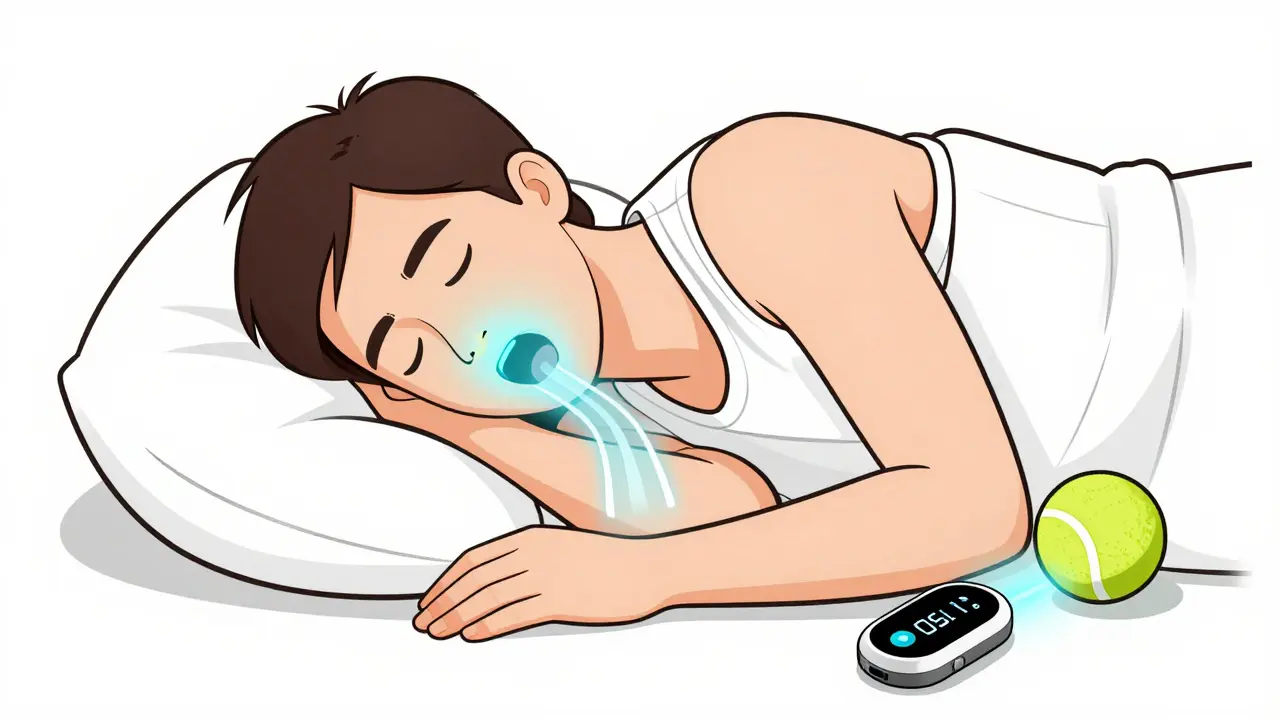
- The tennis ball technique (TBT): Sew a tennis ball into the back of a sleep shirt. If you roll onto your back, it hurts. It’s cheap, simple, and surprisingly effective. But many people stop using it after a few weeks because it disrupts sleep. One informal survey found 45% of users quit within three months due to discomfort.
- Wearable position trainers (SPT): Devices like the NightBalance or Smart Nora use gentle vibrations to nudge you back to your side when you roll onto your back. They don’t wake you up - they just guide you. These devices track your position and adjust feedback intensity over time. In a 2015 study, 68% of users of SPT devices achieved treatment success (AHI under 5), compared to just 43% with the tennis ball method. Compliance was over 30% higher with SPT.
Both methods reduce supine time to nearly zero. But only one keeps you sleeping soundly.
Positional Therapy vs. CPAP
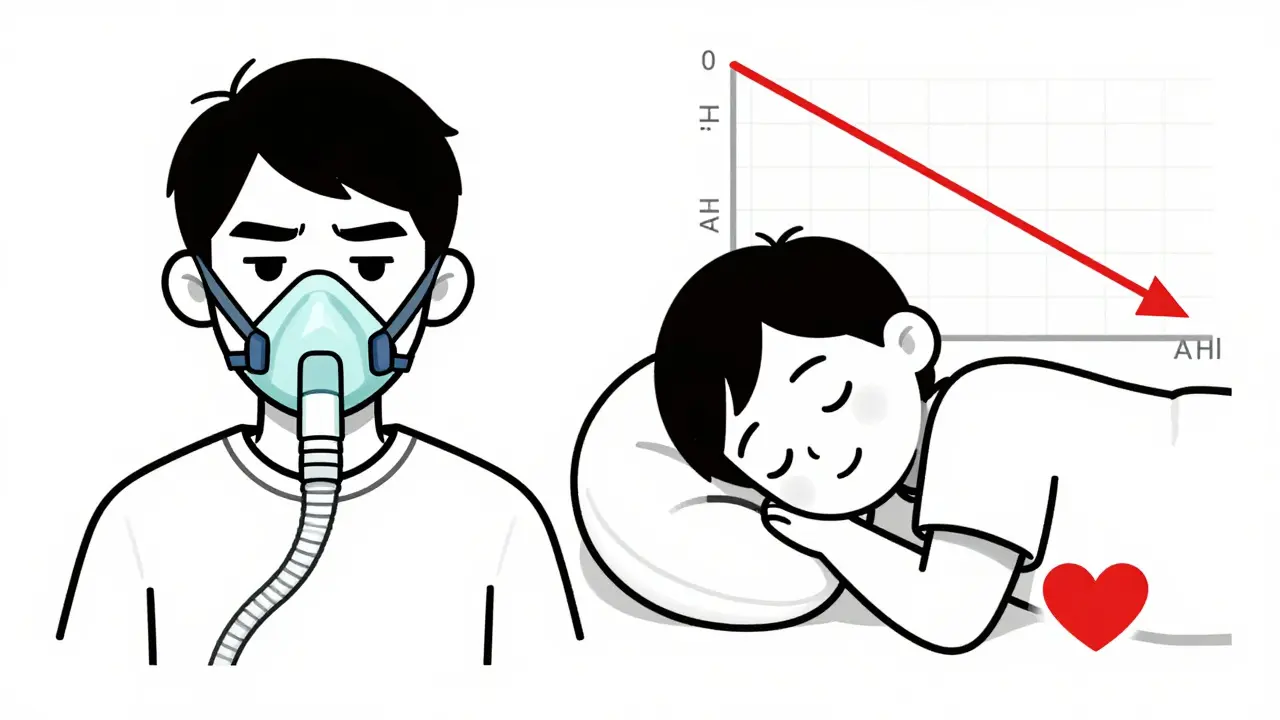
Continuous positive airway pressure (CPAP) is the gold standard for treating OSA. It works - really well. But here’s the problem: about half of CPAP users stop using it within a year. Masks leak. It’s noisy. It feels claustrophobic. For many, the treatment is worse than the condition.Positional therapy doesn’t have that problem. Adherence rates are 35-40% higher than CPAP. Why? Because you don’t need to wear a mask. You don’t need electricity. You just need to stay on your side. For mild to moderate POSA patients, positional therapy can reduce AHI from severe to normal levels - without a machine.
That’s why the American Academy of Sleep Medicine recommends positional therapy as a first-line option for patients with clear positional dependence. If your supine AHI is at least double your side AHI, you’re a candidate. And if you’ve struggled with CPAP, positional therapy might be your breakthrough.
Who Should Try It - and Who Shouldn’t
Not everyone with sleep apnea benefits from positional therapy. It only works if your apnea is worse when you’re on your back. That’s why a full sleep study is essential. A standard sleep test without positional data can miss the problem entirely. One study found that ignoring position led to underestimating OSA severity by up to 30%.Good candidates:
- Have an AHI between 5 and 30
- Have a supine AHI at least twice their side AHI
- Are mild to moderate OSA patients
- Have tried CPAP and struggled with adherence
Poor candidates:
- Have severe OSA (AHI over 30) regardless of position
- Have central sleep apnea (CSA) - positional therapy has little effect here
- Have neck or spine issues that make side sleeping painful
If you’re unsure, ask your sleep doctor to review your sleep study data by position. If your supine AHI is 20 and your side AHI is 4 - you’re a perfect candidate.
What Works Best in Real Life?
Most people start with the tennis ball. It’s free. But if you’re tossing and turning, waking up with bruises, or just giving up after a month - it’s time to upgrade.Advanced devices cost $300-$500, but they’re designed for long-term use. They don’t hurt. They don’t wake you. They learn your habits. And they work. One user in Melbourne told me he’d been on CPAP for three years. He hated it. He switched to NightBalance. Within two weeks, his snoring stopped. His wife slept through the night. He hasn’t missed a night in six months.
Even simple changes help. Elevating your head 6-8 inches with a wedge pillow can reduce positional apnea by up to 25%. Combine that with side sleeping, and you’ve got a powerful, drug-free strategy.
The Bigger Picture: More Than Just Breathing
Poor sleep doesn’t just make you tired. It strains your heart. Supine sleeping is linked to higher risks of heart failure, high blood pressure, and even stroke. By staying on your side, you’re not just preventing apnea - you’re protecting your cardiovascular system.Studies are still catching up. We don’t yet have long-term data on whether positional therapy reduces heart attacks or strokes. But the logic is clear: less airway collapse = less oxygen drop = less stress on your heart. For many, positional therapy isn’t just about sleep - it’s about longevity.
Getting Started
If you suspect you have positional sleep apnea:- Ask your sleep specialist to review your sleep study data by position.
- If your supine AHI is at least double your side AHI, positional therapy is an option.
- Try the tennis ball technique for two weeks. If it’s too disruptive, consider a wearable position trainer.
- Use a wedge pillow to slightly elevate your upper body.
- Track your progress: snoring, energy levels, morning headaches.
You don’t need a prescription to start. But you do need to know if it’s right for you. And if it is - you might finally sleep through the night.
Is side sleeping better than back sleeping for sleep apnea?
Yes, side sleeping is significantly better for obstructive sleep apnea. When you sleep on your back, gravity pulls your tongue and soft tissues into your airway, causing more frequent and severe breathing pauses. Side sleeping keeps your airway open, reducing apnea events by up to 50% or more in people with positional OSA. Studies show it also reduces snoring and improves oxygen levels.
Can positional therapy replace CPAP?
For people with positional obstructive sleep apnea (POSA), yes - positional therapy can be as effective as CPAP, and often more sustainable. While CPAP lowers overall AHI more, most users abandon it due to discomfort. Positional therapy has much higher long-term adherence. If your supine AHI is at least twice your side AHI, and your OSA is mild to moderate, positional therapy is a valid first-line treatment.
How do I know if I have positional sleep apnea?
You need a sleep study that breaks down your apnea-hypopnea index (AHI) by sleep position. If your AHI when sleeping on your back is at least double your AHI when sleeping on your side, you have positional OSA. Most standard sleep studies don’t report this - you need to ask your sleep specialist to analyze the data by position.
What’s the difference between the tennis ball method and a sleep position trainer?
The tennis ball method uses physical discomfort to stop you from rolling onto your back. It’s cheap but often disrupts sleep - many people quit within weeks. A sleep position trainer (like NightBalance) uses gentle vibration to nudge you back to your side without waking you. It’s more expensive ($300-$500) but has higher compliance, better sleep quality, and better long-term success rates.
Does side sleeping help central sleep apnea?
Not as reliably. Central sleep apnea is caused by the brain failing to signal the body to breathe - not by airway blockage. While side sleeping may help slightly by improving lung expansion, it doesn’t address the root cause. Positional therapy is primarily effective for obstructive sleep apnea, not central. If you have central sleep apnea, treatment usually requires different approaches, like adaptive servo-ventilation (ASV).

Comments
Korn Deno
Gravity doesn't care about your sleep schedule. It just pulls. And if your tongue is lazy enough to roll back, it'll block your airway like a drunk bouncer at a club.
Side sleeping isn't a hack-it's physics winning. No mask. No noise. Just your body doing what it's supposed to.
Why do we overcomplicate health? We got a body. Use it.
Danielle Arnold
Oh great. Another post that makes me feel guilty for being a back sleeper.
My pillow has a 12-year contract with my spine. You think I'm gonna break up with it because some study says so?
Also, tennis ball? Cute. I'd rather just snore and let my partner suffer.
Jesse Hall
THIS. I switched to side sleeping after my wife started sleeping in the guest room 😅
First night? No snoring. Second night? I actually woke up refreshed.
Then I got a side-sleeping pillow and now I’m hooked. No CPAP, no drama, just better sleep.
Try the tennis ball for a week. If you hate it, get a real device. Your heart will thank you ❤️
Donna Fogelsong
They don’t want you to know this but positional therapy is just the gateway drug to Big Sleep’s real agenda.
Wearable trackers? They’re collecting your sleep data to sell to insurers.
And that ‘gentle vibration’? It’s not nudging you-it’s conditioning you.
Next thing you know, your smart mattress will auto-adjust your position and charge you $99/month.
Wake up. This isn’t medicine. It’s surveillance with a sleep mask.
Namrata Goyal
side sleeping? please. i live in mumbai, we sleep on floors with 1 pillow. no one has this problem. its a first world sleep crisis.
also, cpap is a cult. the machines are loud. the masks are plastic prisons.
you think your body needs a machine to breathe? lol. try yoga. or just sleep on your stomach. its 2025.
Alex Arcilla
Yo, I’m from the Philippines and we’ve been doing positional therapy for generations.
My lola slept on her side with a bamboo pillow and never needed a machine.
CPAP is just capitalism trying to monetize your snoring.
Also, tennis ball? That’s a Filipino hack. We use mangoes. Works better. And tastier.
Stop overengineering sleep. Your ancestors did fine without a $500 tracker.
Caroline Dennis
POSA: positional obstructive sleep apnea. Defined by supine AHI ≥2× side AHI.
Non-positional OSA: AHI remains high regardless of position.
CPAP adherence <30% after 12mo. Positional therapy adherence >65% with SPT.
First-line for mild-mod POSA per AASM 2023 guidelines.
Simple. Evidence-based. Underutilized.
Zola Parker
So… you’re saying I’m not broken?
I thought I was just a bad sleeper.
Turns out I just needed to stop letting gravity turn my throat into a kinked garden hose.
Also… why does everyone act like this is new info? My grandma knew this in 1972.
Anyway… 🙃
florence matthews
I love how this post doesn’t shame people who use CPAP. It just says: here’s another tool.
Some of us need the mask. Some of us need the pillow. Some of us need both.
There’s no ‘right’ way to sleep. Just better ways to breathe.
Thank you for the science. And the kindness.
❤️
Kenneth Jones
You’re telling people to change their sleep position to avoid heart failure.
Meanwhile, the same doctors who wrote this are prescribing statins for cholesterol.
And they’re still pushing masks on people who can’t tolerate them.
Wake up. This isn’t medicine. It’s damage control.
Stop trusting institutions. Start trusting your body.
Mihir Patel
OMG I JUST REALIZED I’VE BEEN SLEEPING ON MY BACK FOR 12 YEARS 😱
MY WIFE SAID I SOUND LIKE A DRAGONS NEST
AND I THOUGHT IT WAS JUST BECAUSE I ATE TOO MUCH PIZZA
IM GETTING A TENNIS BALL TOMORROW
WISH ME LUCK IM SCARED
Raphael Schwartz
CPAP is a government tool to control sleep. The mask is a symbol of submission.
Side sleeping? That’s what they want you to believe.
Real freedom? Sleep on your back. Let the system see you breathe.
They fear natural sleep.
They fear quiet.
They fear silence.
Stay awake. Stay free.