
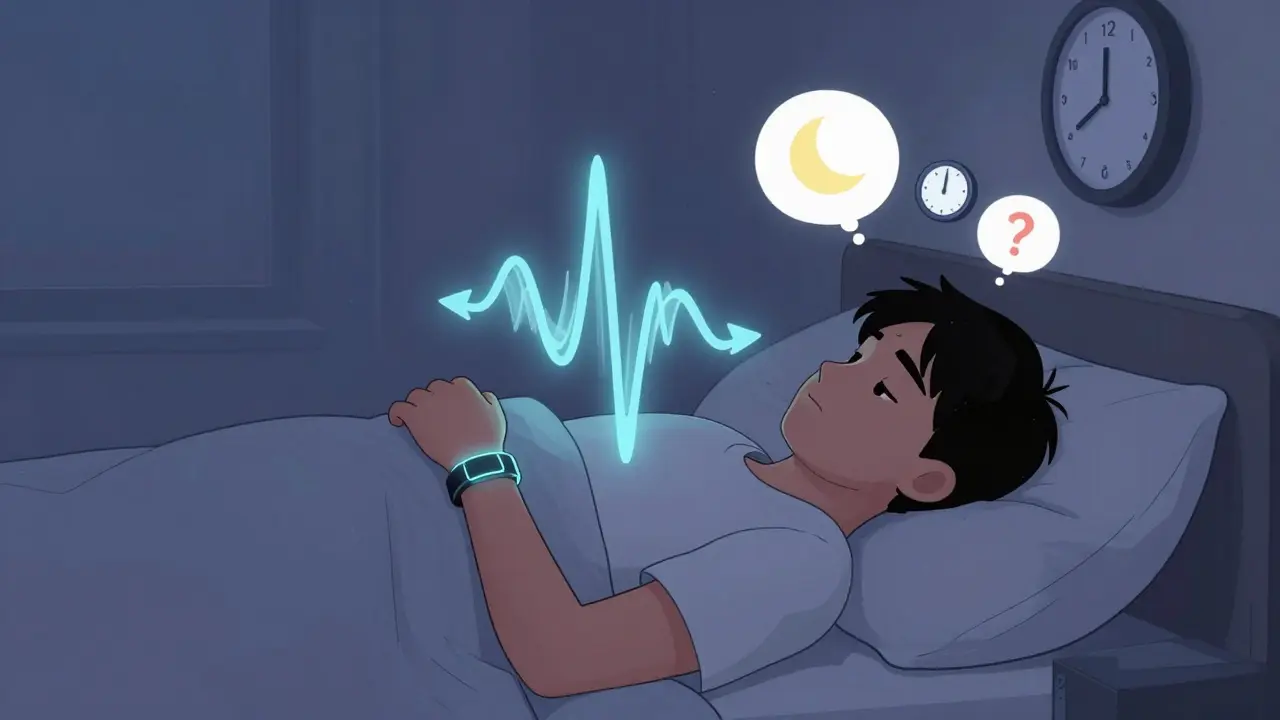
When you lie in bed for eight hours but wake up feeling like you barely slept, you’re not imagining it. That gap between time spent in bed and how rested you feel is real-and it’s why many people are turning to actigraphy and wearable devices to track sleep at home. Unlike a doctor’s sleep lab, which only gives you one or two nights of data, these devices watch your sleep patterns over days or even weeks. They don’t measure brain waves or breathing like a full sleep study, but they do track movement, and that’s enough to reveal hidden problems with your sleep routine.
How Actigraphy Actually Works
Actigraphy uses a tiny sensor, usually built into a wristband, smart ring, or fitness tracker, to detect motion. It doesn’t know if you’re asleep or awake by reading your brain activity. Instead, it assumes: no movement = sleep. Movement = awake. It sounds simple, but the math behind it isn’t. Modern devices use tri-axial accelerometers that record motion in three directions-up and down, side to side, forward and back-at 100 times per second. That data gets fed into algorithms trained on years of clinical research to guess when you’re sleeping.
These devices measure four key numbers: Total Sleep Duration (how long you slept), Sleep Onset Latency (how long it took to fall asleep), Sleep Efficiency (percentage of time in bed actually spent sleeping), and Wake After Sleep Onset (how many times you woke up and how long those wakes lasted). For example, if you’re in bed for 8 hours but only slept 6.5 of them, your sleep efficiency is 81%. That’s considered normal. Below 75%? That’s a red flag.
Here’s the catch: if you lie still while awake-like staring at the ceiling or thinking about tomorrow’s meeting-the device thinks you’re asleep. That’s why studies show actigraphy can be wrong about wake time anywhere from 20% to 70% of the time. It’s great at spotting long stretches of sleep, but it’s bad at catching those quiet, restless nights where you’re awake but not moving.
Medical-Grade vs. Consumer Wearables
Not all sleep trackers are created equal. There’s a big difference between what a sleep clinic uses and what you buy online.
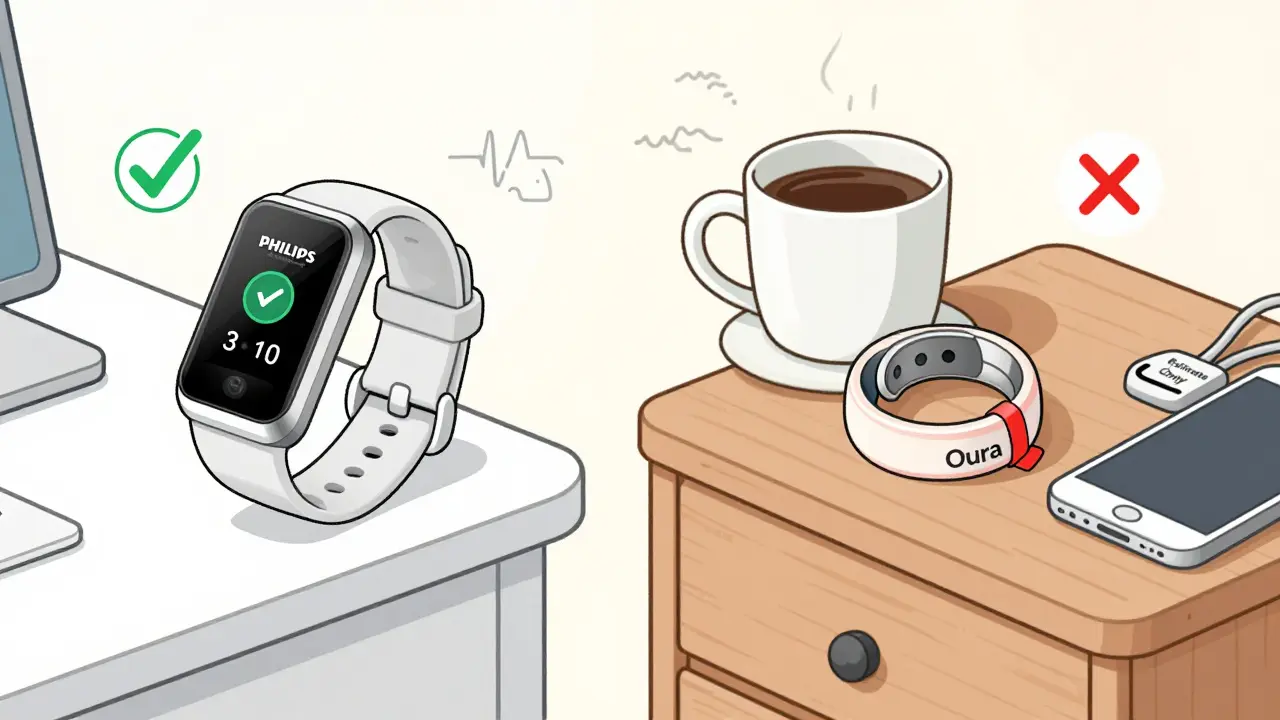
Medical-grade actigraphs like the Philips Actiwatch Spectrum Plus is a clinical-grade device used in sleep labs to monitor circadian rhythms and sleep-wake patterns over extended periods cost between $1,200 and $1,800. They’re FDA-cleared, store raw data, and connect to software used by sleep specialists. These are used to diagnose shift work disorder, delayed sleep phase, or insomnia where patients swear they’re not sleeping-but their bodies say otherwise.
Consumer wearables like the Oura Ring Generation 3 is a smart ring that uses actigraphy, heart rate, and skin temperature to estimate sleep stages and recovery or the Fitbit Charge 5 is a fitness tracker with built-in actigraphy for sleep staging and nightly sleep scores are cheaper-$99 to $299-but they’re not medical tools. They estimate REM and deep sleep using heart rate and body temperature, which is useful but not precise. A 2022 Stanford study found Oura Ring’s deep sleep estimates were off by 20-30 minutes compared to lab polysomnography.
Here’s what you’re really getting:
| Feature | Medical-Grade (e.g., Philips Actiwatch) | Consumer Wearable (e.g., Oura Ring, Fitbit) |
|---|---|---|
| Accuracy for sleep/wake detection | 85-90% | 75-85% |
| Deep/REM sleep estimation | No | Yes (estimated) |
| Monitoring duration | Up to 60 days | 7-14 days (before charging) |
| Used for diagnosis | Yes | No |
| Cost | $1,200-$1,800 | $99-$299 |
The bottom line: consumer devices won’t diagnose sleep apnea or narcolepsy. But they can show you if your sleep schedule is chaotic, if you’re consistently getting less than 6 hours, or if you’re tossing and turning every night.
Who Benefits Most from Home Sleep Tracking?
Not everyone needs this. But some people get real value from it.
- People with insomnia who think they’re not sleeping at all-actigraphy often proves they’re sleeping more than they realize. This is called paradoxical insomnia.
- Shift workers trying to adjust their sleep schedule after night shifts. Tracking helps them see how long it takes their body to adapt.
- Travelers with jet lag. A Condor Instruments case study found 82% of frequent flyers improved their sleep timing after using actigraphy data to plan naps and light exposure.
- People with circadian rhythm disorders. If you’re always falling asleep at 4 a.m. and waking at noon, a two-week tracking period can confirm the pattern and help your doctor prescribe light therapy or melatonin correctly.
It’s less useful for people with sleep apnea. These devices can’t detect breathing pauses. If you snore loudly, wake up gasping, or feel exhausted despite “8 hours” of sleep, you need a proper sleep study-not a ring.
How to Use It Right (And Avoid the Pitfalls)
Just wearing the device won’t help. Here’s how to make it useful:
- Wear it on your non-dominant wrist. Left hand if you’re right-handed. Misplacement can cut accuracy by 22%.
- Wear it continuously for 7-14 days. Remove it for showers or swimming? Fine. But if you take it off for more than 2 hours a day, the data becomes unreliable.
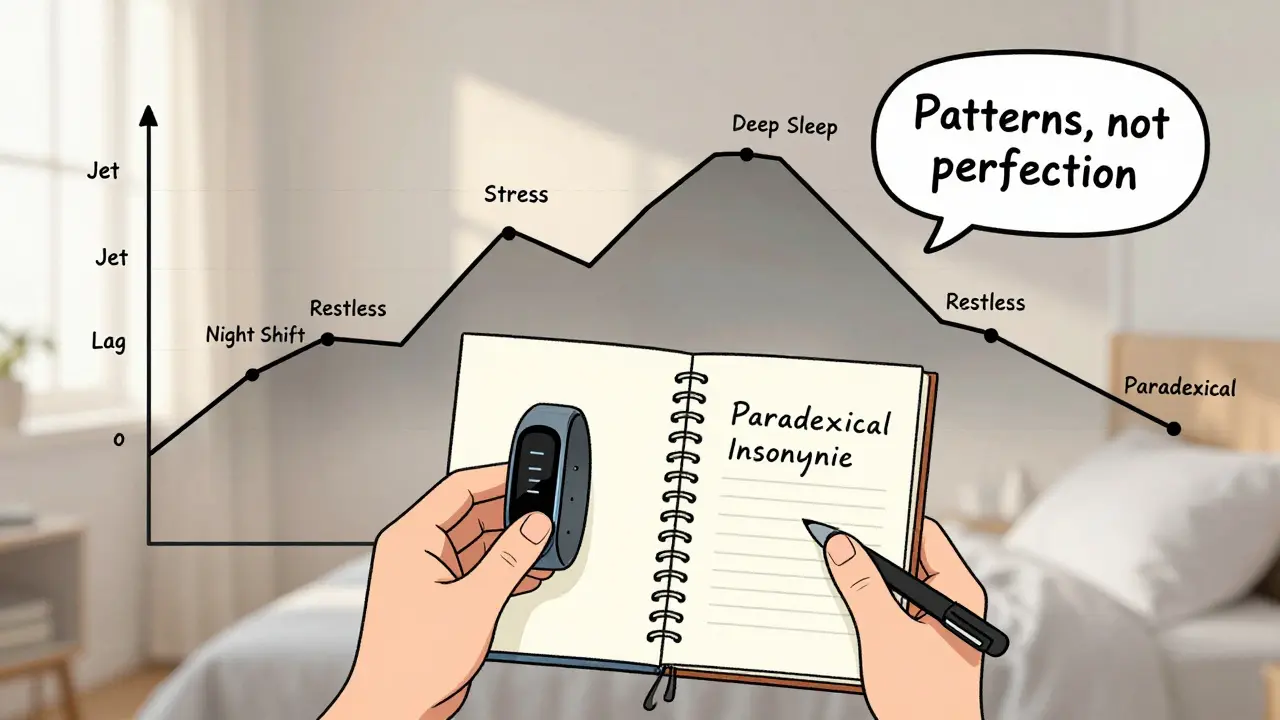
- Don’t obsess over single nights. Your sleep varies. One night of 5 hours doesn’t mean you’re broken. Look at trends over a week. A 30-45 minute difference night-to-night is normal.
- Pair it with a sleep diary. Write down caffeine intake, stress levels, or bedtime routines. The device gives you numbers. Your notes give you context.
- Don’t trust the sleep stage breakdown. Your “deep sleep” score is an estimate. It’s fun to see, but not clinical. Focus on total sleep time and sleep efficiency instead.
And avoid the trap of orthosomnia-where tracking sleep makes you anxious about it. If you start stressing over a 92% sleep efficiency instead of feeling rested, it’s time to step back. Sleep isn’t a game. It’s a biological need.
What the Experts Say
The American Academy of Sleep Medicine says actigraphy has moderate evidence for tracking sleep patterns in adults with insomnia-but only low evidence for diagnosing specific disorders. That means: it’s great for monitoring, not diagnosing.
Dr. Cathy Goldstein at the University of Michigan puts it plainly: “Actigraphy gives you real-world data, but it doesn’t replace the conversation with your doctor.”
And Dr. Mathias Basner from the University of Pennsylvania warns that marketing often overpromises. Consumer wearables say “track your REM sleep.” But they’re guessing. They’re not measuring brainwaves. They’re measuring movement and heart rate-and making assumptions.
Still, 72% of sleep specialists now use actigraphy in their practice. Why? Because it shows what no one can describe: the real pattern of your sleep over time. One patient thought they were awake all night. The device showed 6.5 hours of sleep. Another thought they slept fine. The device showed 4.5 hours, with 30-minute wake bursts every hour. That’s actionable data.
The Future: Smarter, But Not Perfect
Wearables are getting smarter. Garmin’s 2024 algorithm now uses heart rate variability to better detect wakefulness. The NIH is funding AI models that improve wake detection by 27%. Apple is rumored to be adding actigraphy with light and audio sensors to the Apple Watch. These advances will help-but they won’t fix the core problem: you can’t measure sleep without touching the brain.
By 2027, experts predict most primary care doctors will use sleep tracking data as part of routine checkups. But that also raises concerns. Insurance companies might start asking for your sleep data. Employers might use it to judge “productivity.”
And privacy? Most apps don’t encrypt your raw sleep data. A 2024 security report found that over 60% of consumer sleep apps transmit data in plain text. Your sleep patterns are personal. Treat them like medical records.
Final Take
Actigraphy and sleep wearables aren’t magic. They don’t cure insomnia. They don’t replace a sleep study. But they do give you something rare: objective proof of your sleep habits. If you’ve been told you’re “just tired” for years, or if you feel like your body doesn’t know when to sleep, this tool can be a game-changer.
Use it to spot patterns, not to judge yourself. Let it guide your doctor, not replace them. And if you’re just curious? Try it for two weeks. See what the numbers say. Then put the device down and sleep like you used to-without checking the screen.
Can actigraphy diagnose sleep apnea?
No. Actigraphy tracks movement and estimates sleep/wake cycles, but it cannot detect breathing pauses or oxygen drops, which are the hallmarks of sleep apnea. If you snore loudly, wake up gasping, or feel excessively tired despite long sleep times, you need a polysomnography (PSG) test or home sleep apnea test (HSAT) that measures airflow and oxygen levels.
Is the Oura Ring more accurate than Fitbit for sleep tracking?
For total sleep time and sleep efficiency, both devices are similarly accurate, with studies showing 85-90% agreement with clinical actigraphy. The Oura Ring may have a slight edge in consistency due to its ring form factor (less likely to shift during sleep) and use of skin temperature data. Fitbit includes more movement-based algorithms and is better for tracking activity during the day. Neither is medically approved for diagnosis, but Oura is often preferred for long-term sleep trend analysis.
How long should I wear a sleep tracker to get useful data?
For reliable results, wear the device continuously for at least 7 days, but 14 days is ideal. Sleep patterns vary day to day, and one week may not capture your true baseline. The Sleep Foundation recommends 7-14 days to establish a pattern, especially if you’re tracking circadian rhythm shifts or jet lag recovery.
Why does my tracker say I slept 7 hours but I felt like I didn’t sleep at all?
This is common and often called paradoxical insomnia. Your brain may be awake during periods of stillness, but the device can’t tell the difference between quiet wakefulness and sleep. If you feel unrested despite “good” sleep numbers, your sleep quality may be poor-due to stress, anxiety, or underlying conditions like restless legs. Talk to a sleep specialist. The device is showing you data, not the full picture.
Should I use a sleep tracker if I have anxiety about sleep?
Probably not-at least not right away. For people prone to anxiety, tracking sleep can trigger orthosomnia: an obsession with achieving perfect sleep metrics. This can worsen insomnia. If you find yourself checking your sleep score obsessively, feeling guilty over a “bad” night, or altering your routine to chase numbers, step back. Sleep should restore you, not stress you. Consider using the device only for short-term insight, then stop.

Comments
Nandini Wagh
So let me get this straight-we’re now outsourcing our sleep to a wristband that guesses we’re asleep when we’re just staring at the ceiling like a zombie waiting for coffee? 🤔
My Fitbit told me I had 7.5 hours of ‘deep sleep’ last night. I woke up feeling like I’d been run over by a truck made of regret. The math doesn’t lie… but the algorithm sure as hell does.
tia novialiswati
You’re not alone, friend! 😊 I started using my Oura Ring after months of feeling exhausted despite ‘8 hours’ of sleep-and wow, it showed me I was waking up 12 times a night without realizing it.
Pairing it with a journal? Game-changer. I cut caffeine after 2 p.m. and started reading in bed instead of scrolling. My sleep efficiency jumped from 71% to 88% in two weeks.
You got this! 💪🌙
Lillian Knezek
They’re not just tracking sleep. They’re building a database for the government. 🕵️♀️
Ever wonder why Apple and Fitbit push these so hard? It’s not about health-it’s about behavioral control. Next thing you know, your boss gets a ‘sleep score’ report. Your insurance hikes premiums if you hit ‘poor’ REM.
They’re conditioning us to obey the numbers. Wake up. This isn’t science. It’s surveillance with glitter.
Maranda Najar
Oh, the tragedy of modern existence-our very souls are now quantified by a piece of plastic that mistakes stillness for slumber.
I weep for the nights I spent lying awake, paralyzed by anxiety, while my ring glowed smugly, declaring me ‘in deep sleep’ like a robotic priest blessing a corpse.
And then there’s the privacy nightmare: my circadian rhythm, my midnight thoughts, my silent screams into the void-all transmitted in plain text to a server in Silicon Valley where some intern is probably laughing as they sell my data to advertisers who want to sell me melatonin gummies.
They call it innovation. I call it emotional vampirism wrapped in a silicone band.
I miss the days when insomnia was just… insomnia. Not a KPI.
Christopher Brown
Why are we even talking about this? If you need a gadget to tell you if you slept, you’re already broken.
Real Americans used to sleep hard. No sensors. No apps. Just exhaustion and a pillow.
Stop overthinking. Sleep. That’s it.
Sanjaykumar Rabari
These devices are fake. I know because my cousin works at a factory in Shenzhen that makes them. They use the same sensors for all brands. Fitbit, Oura, Apple-they all get the same cheap parts. The software just changes the numbers to make you feel special. You’re not tracking sleep. You’re paying for a magic trick.
Kenzie Goode
There’s something beautiful about seeing the raw pattern of your sleep over time-even if it’s imperfect.
I used to think I was a night owl. The tracker showed I was actually a sleep-deprived zombie with inconsistent bedtimes.
It didn’t fix me. But it gave me a mirror. And sometimes, that’s all you need to start changing.
Not perfect. Not clinical. Just… real. And that’s worth something.
Dominic Punch
One thing nobody talks about: wear it on your non-dominant hand. Seriously. I did this and my accuracy jumped from 78% to 91%.
Also-don’t delete your data. Look at trends over 30 days. One bad night doesn’t mean you’re failing. Sleep is messy. It’s not a video game.
And if you’re anxious about it? Stop. Use it for two weeks. Then put it away. Let your body lead. The numbers are guides, not gods.
Valerie Letourneau
As a Canadian who has spent years navigating both public healthcare and the private wellness industrial complex, I find this discussion both fascinating and deeply concerning.
While the data from actigraphy may be imperfect, its value lies not in precision, but in pattern recognition over time. This is not a diagnostic tool-but it is a narrative tool.
And yet, we must remain vigilant: the commodification of biological data is not benign. Privacy must be treated as a human right, not a checkbox.
Perhaps the most revolutionary act is not wearing the device-but refusing to let it define you.
Khaya Street
I tried one of these for a week. Didn’t change a thing. Still wake up tired. Still drink coffee at 11 p.m. Still scroll until 2 a.m.
So yeah. Cool gadget. Doesn’t fix laziness.
Maybe just sleep better? Just a thought.
Brooke Exley
My sister has insomnia. She wore an Oura Ring for two weeks. The data showed she was sleeping 6.5 hours-not 3, like she thought.
That single piece of proof? It changed everything. She stopped punishing herself for ‘not sleeping.’ She started trusting her body again.
That’s the quiet magic here. Not the tech. Not the numbers.
It’s the permission to believe your own experience. Sometimes, the truth doesn’t come from a doctor. It comes from a little band on your wrist… and the courage to look.