
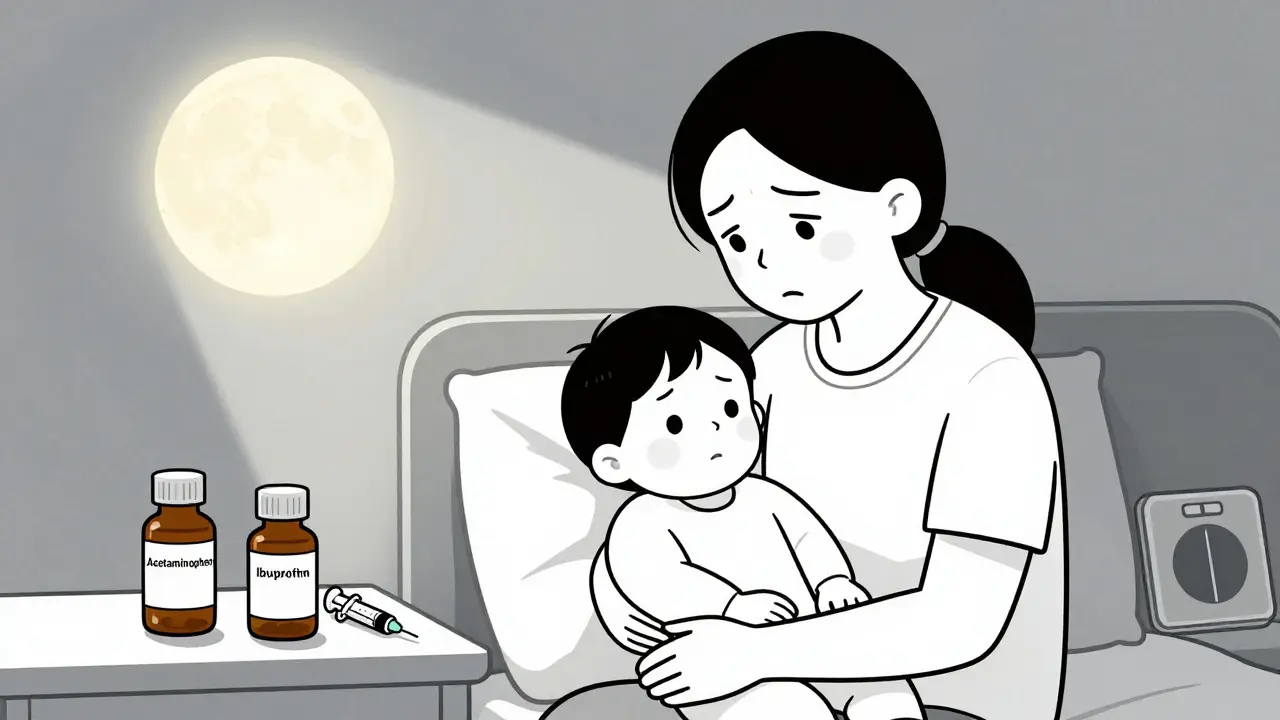
When your child has a fever, you want relief-fast and safe.
It’s 2 a.m. Your toddler is burning up, crying, and won’t settle. You grab the medicine cabinet, but now you’re stuck: acetaminophen or ibuprofen? Which one works better? Which is safer? And why does your pediatrician keep asking for your child’s weight instead of their age?
The truth is, both medications are commonly used, widely available, and generally safe when used correctly. But mixing them up, guessing doses, or using the wrong product can lead to serious harm. This isn’t about choosing between two pills-it’s about understanding how they work, when to use each, and how to avoid the most common mistakes parents make.
What’s the difference between acetaminophen and ibuprofen?
Acetaminophen (also called paracetamol) and ibuprofen are both fever reducers and pain relievers, but they work differently in the body.
Acetaminophen reduces fever and eases pain by acting on the brain’s temperature control center. It doesn’t fight inflammation. That’s why it’s often chosen for teething pain or mild headaches.
Ibuprofen, on the other hand, is an NSAID. It lowers fever and pain by blocking chemicals that cause inflammation. That makes it more effective for swelling, ear infections, or sore muscles. It also lasts longer-up to 8 hours versus 4-6 hours for acetaminophen.
Here’s what the data shows: In studies of children under two, ibuprofen brought down fevers faster and kept them down longer. One 2021 review of 85 studies found kids were 1.8 times more likely to be fever-free at four hours after taking ibuprofen than acetaminophen. That’s not a small difference-it’s the difference between a restless night and a few hours of sleep.
Age limits: When can you give each medicine?
Age matters more than you think.
The American Academy of Pediatrics (AAP) says: Don’t give acetaminophen to babies under 3 months unless a doctor tells you to. Why? Their livers are still learning how to process medications. A small mistake in dosing can overload their system.
For ibuprofen, the cutoff is 6 months. Infants under that age have kidneys that aren’t fully developed. Ibuprofen can reduce blood flow to the kidneys, raising the risk of injury-especially if they’re dehydrated from fever or vomiting.
That doesn’t mean you’re stuck. If your 2-month-old has a fever, call your pediatrician. Don’t wait. Fevers in young babies can signal serious infections. Never guess. Never wing it.
Dosing: Weight, not age, is the key
Here’s the biggest mistake parents make: dosing by age.
According to a 2021 audit from a major children’s hospital, 68% of dosing errors in kids under two happened because caregivers used the age-based chart on the bottle instead of the child’s actual weight.
Acetaminophen: 7-15 mg per kilogram of body weight, every 4-6 hours. Max: 75 mg/kg per day.
Ibuprofen: 4-10 mg per kilogram, every 6-8 hours. Max: 40 mg/kg per day.
Example: A 10-pound baby weighs about 4.5 kg. That means:
- Acetaminophen: 32-68 mg per dose (about 1.25-2.5 mL of 160 mg/5 mL concentration)
- Ibuprofen: 18-45 mg per dose (about 0.75-1.875 mL of 50 mg/mL concentration)
Always use the syringe or dosing cup that comes with the medicine. Never use a kitchen spoon. Those are wildly inaccurate. And never use adult formulas. They’re five to ten times stronger. In 2022, 17% of pediatric poisoning cases came from accidental ingestion of adult pain relievers.

Safety: What are the real risks?
Both medicines are safe when used right. But both can hurt if used wrong.
Acetaminophen overdose is the leading cause of acute liver failure in children in the U.S. It doesn’t happen from one mistake-it happens from repeated small mistakes. Giving it every 4 hours for 3 days straight? Adding it to a cold medicine that already contains it? That’s how it happens.
One 2021 study found that 29% of acetaminophen-related liver injuries in kids under six came from combination cold and flu products. Always check the ingredient list. If it says “acetaminophen,” “APAP,” or “paracetamol,” you’re doubling up.
Ibuprofen’s biggest risk is kidney stress. It’s rare, but it can happen if the child is dehydrated, has the flu, or has been vomiting. Watch for signs: dry mouth, no wet diaper in 8 hours, lethargy. If you see those, stop the medicine and call your doctor.
There’s also emerging research about acetaminophen and asthma. A 2022 meta-analysis found kids exposed to acetaminophen in their first year had a 1.6 times higher risk of developing asthma by age 6. It’s not proof it causes asthma-but it’s enough to make some pediatricians think twice before reaching for it for every little fever.
Alternating or combining? Don’t do it without a plan.
You’ve probably heard: “Alternate acetaminophen and ibuprofen to keep the fever down.”
It sounds smart. But it’s risky.
A 2023 AAP study found alternating did bring down fever faster-but only if parents kept perfect records. In real life? 63% of parents who tried it ended up giving both meds too close together, or too much of one. That’s how overdoses happen.
Unless your doctor gives you a written schedule, don’t alternate. If one medicine isn’t working after 4-6 hours, wait. Try a sponge bath. Offer fluids. Call your pediatrician. Don’t reach for the second bottle.
What about brand names vs. generics?
Children’s Tylenol and Children’s Motrin are the big names. But generics are just as safe and cost 60-70% less.
The active ingredient is the same. The flavoring? Slightly different. The dosing device? Often better in generics because manufacturers learned from past mistakes.
In 2011, the FDA required all liquid acetaminophen for kids to be standardized to 160 mg per 5 mL. Before that, some bottles had 80 mg per 0.8 mL. Parents mixed them up. Kids got overdosed. The change cut dosing errors by 43%.
Today, both brand and generic products must include a calibrated dosing device. Always use it. Always check the concentration. Always write down the time and dose.
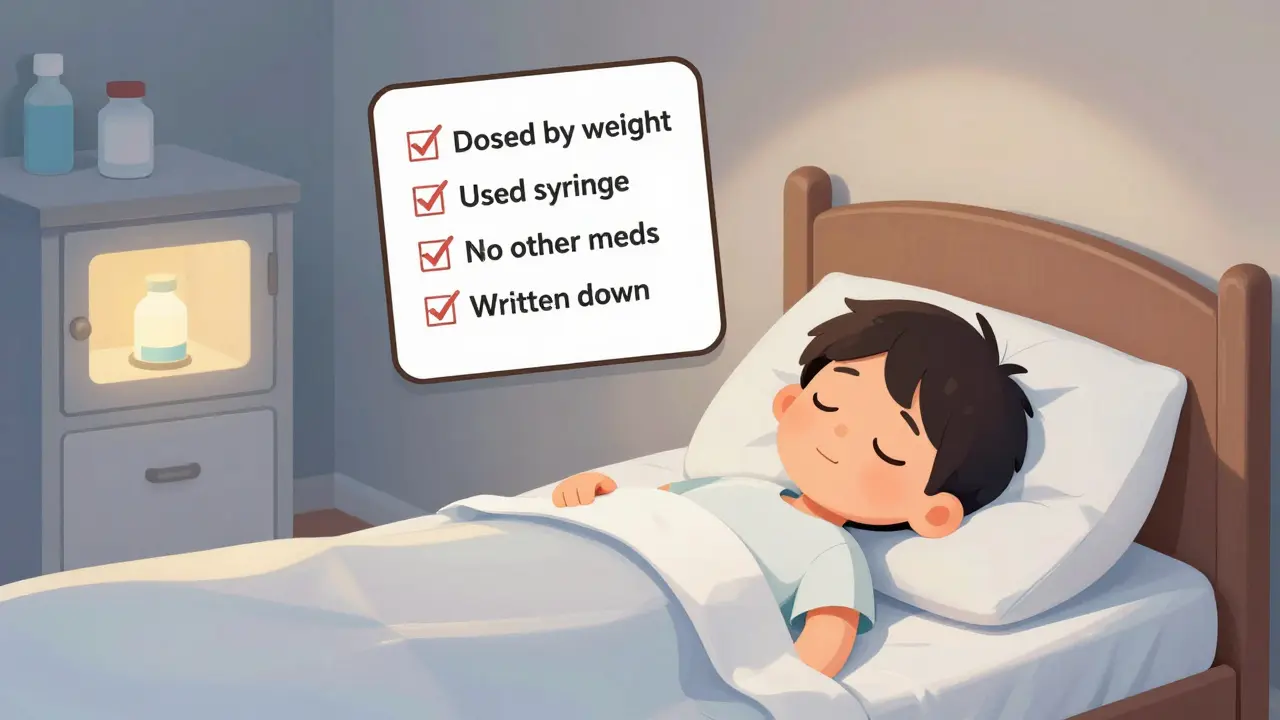
How to give medicine safely
- Use the syringe or cup that came with the bottle. Not a spoon. Not a medicine dropper.
- Hold your child upright. Never lay them flat when giving liquid medicine.
- Give the full dose. Don’t stop if they spit some out. If they vomit within 15 minutes, call your doctor before giving more.
- Keep medicines locked up. Kids can open bottles. One 2022 report found 32% of accidental ingestions happened in homes where medicine was left on counters.
- Write down each dose in a notebook or phone app. Include time, medicine, dose, and reason.
Many parents say they feel more confident after two or three visits to the pediatrician where they practiced dosing with a nurse. Don’t be afraid to ask for a demo. It’s part of the job.
When to call the doctor
Medicine helps. But it doesn’t fix the cause.
Call your pediatrician if:
- Your baby is under 3 months and has a fever of 100.4°F or higher
- Your child won’t drink, hasn’t peed in 8 hours, or is unusually sleepy
- The fever lasts more than 72 hours
- The fever goes away but comes back after 24 hours
- Your child has a rash, stiff neck, trouble breathing, or seizures
Fevers are the body’s way of fighting infection. The goal isn’t to get rid of the fever-it’s to make your child comfortable enough to rest and drink. If they’re playing, drinking, and responding to you, that’s a good sign-even if their temperature is still 102°F.
What’s changing in 2025?
The AAP is updating its fever guidelines in January 2025. They’re reviewing new data on acetaminophen and asthma, ibuprofen use in babies under 6 months, and long-term safety.
Right now, the evidence is clear: ibuprofen is more effective for fever. Acetaminophen is gentler on the stomach. But safety isn’t about which one is “better.” It’s about using the right one, at the right dose, at the right time.
As one pediatric pharmacist put it: “The medicine isn’t dangerous. The mistake is.”
Bottom line
For kids over 6 months with fever or pain, ibuprofen works faster and lasts longer. For kids 3-6 months, acetaminophen is the safer first choice. For babies under 3 months, call your doctor-don’t give medicine.
Always dose by weight. Always use the right tool. Never mix with other meds. And never assume because it’s over-the-counter, it’s risk-free.
Most parents want to do the right thing. The science is clear. Now you know how to use it right.

Comments
Ken Porter
This is the most accurate, no-nonsense guide I've seen. Dose by weight. Not age. Use the syringe. Not a spoon. Stop guessing. Stop risking your kid's liver. Period.
Molly Silvernale
I love how this article doesn’t just say ‘give medicine’-it asks us to sit with the discomfort of watching our child suffer… and still choose patience over panic. Acetaminophen isn’t evil-it’s just a tool. And like any tool, misuse turns it into a weapon. The real villain? The myth that ‘more is better.’
Manish Kumar
You know what's funny? In India, we don't even have these debates-parents just use paracetamol because it's cheap and available everywhere. But I've seen kids get sick because moms gave it every 3 hours thinking it'd work faster. The science here is solid-weight matters, timing matters, and sometimes, the best medicine is just water and cuddles. We forget that. We're too busy chasing fever numbers instead of watching our kids breathe.
Donny Airlangga
I read this at 3 a.m. with my 14-month-old feverish in my arms. I was about to grab the ibuprofen-then I remembered he’s 11 lbs, not 12. I double-checked the syringe. I wrote down the time. I didn’t give it until 6 hours later. He slept. I cried. Thank you for writing this. Not everyone gets how terrifying this is.
Lois Li
I wish this had been around when my daughter was a baby. I mixed up the concentrations once-thank god I caught it before giving it. Now I keep a printed chart taped to the fridge. I also write every dose in my phone calendar with a little note: 'why I gave it.' It helps me stay calm. And I always, always use the syringe. No excuses.
christy lianto
I'm sick of people saying 'it's just a fever.' It's not. It's your child's body screaming for help. And if you're giving medicine like it's candy, you're not being a good parent-you're being reckless. This guide is a lifeline. Print it. Laminate it. Hang it next to the medicine cabinet.
swati Thounaojam
In India, we use paracetamol drops. No syringe. Just the dropper. I know it’s not accurate but we don’t have choice. Still, I always check weight. Always. This article made me feel less alone.
Annette Robinson
I’m a pediatric nurse. I’ve seen the ER after parents give adult Tylenol ‘because it’s all I had.’ I’ve seen liver failure in 18-month-olds. This guide? It’s not just advice-it’s prevention. Share it. Save a life.
Prakash Sharma
Why do Americans make everything so complicated? In my country, we just give paracetamol and wait. No charts. No syringes. No overthinking. You want to know what’s dangerous? Over-medicalizing normal childhood illness.
Kristina Felixita
I’m Indian-American and I’ve had to explain to my mom that ‘1 tsp’ isn’t the same as ‘1 mL.’ She used to use a soup spoon. I now keep a labeled dosing cup next to the medicine. I also tell her: ‘If the bottle says 160mg/5mL, that’s it. No more, no less.’ She still calls me obsessive. I call it survival.
Joanna Brancewicz
The 2022 meta-analysis on acetaminophen and asthma is under-discussed. We’re seeing a rise in early-onset wheezing in kids with recurrent febrile episodes. The mechanism isn’t fully understood, but the correlation is statistically significant. Caution warranted.
Evan Smith
So… we’re supposed to be scientists now? Dose by weight? Write it down? Use the syringe? What’s next? Do a blood test before giving a baby Tylenol? Chill. Most kids are fine. But hey, if you wanna be a fever ninja… go for it.