
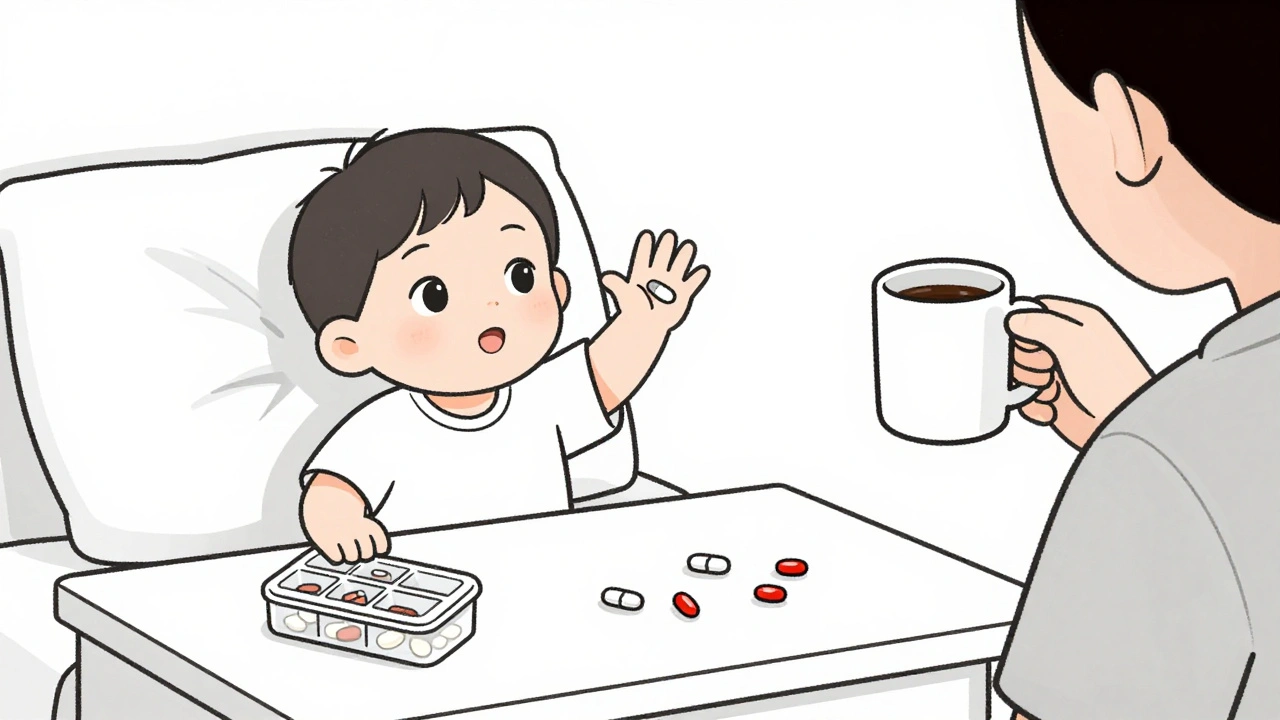
Every year, medication sends tens of thousands of young children to the emergency room-not because they were prescribed too much, but because they found it on their own. In the U.S. alone, about 60,000 kids under five are treated annually for accidental medicine poisoning. That’s not a rare accident. It’s a preventable crisis. And it’s happening right in homes where parents think they’ve done enough.
Here’s the hard truth: child-resistant caps aren’t childproof. A nightstand within reach? A purse on the couch? A pill organizer left on the counter? Those aren’t safe. They’re invitations. And kids are curious, fast, and smarter than we give them credit for.
Where Kids Find Medicine (And How to Stop It)
Most parents assume the medicine cabinet is the biggest risk. It’s not. According to safety data, 78% of incidents happen because medicine was left on nightstands, dressers, or bedside tables. That’s where adults keep their nightly pills-convenient, but deadly for toddlers who can climb, pull, and grab.
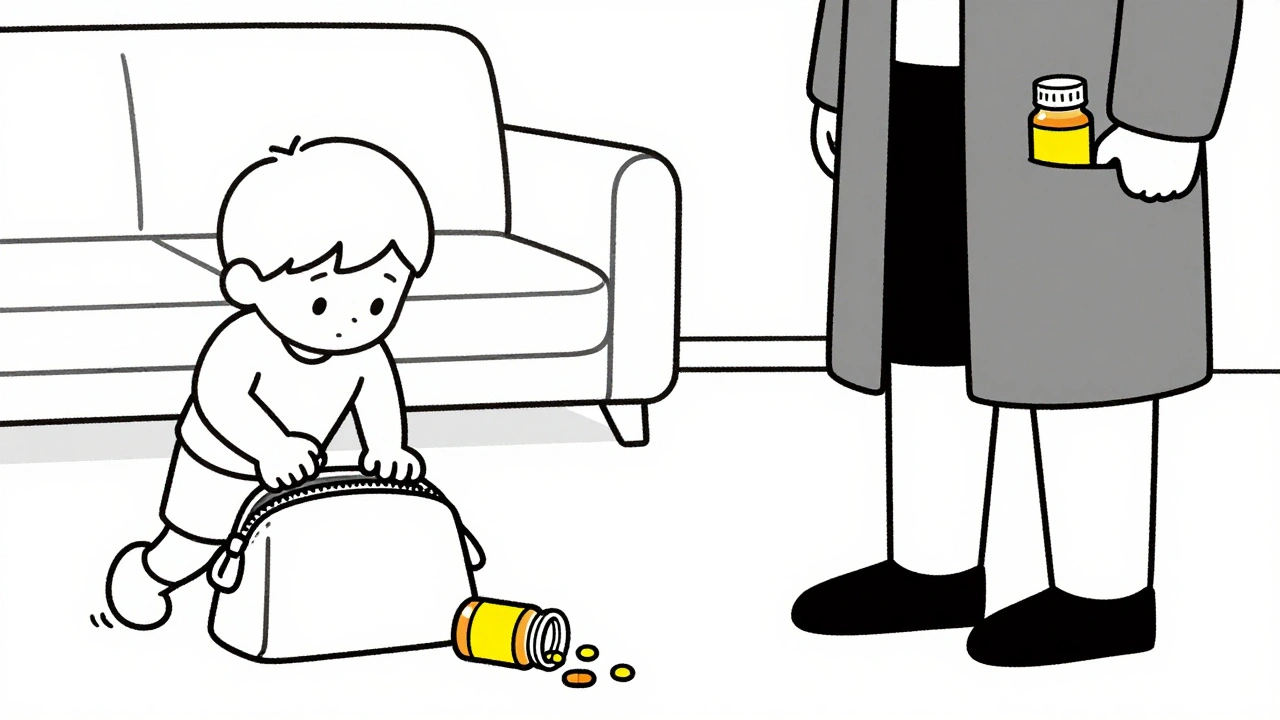
Then there’s the purse. Or the diaper bag. Or the coat pocket. In 15% of cases, kids got into medicine from a bag left on the floor. Visitors don’t think twice about hanging their purse on a hook near the front door. But that’s where your 2-year-old sees it-and pulls out a bottle of painkillers or grandma’s blood pressure pills.
Even the kitchen is dangerous. Twelve percent of poisonings happen because medicine was left on the counter while preparing a dose. And 7% occur when pills fall during administration. One slip. One moment of distraction. That’s all it takes.
Don’t forget under the bed. Five percent of incidents come from meds rolled under there after being dropped. Kids crawl. They explore. They find things you didn’t even know were missing.
Storage That Actually Works
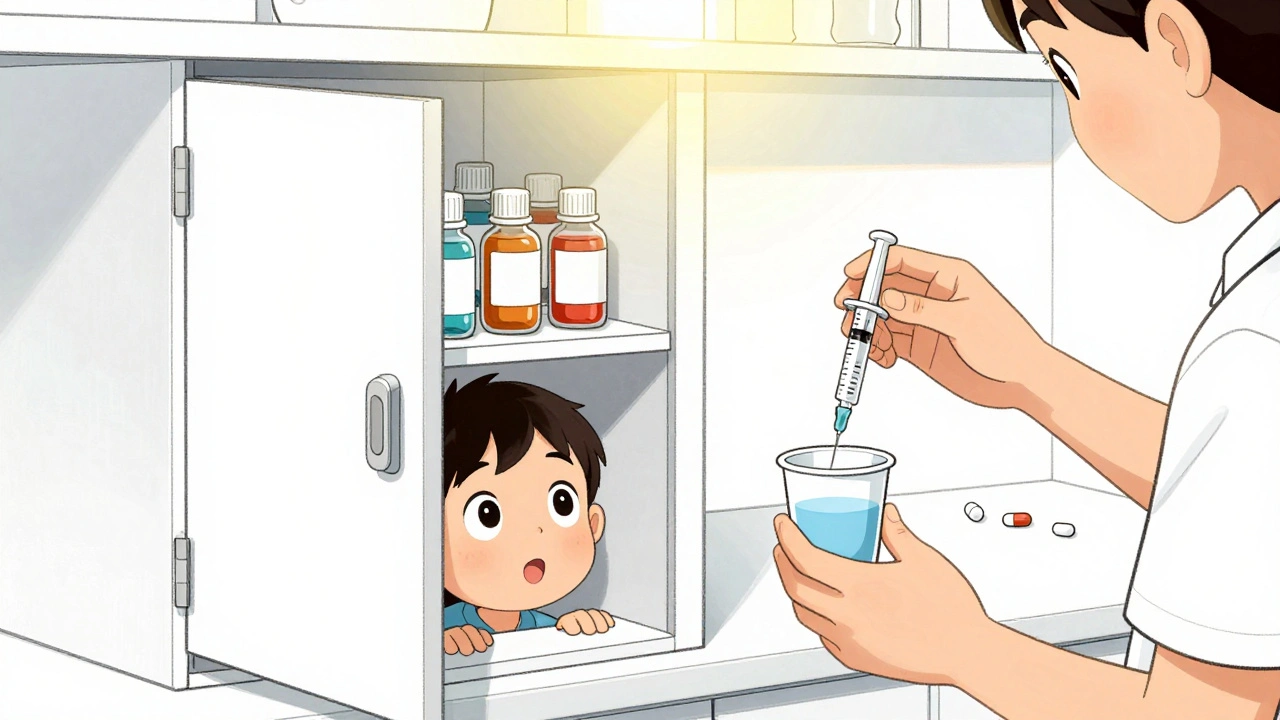
Forget the bathroom cabinet. It’s too low. Too humid. Too easy to reach. The CDC and Safe Kids Worldwide agree: medicine must be stored up and away and out of sight.
Best spot? The top shelf of a linen closet-high, dry, and out of the way. That’s where 45% of families who’ve successfully childproofed keep their meds. Next best? High kitchen cabinets with a lock. Locks aren’t optional. Safety latches alone only block 35% of kids. Locked cabinets? They stop 89%.
Consider a dedicated medication safe. Sales of these have grown 32% year over year. They’re not expensive. They’re simple. And they’re the only way to guarantee no one-kids, guests, even older siblings-can get to your pills.
And here’s a trick: if you use a pill organizer, only take out what you need for the day. Don’t leave the whole week’s supply sitting on the counter. That’s a magnet for little hands.
Child-Resistant Caps? Not Enough
Yes, your bottles have child-resistant caps. But here’s what no one tells you: they’re designed to slow down a child-not stop them. In a JAMA study, properly secured child-resistant caps reduced access by half compared to regular caps. But 50% is still too high.
And here’s the kicker: if you don’t tighten the cap after every use, it’s useless. One study found that 68% of poisonings happened because the cap was left loose after a dose. You’re in a rush. You’re tired. You think, “I’ll just put it back.” But that’s the moment your child gets to it.
So make a rule: after every single use-even if you need it again in an hour-put the cap on tight. Lock it away. No exceptions.
Guests, Visitors, and the Hidden Danger
You childproofed your home. But what about your sister? Your neighbor? The babysitter? They bring their own meds. And they don’t think twice about leaving their pill bottle in their purse on the couch.
28% of poisoning incidents involve medicine from visitors. That’s nearly one in three. So when someone comes over, don’t just say, “Make yourself at home.” Say, “Let me help you with your coat and bag.” Offer to put it in a locked cabinet or a high drawer. Make it normal. Make it part of your routine.
And if you’re visiting someone else’s house? Don’t assume they’ve childproofed. Bring your own meds in a small, locked container. Or ask to store them somewhere safe. It’s not rude. It’s responsible.
Dosing Mistakes Are Just as Dangerous
It’s not just about access. It’s about accuracy. One of the most common errors? Using a kitchen spoon.
Studies show kitchen teaspoons vary from 2.5mL to 7.3mL. That’s a 250% difference. If you’re giving your child 5mL of acetaminophen with a spoon that holds 7mL, you’ve just overdosed them. And that’s not rare-it happens all the time.
Always use the dosing tool that came with the medicine: a syringe, a cup, or a dropper. And make sure it’s marked in milliliters (mL) only. No teaspoons, no tablespoons. No conversions. Just mL.
Also, never assume all versions of the same medicine are the same. Infant ibuprofen and adult ibuprofen can differ by 300-400% in strength. Read the label every time. Even if you’ve given it before. Even if it’s the same brand.
And if someone else is giving the medicine-like a grandparent or babysitter-write down the instructions clearly: what medicine, how much, when, and why. Keep it simple. “Give 5mL of Children’s Tylenol every 6 hours if fever is over 38.5°C.”
Never Call Medicine “Candy”
This one is surprising-but deadly. Parents sometimes say, “This medicine tastes like candy,” or “Here’s your candy to help you feel better.”
That’s a 40% higher risk of accidental ingestion, according to HealthyChildren.org. Kids don’t know the difference between “medicine that tastes sweet” and “candy.” They learn fast. And if they think it’s a treat, they’ll go looking for it.
Teach them the truth from age two: “Medicine is not candy. It’s for helping when you’re sick. Only grown-ups know how to give it safely.” Simple. Clear. Repeated often.
Studies show kids who hear this message regularly by age three recognize medicine as dangerous by age five-65% better than those who don’t.
Dispose of What You Don’t Need
Unused medicine is a ticking time bomb. The CDC says 22% of households keep leftover opioids long after they’re needed. That’s a huge risk.
Don’t flush it. Don’t throw it in the trash loose. Don’t leave it in an old bottle on the shelf.
Here’s what to do: take unused pills, crush them, mix them with something unappetizing-used coffee grounds, kitty litter, or dirt. Put it all in a sealed plastic bag. Rip off the label or black out your name. Then toss it in the trash.
This method is 95% effective at preventing access during disposal. If your town has a take-back program, use it. But if you’re in a rural area and there isn’t one? This method is your best-and safest-option.
And if you’re cleaning out a medicine cabinet? Do it every few months. Get rid of anything expired, any pills you didn’t finish, any old prescriptions.
Weekly Safety Sweeps
Childproofing isn’t a one-time job. It’s a habit.
Set a reminder: every Sunday, do a 5-minute safety sweep. Check every room. Look under beds, behind couches, inside drawers, on nightstands. Look for dropped pills, open bottles, forgotten bags.
It takes five minutes. But it stops accidents before they happen.
And if you have more than one child? Make it a team effort. Teach your older kids to help. “Can you check the top shelf for me?” It builds awareness. It builds responsibility. And it keeps everyone safer.
What You Can Do Today
You don’t need to buy a safe. You don’t need to rearrange your whole house. Start here:
- Find every medicine in your home-prescription, OTC, vitamins, supplements, even cough syrup.
- Put them all in one place. A locked cabinet, a high closet shelf, a medicine safe.
- Throw away anything expired or unused, using the coffee grounds method.
- Buy a dosing syringe if you don’t have one. Use it every time.
- Start saying, “Medicine is not candy,” out loud, every time you give it.
- Next time a guest comes over, offer to store their bag.
- Set a weekly reminder to check for dropped pills.
These aren’t big changes. But they’re the ones that save lives.
Medication poisoning doesn’t happen because parents are careless. It happens because we assume our kids won’t find it. But they will. And the only way to stop it is to make sure they can’t.

Comments
dylan dowsett
Let me just say this: if you’re not locking your meds, you’re literally gambling with your child’s life. I’ve seen it happen. A neighbor’s kid got into OTC ibuprofen because Mom ‘just left it on the counter for a sec.’ Secs don’t save lives. Locks do. Stop being lazy. Your kid isn’t a mind-reader-they’re a tiny, determined ninja with opposable thumbs.
Susan Haboustak
You say ‘child-resistant caps aren’t childproof’-but you don’t mention that most of these caps are designed for 5-year-olds, not 2-year-olds who’ve mastered climbing and have the persistence of a raccoon. Also, why is the CDC only cited for storage but not for the fact that 70% of poisonings occur in homes where caregivers don’t even know the difference between mL and tsp? You’re missing the root problem: education. Not just storage. Training. Accountability.
Chad Kennedy
Ugh. I get it. Lock your pills. Don’t call it candy. But honestly? Most parents are just tired. They’re working two jobs, raising kids, and barely sleeping. You’re telling them to buy a safe, do weekly sweeps, and re-label every bottle? That’s not practical. It’s guilt-tripping. I get it’s important-but don’t act like we’re all neglectful monsters because we didn’t install a vault in the closet.
Siddharth Notani
Excellent and meticulously researched article. 🙏 I would like to add that in India, many households store medicines in open drawers near children’s play areas due to cultural norms around accessibility. A simple, low-cost solution is to use child-lock boxes made of hard plastic, available at local pharmacies for under $5. Also, using a pill organizer with separate compartments for morning/evening and locking it after use reduces risk significantly. Safety is not a privilege-it’s a practice. Thank you for raising awareness. 🌍❤️
Cyndy Gregoria
YES. This is exactly the kind of info we need. No fluff. No guilt. Just clear, doable steps. I started doing the Sunday 5-minute sweep after my niece nearly swallowed my vitamins. It’s changed everything. I even made a checklist and taped it to the fridge. My kids help now-they’re 4 and 6. They say, ‘Mom, check the top shelf!’ It’s not scary. It’s just part of our routine. You got this. Start small. One step. One day. One lock. You’re already doing better than most.
Akash Sharma
Interesting perspective, but I wonder if the data on pill organizers being left on counters is conflated with cultural habits around medication use. In many households, especially in multigenerational homes, the pill organizer is a shared, visible object-not because of negligence, but because it’s a tool for coordination among caregivers. Perhaps the real issue isn’t location but communication: who knows what’s in the organizer, who’s supposed to take it, and when? A locked cabinet doesn’t solve the problem if Grandma doesn’t know the schedule. Maybe the solution is a digital tracker with alerts, synced to family members, rather than just physical storage? Also, I’ve seen cases where locked cabinets became inaccessible during emergencies-like if a child needs immediate dosing and the parent can’t find the key. Is there a balance between safety and accessibility?
Palanivelu Sivanathan
Bro. This isn’t about medicine. This is about control. We’re being told to turn our homes into Fort Knox because kids are ‘curious’? Newsflash: kids are supposed to be curious. That’s how they learn. You want to lock everything? Then don’t be mad when they grow up terrified of the world. This is fear-mongering dressed up as safety. What about the emotional cost of raising kids in a fortress? Where’s the trust? Where’s the freedom? I’m not saying don’t be careful-but don’t turn parenting into a survival horror game.
Joanne Rencher
Of course you’re not supposed to leave meds on the counter. DUH. But why is this even an article? Like, did someone just wake up and realize toddlers are sneaky? I’ve been a mom for 12 years. I’ve never once left a bottle out. I’ve also never read a parenting article that didn’t make me feel like a terrible person. Thanks for the condescension. 🙄
Cristy Magdalena
Medicine is not candy.