
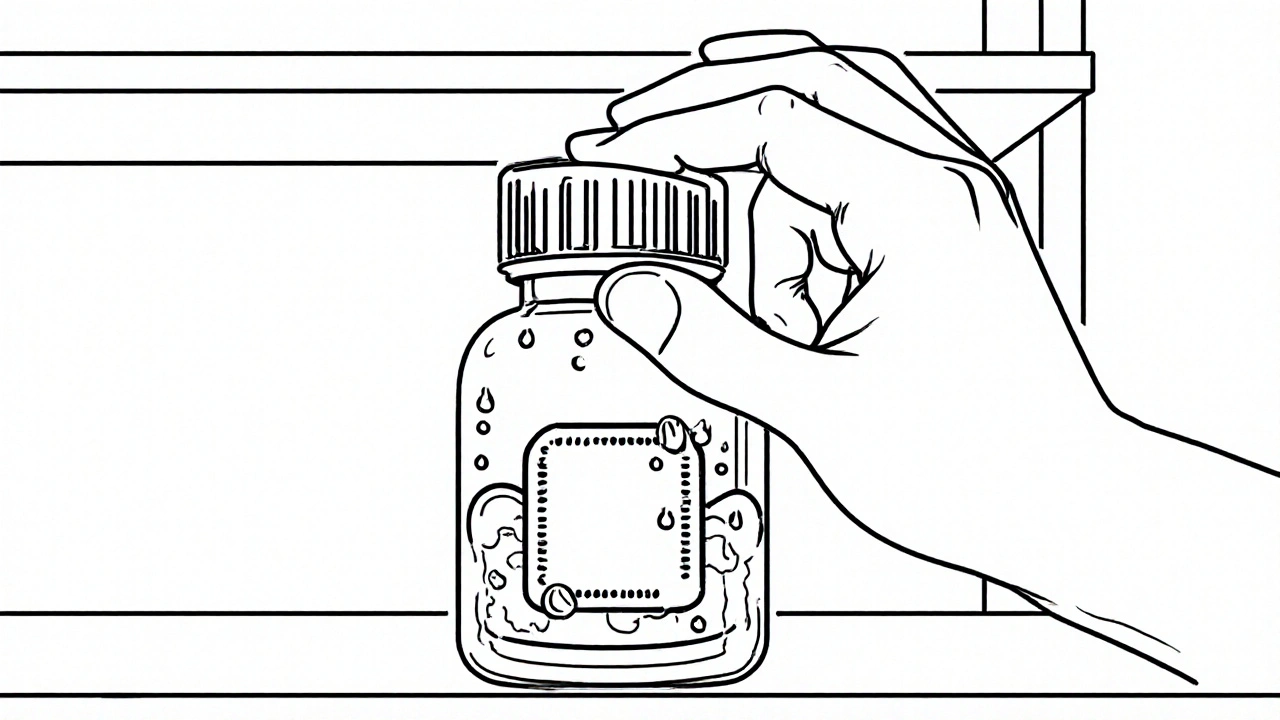
Moisture doesn’t just ruin your phone or your books-it can wreck your pills and capsules too. If you’ve ever opened a bottle of medicine and found tablets stuck together, discolored, or smelling odd, you’ve seen moisture damage in action. It’s not just a cosmetic issue. Moisture breaks down active ingredients, making your meds less effective-or worse, unsafe. In humid climates like Melbourne, where humidity regularly hits 70% or more, this isn’t rare. It’s a real risk.
Why Moisture Destroys Pills and Capsules
Water doesn’t just make pills soggy. It triggers chemical reactions called hydrolysis and oxidation. These reactions break down the active ingredients in your medication. For example, aspirin turns into salicylic acid and acetic acid (vinegar) when it gets wet. That’s not just ineffective-it can irritate your stomach. Vitamin C, antibiotics like amoxicillin/clavulanic acid, and many supplements are especially vulnerable. Even a tiny amount of moisture over time can reduce potency by 20% or more.
Studies show that 67% of U.S. medication shortages between 2010 and 2012 were linked to quality issues, with moisture damage being a top cause. In Australia, where humidity is high and storage conditions are often poor, pharmacists report frequent returns of degraded products-especially from patients who keep meds in bathrooms or kitchens.
The Three-Layer Defense System
Pharmaceutical manufacturers don’t leave your meds to chance. They use three layers of protection: film coating, packaging, and desiccants. You can-and should-use the same strategy at home.
1. Keep Pills in Their Original Bottle
That plastic bottle your pharmacist gave you? It’s not just for convenience. Most are made of high-density polyethylene (HDPE) or polypropylene (PP), which block liquid spills. But here’s the catch: these plastics don’t stop water vapor. That’s why every bottle with moisture-sensitive meds includes a desiccant pack. Don’t throw it out. Don’t even remove it unless you’re transferring pills to a daily pill organizer.
Every time you open the bottle, you let in humid air. A 500-pill bottle opened twice a day creates over 250 air exchanges over its lifetime. Each one brings in more moisture. The desiccant pack inside is designed to handle that. Remove it, and you’re asking for trouble.
2. Use Silica Gel Desiccants When Transferring Pills
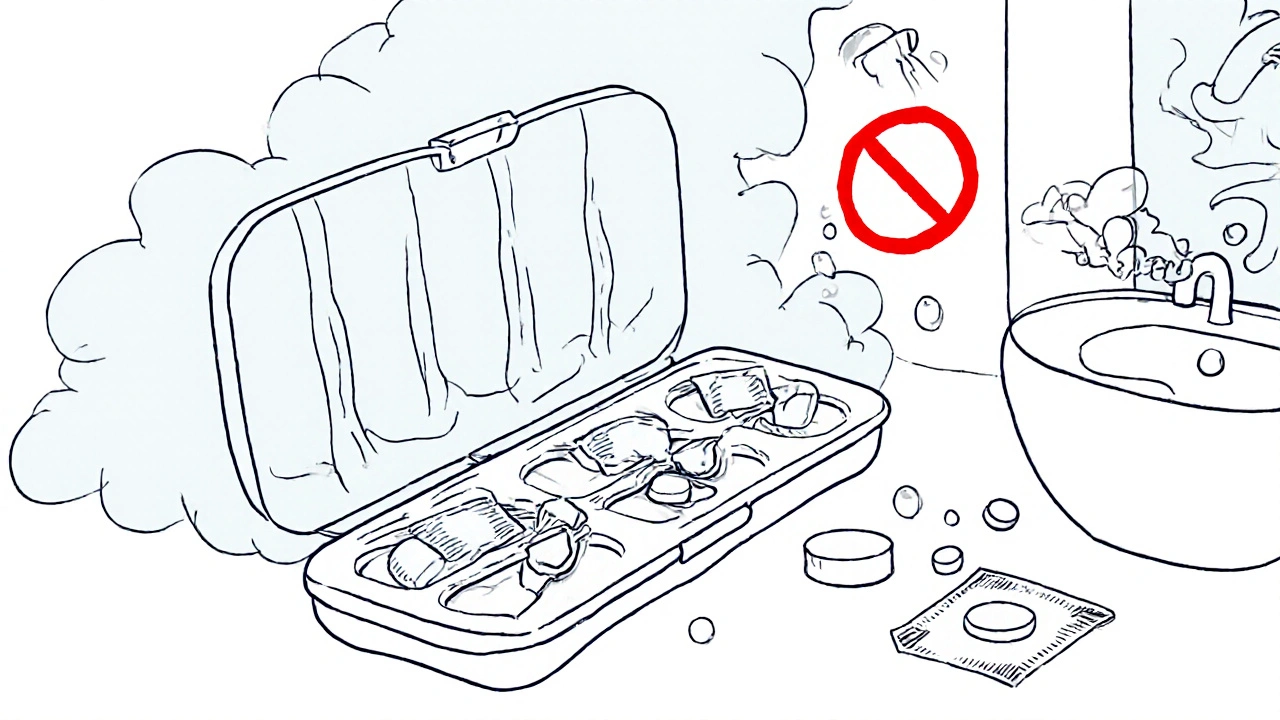
Many people dump their pills into plastic pill organizers for convenience. That’s fine-but only if you add moisture protection. A standard 7-day pill box offers zero moisture barrier. If you’re storing meds in one, especially in humid areas, slip in a small silica gel packet. You can buy these online or reuse the ones from your original bottle. Just make sure they’re not the kind meant for electronics-they need to be food-grade and labeled for pharmaceutical use.
Wisesorbent’s testing shows that properly sized silica gel packs can limit moisture increase to just 0.3% over 24 months. That’s the difference between a pill that works and one that’s useless. Look for packs labeled “silica gel” with a moisture capacity of at least 30% of their own weight. Avoid clay or charcoal packs-they’re not as effective.
3. Choose PVA-Coated Medications When Possible
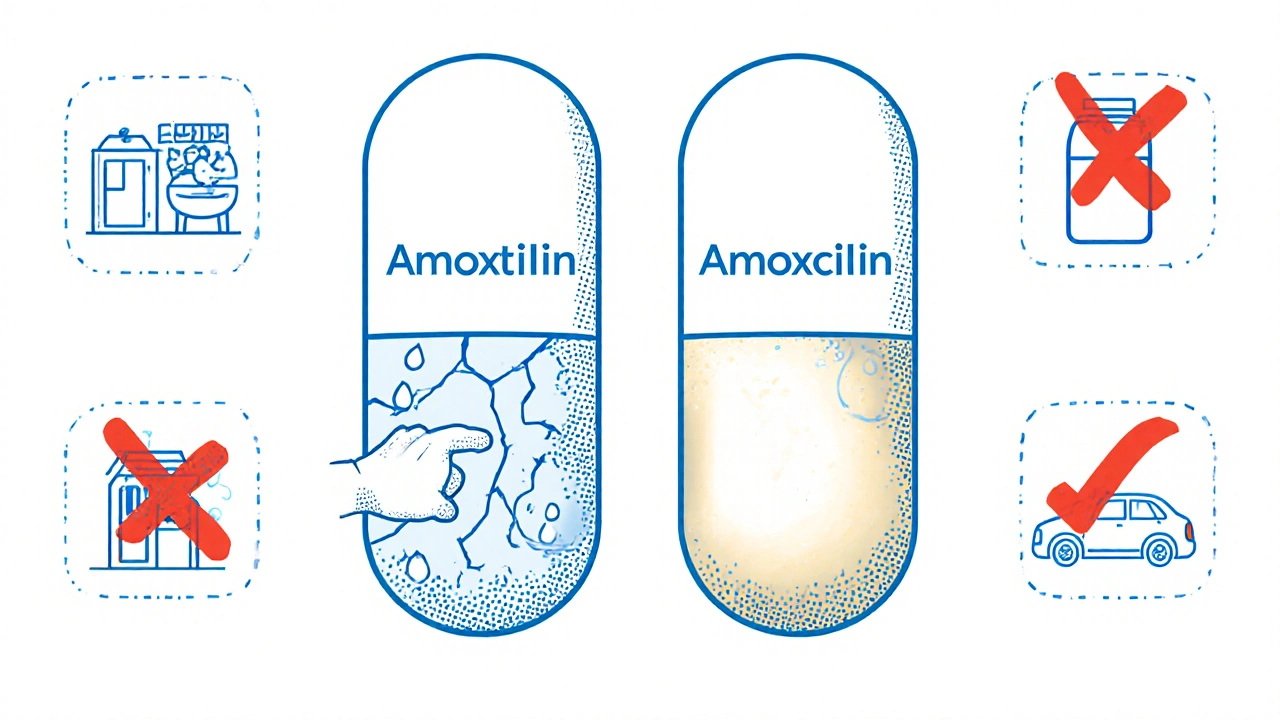
Not all pills are made the same. Some use a basic hydroxypropyl methylcellulose (HPMC) coating. Others use polyvinyl alcohol (PVA)-like Colorcon’s Opadry® Amb II. PVA coatings are three times better at blocking moisture than HPMC. In tests, amoxicillin/clavulanic acid tablets with HPMC coatings lost all their clavulanic acid after 10 days outside the bottle. PVA-coated ones? Still fully potent.
Ask your pharmacist: “Are these pills coated with PVA?” If they’re not sure, check the manufacturer’s website or call their customer service. Brands like Amoxil, Augmentin, and many generic antibiotics now use PVA coatings. It’s worth paying slightly more for-because you’re paying for effectiveness, not just the pill.
Where NOT to Store Your Medications
There are three worst places to keep pills:
- Bathroom cabinets - Steam from showers and sinks creates constant humidity. Even if it’s not obvious, moisture builds up.
- Kitchen counters or near the sink - Cooking, boiling water, and dishwashers raise humidity levels.
- Car glove boxes or sunlit windowsills - Heat speeds up chemical breakdown. Moisture + heat = double trouble.
The best place? A cool, dry drawer in your bedroom or a closet away from plumbing. A temperature between 15°C and 25°C is ideal. If you live in a humid area, consider a small dehumidifier in your bedroom. It helps more than you think.
What to Do If Your Pills Look Off
Not all damage is obvious. But here are warning signs:
- Tablets are stuck together or crumbling
- Color has changed-yellowing, dark spots, or fading
- Odor is strange-vinegary, musty, or sour
- Capsules are soft, sticky, or leaking
If you see any of these, don’t take them. Even if they look “mostly okay,” the active ingredient may have degraded. Contact your pharmacist. They can often replace them, especially if you bought them recently. Many pharmacies have return policies for degraded meds.
What About Expired Pills?
Expiration dates aren’t just a suggestion. They’re based on stability testing under real-world conditions-including humidity. Pills stored in bad conditions can degrade months before their expiry date. Don’t rely on the date alone. If your meds were kept in a humid bathroom for a year, they might not be safe even if the date is still valid.
When in doubt, throw them out. And dispose of them properly. Don’t flush them or toss them in the trash. Take them to a pharmacy that offers a medication take-back program. In Melbourne, most major pharmacies like Chemist Warehouse and TerryWhite Chemmart have drop-off bins.
Real-World Success Stories
One pharmacist in Sydney switched her entire inventory to PVA-coated antibiotics after a string of customer complaints about stomach irritation and failed treatments. Within three months, complaints dropped from five per week to zero.
A family in Cairns started using silica gel packs in their daily pill organizers after their mother’s blood pressure meds stopped working. Her readings improved within days. She now keeps a small desiccant in every container she uses.
These aren’t rare cases. A 2023 survey of Australian pharmacists found that 78% say moisture damage affects patient adherence. People stop taking meds they think aren’t working-when the real problem was moisture.
Quick Checklist for Moisture-Proof Storage
- ✅ Keep pills in original bottle with desiccant pack inside
- ✅ Never store in bathroom, kitchen, or car
- ✅ Use silica gel packs in pill organizers
- ✅ Ask your pharmacist: “Is this coated with PVA?”
- ✅ Check pills monthly for color, texture, or smell changes
- ✅ Return degraded meds to pharmacy-don’t keep them
- ✅ Dispose of expired meds at a pharmacy drop-off point
Moisture damage is silent. It doesn’t make noise. It doesn’t explode. It just slowly kills your meds. But you can stop it-with simple, smart steps.

Comments
Erin Nemo
Just threw out my amoxicillin last week because it smelled weird. Never thought it was moisture until now. Thanks for the wake-up call.
Suzanne Mollaneda Padin
I’ve been using silica gel packs in my pill organizer for years-bought them from Amazon in bulk. They’re cheap, effective, and I replace them every 6 months. No more soggy pills. Also, always keep meds in the bedroom drawer. Bathroom? No way.
Charlotte Collins
Let’s be real-most people don’t care until their blood pressure med stops working. Then they blame the doctor, not the humid bathroom cabinet. This article’s spot-on. The 67% statistic? That’s the tip of the iceberg. The FDA barely tracks this. Pharma companies know. They just don’t tell you.
Bonnie Youn
OMG YES. My grandma’s meds were turning yellow and she thought she was getting sicker. Turned out the pills were dead. We switched to PVA-coated ones and she’s been stable for a year now. You’re a lifesaver for writing this!
Kenny Leow
Thank you for this meticulously researched piece. The distinction between HPMC and PVA coatings is not widely understood by consumers-and yet, it’s one of the most critical factors in therapeutic efficacy. I’ve shared this with my entire family, especially those managing chronic conditions. A small change in storage habits can have profound clinical implications.
ariel nicholas
Wait-so you’re telling me… the government… let’s be honest… they’re letting people die slowly… because they don’t want to pay for better packaging? And now you’re telling me to buy PVA-coated pills… at a premium… while the pharmaceutical-industrial complex laughs all the way to the bank? I’m not buying it. This is capitalism in action. The pill you need… costs more… because it doesn’t dissolve in your bathroom.
Amber-Lynn Quinata
People need to stop being lazy. If you’re storing meds in the bathroom, you deserve whatever happens. It’s not rocket science. It’s basic hygiene. And if you don’t have a drawer in your bedroom? Get one. Or sleep on the floor. Either way-stop risking your life over convenience. 😒
Lauryn Smith
I used to think this was overkill until my dad’s insulin started clumping. We moved it to a cool closet, added a silica gel pack, and his numbers stabilized. It’s not dramatic-it’s just smart. If you’re taking meds daily, treat them like your life depends on it… because it does.
Margaret Stearns
i read this and thought wow this is so important but i also think people in rural areas or with limited space cant always have a dry drawer. maybe suggest a small plastic container with a silica pack as an alternative? just a thought
Alexander Williams
Hydrolysis kinetics of beta-lactam antibiotics under elevated RH conditions are non-linear, with Arrhenius activation energies typically ranging between 45–65 kJ/mol. Desiccant efficacy is contingent upon equilibrium vapor pressure differentials, and silica gel’s hygroscopic capacity peaks at 30–40% RH. PVA coatings reduce water vapor transmission rates by 80% compared to HPMC. The clinical relevance? Non-compliance due to perceived treatment failure is a documented confounder in pharmacovigilance databases. Recommend validating with USP <671> protocols.
Kelly Essenpreis
So what youre saying is dont keep pills in the bathroom but its totally fine to keep them in a hot car or a sunlit window? Thats just dumb. Heat is worse than moisture. And who cares about PVA coatings when most people are on generics that dont even say what coating they use
amit kuamr
in india we just keep pills in a tin box with rice inside. rice absorbs moisture. cheaper than silica gel. and no one dies. maybe your medicine is too fancy
Edward Hyde
Let me guess-you’re one of those people who thinks a silica gel packet is a magic fairy. Newsflash: pills don’t expire because of humidity. They expire because Big Pharma wants you to buy more. You’re being played. And now you’re paying extra for PVA coatings like some kind of pharmaceutical peacock. Wake up.
James Allen
Wow. Just wow. I’ve been keeping my meds in the bathroom for 12 years. My wife’s blood thinner, my thyroid med, my antidepressants-all in the cabinet above the sink. I thought I was being smart. Turns out I was slowly poisoning myself. I just threw out 3 bottles. I’m moving everything to the bedroom tonight. And I’m buying silica gel packs. And I’m asking my pharmacist about PVA. Thank you. Seriously. This might’ve saved my life.
Rachel Stanton
For anyone wondering where to get food-grade silica gel: look for packets labeled ‘USP Class I’ or ‘pharmaceutical grade’. Reuse the ones from your original bottles-they’re free. If you’re using a pill organizer, put one in each compartment. And if you’re traveling? Pack a tiny one in your carry-on. Humidity doesn’t care if you’re on vacation. Your meds shouldn’t suffer for it.