
Why Medication Reconciliation Matters More Than Ever
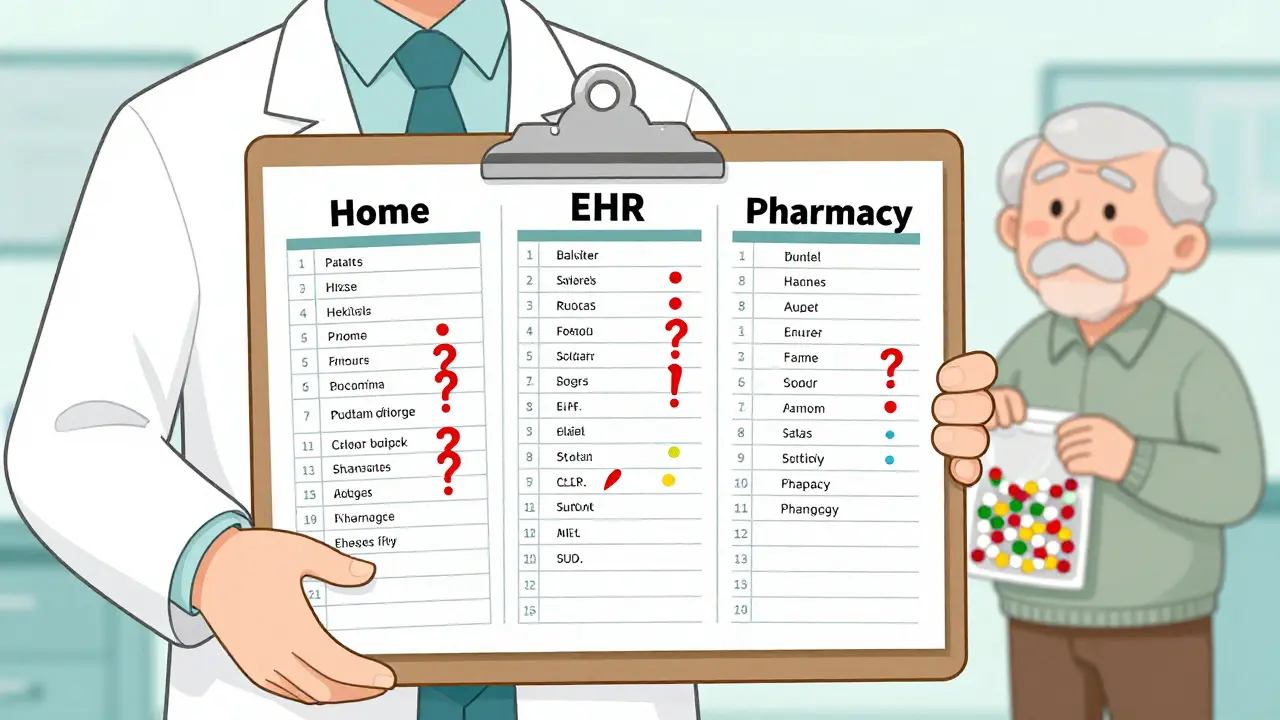
Every year, tens of thousands of patients in the U.S. are harmed because their medication list was wrong when they moved from one care setting to another. It could be from hospital to home, from ER to clinic, or even from one nursing unit to another. The problem isn’t that doctors or nurses are careless-it’s that the system is broken. A patient might say they take lisinopril 10mg daily, but their pharmacy record shows 20mg. Their discharge summary forgets their daily aspirin. Their family doesn’t know about the herbal supplement they take for sleep. These aren’t rare mistakes. They happen in 50-70% of transitions between care settings, and 20-30% of those lead to real harm.
Medication reconciliation isn’t just paperwork. It’s the last safety net before a patient walks out the door-or gets admitted-with the wrong pills. The goal is simple: make sure the list of medications a patient is actually taking matches what’s written in the chart, and what’s going to be given next. When done right, it cuts medication errors by 67%. When done poorly, it becomes a checkbox exercise that gives false confidence.
The Five Steps That Actually Work
There’s no magic here. It’s a five-step process, and skipping any one of them puts patients at risk.
- Get the Best Possible Medication History (BPMH)-This isn’t just asking the patient. It’s calling their pharmacy, checking their primary care records, talking to family, and reviewing old discharge papers. Relying only on what the patient remembers leads to errors in 42% of cases. Elderly patients, especially, often can’t name their meds or explain why they take them.
- Build the New Medication List-What’s being ordered for this admission, transfer, or discharge? This list comes from the prescriber’s orders, but it’s not final yet. It’s just the starting point.
- Compare the Two Lists-Side by side. Look for missing drugs, wrong doses, duplicates, or interactions. A patient on two blood pressure pills? Maybe one was stopped. A new antibiotic added without checking for kidney interactions? That’s a red flag. Clinical decision tools flag about 15-25% of lists as having potential issues.
- Make Clinical Decisions-Don’t just note the differences. Decide what to do. Stop the duplicate? Change the dose? Restart the missed drug? Document the reason. This is where pharmacists shine. They’re trained to spot these issues and know the evidence behind each choice.
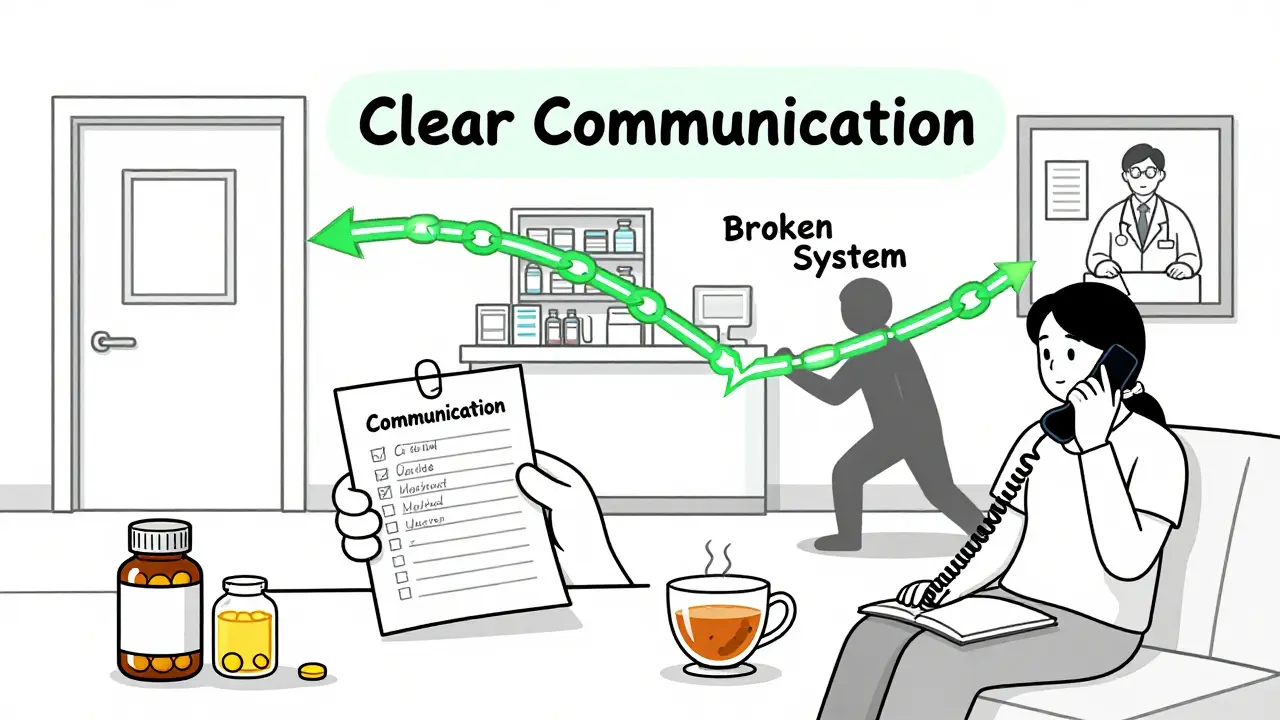
- Communicate the Final List-This is the step most often missed. The updated list must go to the patient, their primary doctor, the next care provider, and the pharmacy. If the patient leaves the hospital without understanding their new regimen, they’ll likely mess it up. Studies show 28% of patients change or skip doses in the first week after discharge because they didn’t get clear instructions.
Who Should Do It-and Why Pharmacists Are Key
Many hospitals try to make nurses do medication reconciliation. It’s convenient. But nurses are already stretched thin. They’re juggling vitals, IVs, charting, and family questions. Reconciliation takes time-15 to 20 minutes per admission, 10 to 15 minutes per discharge. When nurses do it, error rates stay high.
Pharmacists are the experts. They know drug interactions, dosing adjustments for kidney or liver problems, and how to interpret ambiguous orders. The American Society of Health-System Pharmacists says it plainly: “Pharmacists are the medication experts whose specialized knowledge and skills are essential.” Facilities with pharmacist-led reconciliation see 47% fewer errors than those relying on nurses alone.
Some hospitals now hire dedicated reconciliation technicians-trained support staff who gather data under pharmacist supervision. This model cuts time and improves accuracy. At Johns Hopkins, this approach reduced medication discrepancies by 72% in 18 months.
Technology Helps-But Doesn’t Fix Everything
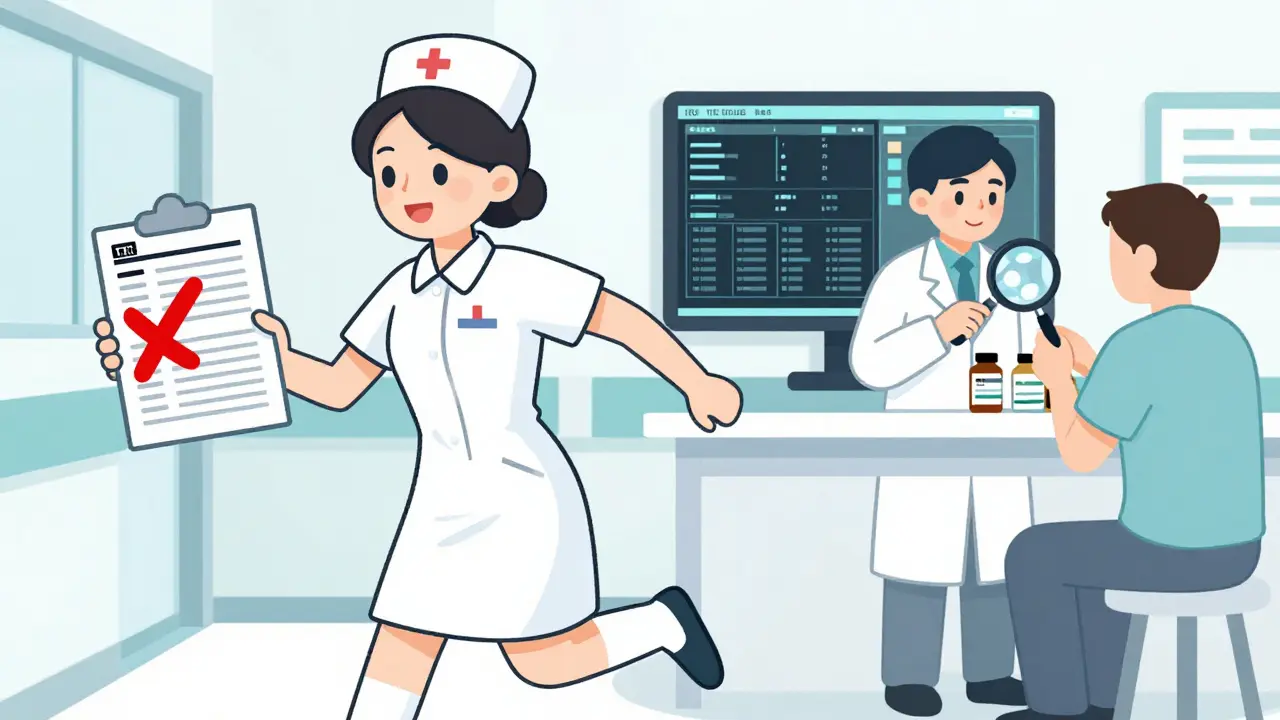
EHR systems like Epic and Cerner have reconciliation modules. They pull data from Surescripts, which connects to 90% of U.S. pharmacies. That sounds great. But here’s the catch: 18-22% of medication data is still missing. A patient gets their insulin from a small local pharmacy? It might not be in the system. They take a supplement bought online? It’s not recorded.
Even when the data is there, systems don’t always alert providers to the right things. A 2021 study in JAMA Internal Medicine found that 31% of reconciliation errors still happened even with electronic tools. Why? Because the software just flags mismatches-it doesn’t tell you what to do. That’s still human work.
Some newer tools use AI. Google’s DeepMind Health tested a system that predicted medication discrepancies with 89% accuracy in a pilot at Moorfields Eye Hospital. But even then, a pharmacist had to verify every result. AI doesn’t replace judgment-it supports it.
Real Problems in the Real World
Here’s what actually happens on the ground:
- A hospital pharmacist in Texas says discharge reconciliation takes 45-60 minutes per patient because their EHR doesn’t talk to the community pharmacy system. They’re forced to call each pharmacy manually.
- A survey of over 2,300 nurses found 68% say incomplete medication histories are their top safety concern. 41% admit they sometimes skip full reconciliation because they’re rushed.
- Community pharmacists report that 40-50% of elderly patients can’t tell them what meds they take. One pharmacist said, “I’ve had patients hand me a bag of pills and say, ‘I think these are for my heart.’”
- Only 33% of hospitals ask patients to bring in their actual pill bottles or use a medication diary-tools proven to improve accuracy by 27%.
And then there’s the paperwork. CMS requires reconciliation records to be completed within 24 hours of admission and before discharge. But audits show only 67% of hospitals meet that deadline. When deadlines aren’t met, hospitals risk losing Medicare payments.
What’s Changing in 2025
Medication reconciliation is no longer optional. It’s baked into federal rules:
- CMS increased the weight of the Medication Reconciliation Post-Discharge (MRP) measure from 5% to 8% of Medicare Advantage star ratings. Hospitals with low scores lose money.
- The U.S. Core Data for Interoperability (USCDI) Version 4, rolled out in January 2023, now includes standardized medication reconciliation fields. This means systems must share the same data elements-dose, frequency, route, reason-for better communication.
- The Joint Commission now requires reconciliation to include herbal remedies, supplements, and traditional medicines. Why? Because 52% of patients use them, and most providers never ask.
- The FDA’s 2023 Digital Health Plan is pushing for AI tools to help flag risks faster. But the American Hospital Association warns: “Technology must support, not replace, the human elements.”
Still, most hospitals run reconciliation programs at a net loss. Staff time isn’t reimbursed well. Without better payment models, many will cut corners.
What You Can Do-As a Patient or Caregiver
You don’t have to wait for the system to fix itself. Here’s how to protect yourself or a loved one:
- Keep your own list-Write down every medication: name, dose, why you take it, and when. Include vitamins, supplements, and over-the-counter drugs. Update it every time your doctor changes something.
- Bring your pills to every appointment-Don’t rely on memory. Show the pharmacist or nurse the actual bottles.
- Ask for a written discharge summary-Make sure it includes your full updated list, not just the new meds. If it’s not there, ask for it.
- Call your pharmacy after discharge-Ask them to review your new list. They can catch errors the hospital missed.
- Don’t guess-If you don’t understand why you’re taking a new pill, ask. “What is this for?” “What happens if I skip it?” “Is this replacing something I used to take?”
Final Thought: It’s Not About Forms-It’s About Trust
Medication reconciliation isn’t about filling out a form in an EHR. It’s about making sure the right person has the right information at the right time. It’s about listening to the patient. It’s about pharmacists having time to talk. It’s about systems that talk to each other.
The data is clear: when done well, it saves lives. When done poorly, it’s just another broken promise in a broken system. The solution isn’t more technology. It’s more time, more training, more respect for the people who know the medications best-the pharmacists-and more honesty from patients about what they’re really taking.
What is the difference between medication reconciliation and a medication review?
Medication reconciliation is a structured process done only during transitions of care-like hospital admission, discharge, or transfer. It’s focused on comparing current and new medication lists to prevent errors. A medication review, on the other hand, is a general assessment done during routine visits to evaluate if a patient’s current meds are still working, needed, or safe. Reconciliation is about safety during handoffs; reviews are about optimization during ongoing care.
Why do patients often get their medications wrong after leaving the hospital?
Because the updated medication list isn’t clearly communicated. Studies show 61% of patients feel confused about changes after discharge, and 28% change or stop meds incorrectly within the first week. This happens when discharge summaries are incomplete, patients aren’t given written instructions, or they’re not asked to repeat back their new regimen. Poor health literacy and rushed transitions make it worse.
Can electronic health records fix medication reconciliation errors?
EHRs help by pulling data from pharmacies and flagging potential interactions, but they don’t fix the root problems. About 18-22% of medication data is still missing because not all pharmacies are connected. Plus, systems don’t tell you what to do-they just show differences. Human judgment is still needed to decide whether to stop, start, or change a drug. Studies show 31% of reconciliation errors persist even with EHR tools.
Is medication reconciliation required by law?
Yes. The Joint Commission has required it since 2006 as part of its National Patient Safety Goal. CMS also mandates it under Meaningful Use Stage 2 and ties reimbursement to performance. Hospitals that don’t reconcile medications properly risk penalties under the Hospital Readmissions Reduction Program, which can reduce Medicare payments by up to 0.64% per year. Non-compliance can also lead to loss of accreditation.
What’s the biggest barrier to effective medication reconciliation?
Time and fragmented systems. Pharmacists and staff need 15-20 minutes per patient to do it right, but most facilities don’t schedule that time. EHRs don’t talk to each other or to community pharmacies. Patients often can’t recall their meds. And there’s no good reimbursement for the time it takes. Without fixing these structural issues, even the best tools won’t work.

Comments
Teresa Rodriguez leon
I've seen this too many times. My mom was discharged with a new pill she didn't need and told to stop one she'd been on for 12 years. No one asked her what she actually took. She ended up in the ER. This isn't just policy-it's life or death.
Jasmine Yule
I work in a rural clinic. We don’t have pharmacists on staff. Nurses do reconciliation between rounds, during lunch, while answering phones. We know it’s broken. We’re just trying not to kill anyone before shift ends. 💔
Manan Pandya
The data is unequivocal: pharmacist-led reconciliation reduces errors by 47%. Yet, hospitals continue to assign this task to overburdened nurses. This is not a workflow issue-it is a systemic devaluation of clinical expertise. The evidence is clear; the resistance is institutional.
Aliza Efraimov
I'm a pharmacy tech. I've had patients show up with a Ziploc bag full of pills they got from three different stores, a cousin's leftover antibiotics, and a 'natural sleep aid' from a guy at the gas station. No one asks. No one checks. And then they wonder why someone overdosed on melatonin and lisinopril. This isn't a tech problem. It's a human one.
Nisha Marwaha
The integration of USCDI v4 mandates standardized medication data elements, including route, frequency, and indication-critical for interoperability. Without granular, structured data, reconciliation remains a heuristic exercise rather than a clinical decision support process. The failure to implement FHIR-based medication lists at the point of care is a latent safety hazard.
Paige Shipe
I work for a hospital system. We get audited monthly. We do the paperwork. We check the boxes. But the system? It's a joke. We don't have time. We don't have staff. We don't have money. And the people who write the rules? They've never held a pill bottle in their hand.
Tamar Dunlop
In Canada, we've implemented a national medication reconciliation protocol with community pharmacy integration. It is not perfect, but the outcomes are demonstrably superior. We prioritize patient-centered communication, and we compensate pharmacists for time spent in reconciliation. This is not merely a clinical issue-it is a matter of healthcare equity and dignity.
David Chase
THE SYSTEM IS BROKEN BECAUSE WE LET PEOPLE WHO DON'T KNOW MEDS MAKE DECISIONS!!! NURSES AREN'T PHARMACISTS!!! WHY ARE WE STILL DOING THIS?!?!?!? EHRs don't fix stupid!! YOU NEED PHARMACISTS!!! STOP WASTING TIME ON PAPERWORK AND HIRE THE EXPERTS!!! 🚨💊💣
Emma Duquemin
I used to be a nurse. Now I'm a patient advocate. I've sat in rooms where families are crying because their dad got the wrong dose of warfarin after discharge. The chart said 5mg. He was on 2mg for five years. No one asked. No one checked. No one cared. This isn't about tech. It's about someone finally saying: 'Wait. Let's look at the bottles.' And then-just maybe-saving a life.
Kevin Lopez
Reconciliation ≠ review. Reconciliation is transition-specific. Review is longitudinal. The Joint Commission mandates reconciliation. CMS penalizes non-compliance. EHRs are insufficient. Pharmacists are non-negotiable. End of discussion.
Duncan Careless
I'm from the UK. We don't have the same reimbursement pressures, but we still struggle with fragmented records. Community pharmacists here are doing heroic work-calling hospitals, tracking down meds, translating scribbles on napkins. We need to pay them for it. And maybe, just maybe, stop pretending this is a clerical task.
Samar Khan
I'm a hospital pharmacist. We have 30 patients a day. We're supposed to spend 20 minutes each. We get 5. The EHR says I'm 98% compliant. The audit says I'm fine. But I know. I know the ones I rushed. I know the ones I missed. I cry on the way home. No one asks. No one cares. Just another checkbox.