
When you pick up a prescription, chances are you’re getting a generic drug. Around 90% of all prescriptions filled in the U.S. are for generics. Yet many people still wonder: Are generic drugs really as safe as brand names? The answer isn’t just yes-it’s backed by a detailed, science-driven system the FDA has spent decades building and refining.
What the FDA Actually Requires for Generic Drugs
The FDA doesn’t just approve generics because they’re cheaper. They approve them because they must prove they work the same way, in the same amount of time, with the same safety profile as the original brand-name drug. This isn’t guesswork. It’s a legal and scientific requirement.Every generic drug must contain the exact same active ingredient as the brand-name version. That means if your brand-name pill has 10 mg of atorvastatin, the generic has 10 mg of atorvastatin-no more, no less. The dosage form (tablet, capsule, injection) and route of administration (oral, intravenous, etc.) must also match exactly. This is spelled out in FDA regulations under 21 CFR 314.94(a).
But here’s where most people get confused: inactive ingredients. Generics can-and often do-use different fillers, dyes, or flavorings. That’s why a generic pill might be a different color or shape. But those differences don’t affect how the drug works. The FDA makes sure these inactive ingredients are safe and don’t interfere with absorption or cause unexpected reactions.
Bioequivalence: The Core of Generic Approval
The real test for a generic drug isn’t how it looks or what’s inside the capsule-it’s how your body absorbs it. That’s where bioequivalence comes in.To get approved, a generic must prove it delivers the same amount of active ingredient into your bloodstream at the same rate as the brand-name drug. This is measured using two key metrics: Cmax (the highest concentration in your blood) and AUC (the total amount absorbed over time).
The FDA requires that the 90% confidence interval for the ratio of these values between the generic and brand-name drug falls between 80% and 125%. That’s not a wide margin-it’s a tight window designed to ensure clinical equivalence. For most drugs, this means your body processes the generic and the brand-name version in nearly identical ways.
For drugs with a narrow therapeutic index-like warfarin, levothyroxine, or phenytoin-the standard is even stricter. The FDA requires bioequivalence within 90% to 111%. These are drugs where even small changes in blood levels can cause serious side effects or treatment failure. The FDA doesn’t cut corners here.
Manufacturing Standards: No Compromises
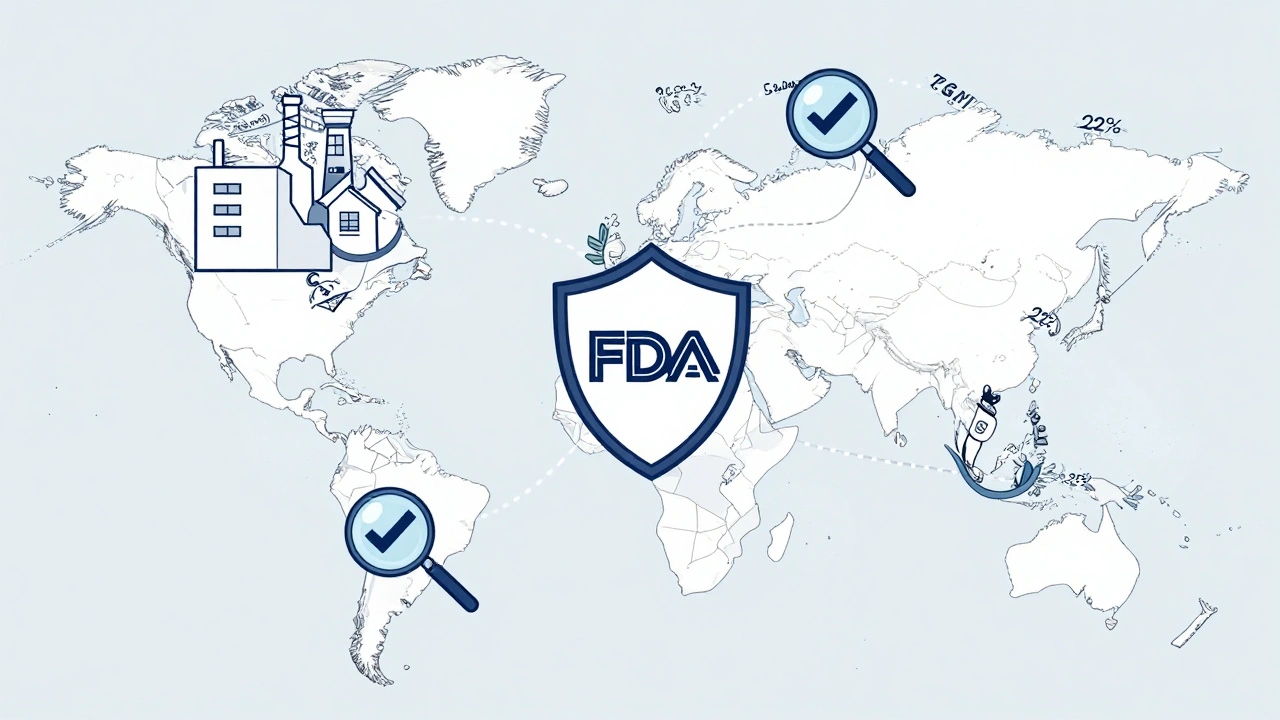
You might think generics are made in cheaper, lower-quality factories. That’s a myth.All generic manufacturers, whether based in the U.S., India, or Germany, must follow Current Good Manufacturing Practices (cGMP). These rules cover everything: how equipment is cleaned, how batches are tested, how environmental controls are maintained, and how records are kept. The FDA inspects these facilities-over 3,000 of them worldwide-without notice. In 2022, the FDA increased inspections of overseas plants by 22% as part of its Risk-Based Facility Assessment program.
Impurity levels are also tightly controlled. The FDA follows international guidelines (ICH Q3B and ICH M7) that set limits for potentially harmful substances. For example, genotoxic impurities are capped at 1.5 micrograms per day-a level considered safe even with lifelong exposure. The FDA doesn’t just accept a manufacturer’s word. They test samples themselves.
Labeling: Same Information, Different Packaging
The FDA requires generic drug labeling to be identical to the brand-name drug’s labeling, except for minor differences like the manufacturer’s name, package size, or inactive ingredients. This means warnings, dosing instructions, side effects, and contraindications are exactly the same.One big change happened in 2022: the FDA proposed a rule allowing generic manufacturers to update safety labels without waiting for the brand-name company to do it first. Before this, generics were stuck with outdated safety info if the original maker didn’t act. That rule change finally closed a decades-old gap in patient protection.
Complex Generics: The Harder Cases
Not all drugs are created equal. Simple pills? Easy to copy. Inhalers, eye drops, topical creams, and biologics? Much harder.For complex products, the FDA requires more than just bioequivalence. They might need comparative clinical studies, advanced imaging to check particle size in inhalers, or lab tests to prove the drug behaves the same in the body. In 2022, the FDA rejected 25% more ANDAs for complex generics than for regular ones.
Take glatiramer acetate (Copaxone), used for multiple sclerosis. It’s a complex molecule. Generic manufacturers tried to copy it using standard bioequivalence tests-but the FDA found those weren’t enough. In 2013, Teva petitioned the FDA to require immunogenicity testing, and the agency agreed. Now, generics for complex biologics must prove they don’t trigger abnormal immune responses.
The FDA’s Complex Generic Drug Products Initiative, launched in 2018, is investing $50 million through 2027 to develop better testing methods. This isn’t about slowing down generics-it’s about making sure they’re safe when the science gets harder.
What the Data Shows: Real-World Safety
Critics sometimes claim generics aren’t as effective. But real-world data tells a different story.A 2022 study in JAMA Internal Medicine tracked 38,000 Medicare patients taking either brand-name or generic statins. There was no statistically significant difference in heart attacks, strokes, or hospitalizations. The p-value? 0.37-meaning any difference was random noise, not a real effect.
On Drugs.com, over 12,500 patient reviews from 2020 to 2023 showed 87% reported no difference in effectiveness between brand and generic cardiovascular drugs. Only 8% blamed inactive ingredients for side effects like nausea or rash-issues that were often resolved by switching to a different generic version.
Even in tricky areas like epilepsy, most doctors trust generics. A 2021 survey of 500 neurologists found 68% had full confidence in generic antiepileptic drugs. That’s a high bar, considering seizures can be life-threatening.
Still, some concerns linger. Reddit threads and patient forums often mention levothyroxine. Even though the FDA requires a tighter 90-111% bioequivalence range for this drug, some patients report feeling worse on a different generic. The FDA acknowledges this and recommends patients stick with the same generic brand once they find one that works. Switching between generics can cause small variations in absorption-enough to affect thyroid levels in sensitive individuals.
Why Generics Cost So Much Less
You might wonder: if generics are just as safe and effective, why are they 80-90% cheaper?Because they don’t have to repeat expensive clinical trials. Brand-name companies spend billions on research, animal studies, and Phase I-III trials to prove a new drug works and is safe. Generics skip all that. They use the existing data from the brand-name drug’s approval.
Instead, they focus on proving bioequivalence and manufacturing quality. A single bioequivalence study costs $1-2 million and takes 18-24 months from start to approval. That’s a fraction of the $1-2 billion it takes to bring a new drug to market.
The result? Generics account for 90% of prescriptions but only 23% of total drug spending in the U.S. In 2022, that saved the healthcare system over $313 billion.
What’s Changing Now
The FDA isn’t resting. New tools are being added to keep up with evolving science.In 2024, the FDA is launching a pilot program with MIT using artificial intelligence to predict harmful impurities in drug manufacturing. Instead of testing every batch, AI models will flag high-risk patterns before production even begins.
They’re also using advanced modeling to simulate how drugs behave in the body-reducing the need for human bioequivalence trials in some cases. And with the Generic Drug User Fee Amendments (GDUFA), approval times have dropped by 35% since 2012, without sacrificing safety checks.
Looking ahead, the Congressional Budget Office warns that without a 15% funding increase by 2027, the FDA may struggle to keep up with the growing number of complex generics. But the agency is clear: safety can’t be traded for speed.
Bottom Line: You Can Trust Generics
The FDA’s system for approving generic drugs is one of the most thorough in the world. It’s not perfect-but it’s science-based, transparent, and constantly improving. Generics aren’t cheap because they’re low quality. They’re cheap because they don’t need to repeat the same research that brand-name companies already did.If your doctor prescribes a generic, you’re not getting a second-rate drug. You’re getting a drug that meets the same safety and effectiveness standards as the brand-name version-often at a fraction of the cost.
For most people, the choice is simple: save money without sacrificing health. And the data shows, overwhelmingly, that’s exactly what you’re getting.
Are generic drugs as safe as brand-name drugs?
Yes. The FDA requires generic drugs to have the same active ingredient, strength, dosage form, and route of administration as the brand-name version. They must also prove bioequivalence-meaning your body absorbs them at the same rate and amount. Manufacturing follows the same strict quality standards (cGMP), and labeling must match except for minor details like color or manufacturer name.
Why do generic drugs look different from brand-name ones?
Generic drugs can differ in color, shape, size, or flavor because those are inactive ingredients, which don’t affect how the drug works. Federal law requires generics to be different in appearance to avoid confusion with the brand-name product. But the active ingredient-and how your body processes it-must be identical.
Can I switch between different generic brands?
For most drugs, yes. But for medications with a narrow therapeutic index-like warfarin, levothyroxine, or certain seizure drugs-switching between generics can cause small changes in blood levels. If you’re stable on one generic, it’s often safer to stick with it. Talk to your pharmacist or doctor before switching.
Are generic drugs made in the same factories as brand-name drugs?
Many are. The FDA inspects all manufacturing facilities-whether they make brand-name or generic drugs-using the same standards. In fact, some brand-name companies also produce generic versions of their own drugs. Location doesn’t determine quality; inspections and compliance do.
What if I think my generic drug isn’t working?
First, don’t assume it’s the generic. Many factors-stress, diet, other medications, or even a change in your condition-can affect how you feel. But if you notice real changes, talk to your doctor. You may need a blood test to check drug levels. In rare cases, switching to a different generic version (not the brand) can resolve issues caused by inactive ingredients.
Are there any drugs that shouldn’t be taken as generics?
The FDA considers all approved generics therapeutically equivalent to their brand-name counterparts. But for very complex drugs-like certain biologics, inhalers, or topical creams-some doctors may recommend sticking with the brand due to limited real-world data. Always discuss concerns with your provider. Never stop a medication without medical advice.

Comments
Inna Borovik
Let’s be real - the FDA’s bioequivalence window of 80-125% is a joke. That’s a 45% swing. If my blood pressure med varies that much, I’m not getting treated - I’m gambling. And don’t get me started on the ‘same active ingredient’ lie. What about metabolites? Impurities? The FDA doesn’t test for all of them - manufacturers self-report. You think that’s safe? I’ve seen patients crash after switching generics. It’s not paranoia - it’s data.
Mayur Panchamia
India makes 40% of the world’s generics - and you’re telling me we’re cutting corners? 🤡 Look at the stats: 90% of U.S. prescriptions are generics, and hospital readmission rates haven’t spiked. We’ve got world-class pharma plants in Gujarat and Hyderabad - FDA-inspected, cGMP-certified, and cheaper because we’re efficient, not cheap. Stop the colonial mindset. Indian generics saved millions during the AIDS crisis. You don’t get to hate the medicine that kept your grandpa alive.
Nava Jothy
My thyroid went haywire after switching generics. I swear, it’s the dyes. I went from 1.8 TSH to 5.2 in two weeks. Doctor said ‘it’s placebo.’ 😒 I did a blood test. It wasn’t placebo. The FDA says ‘stick with one brand’ - but my pharmacy swaps it like candy. Why? Because they get paid to. This isn’t science - it’s supply chain greed. #LevothyroxineTrauma
Myles White
It’s fascinating how the FDA’s approach to bioequivalence is rooted in pharmacokinetic modeling, which was originally developed in the 1970s for warfarin, and then expanded systematically across drug classes as the science evolved. The 80-125% confidence interval isn’t arbitrary - it’s derived from statistical power analyses that balance clinical relevance with practical feasibility, and it’s been validated across thousands of studies. Even for narrow-therapeutic-index drugs, the 90-111% range is based on population pharmacokinetic variability, not corporate compromise. The real issue isn’t the standard - it’s inconsistent generic substitution policies at the pharmacy level, which the 2022 labeling rule was meant to fix. We need better patient education, not fear-mongering.
Brooke Evers
I’m a nurse in a rural clinic. I’ve seen patients cry because they can’t afford brand-name meds. One woman with diabetes switched to generic metformin and said, ‘I can finally buy groceries again.’ The science says it’s the same - and I’ve watched people live longer, not worse, because of generics. I get the fear. I do. But let’s not let anecdotal horror stories drown out the millions who are thriving because of access. You don’t have to love the pill’s color - just be grateful it exists.
Chris Park
Did you know the FDA approves generics from factories that have been flagged for violations? In 2021, a plant in Hyderabad was cited for data falsification - yet its generics were still sold in the U.S. The FDA doesn’t shut them down - they just ‘request corrections.’ Meanwhile, they’re spending $50 million on AI to predict impurities… but won’t audit every batch? This isn’t regulation. It’s theater. And the ‘313 billion saved’? That’s money taken from pharma profits - not from patient safety. You think the FDA’s protecting you? They’re protecting the system.
Rashmi Gupta
Generic drugs are just brand-name drugs with a different label. The FDA’s entire system is built on trust - trust that manufacturers won’t cut corners, trust that inspectors will show up, trust that the AI won’t miss a toxic impurity. But we’ve seen the scandals. We’ve seen the recalls. We’ve seen the lawsuits. If you believe this system is flawless, you’re not paying attention. And yes - I’m the contrarian. Because someone has to be.
Akash Takyar
While I appreciate the detailed regulatory framework outlined in the post, I must emphasize that the clinical equivalence of generics is not merely a matter of pharmacokinetic parameters - it is also a matter of patient trust, which is often eroded by inconsistent packaging, unannounced substitutions, and lack of transparent communication from prescribers and pharmacists. A well-functioning healthcare system must prioritize continuity of therapy, especially for patients with chronic conditions, and ensure that substitutions are not only scientifically valid but also ethically communicated.
Karen Mitchell
Let’s not pretend this is about safety. It’s about profit. The FDA’s entire approval process for generics is a regulatory capture fantasy. Brand-name companies spend billions on R&D. Generics spend $2 million to copy them. And now we’re supposed to believe that’s ethical? You’re not saving money - you’re outsourcing risk. And if your kidney fails because a generic’s impurity wasn’t caught? Too bad. The FDA’s ‘rigorous’ standards are just a marketing brochure. I’ve seen the inspection reports. They’re laughable.
Andrew Frazier
India makes 70% of our generics? LOL. That’s why our meds are full of shit. You think they care about cGMP? They care about cash. My cousin works in a factory there - says they reuse filters, skip tests, and ship batches that fail. The FDA? They’re too busy taking selfies with pharma execs. We need tariffs. We need American-made pills. Stop importing foreign crap and start making real medicine again.
Geraldine Trainer-Cooper
drugs are just molecules. if your body reacts to a color or a filler, maybe it’s not the drug. maybe it’s your mind. or your stress. or your life. the science says it’s the same. stop overthinking it. take the pill. live your life.
Ibrahim Yakubu
You think the FDA is the guardian? Nah. They’re the gatekeeper for a global oligopoly. The real power? The patent trolls who delay generics for 12 years. The pharmacy benefit managers who force switches. The hospital systems that profit from brand-name prescriptions. The FDA? They’re just the face. The system’s rigged. And you’re all just arguing about the label while the real thieves are in the boardroom.