
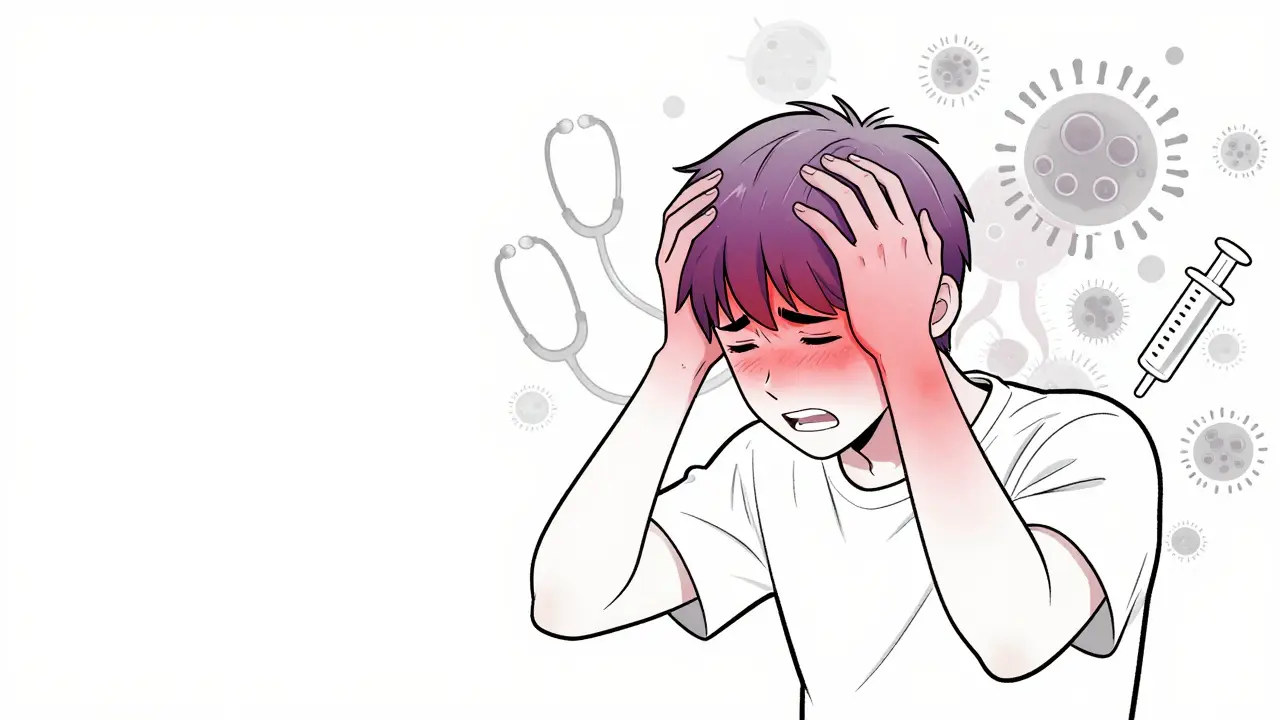
Meningitis isn't just a headache with a fever. It’s an inflammation of the protective membranes around your brain and spinal cord-and it can turn deadly in hours. Every year, over a million people worldwide get it. About 135,000 die. But here’s the good news: most cases are preventable. The key is knowing the signs, understanding the types, and getting the right vaccines.
What Are the Different Types of Meningitis?
Not all meningitis is the same. There are five main types, each with different causes, risks, and outcomes.Bacterial meningitis is the most dangerous. It’s caused by germs like Neisseria meningitidis (meningococcus), Streptococcus pneumoniae (pneumococcus), and Haemophilus influenzae type b (Hib). Symptoms come on fast-sometimes in just a few hours. Without treatment, death can happen within 24 hours. Even with antibiotics, 5% to 30% of patients don’t survive. Survivors often face lifelong problems like hearing loss, seizures, or learning disabilities.
Viral meningitis is far more common. It makes up about 85% of all cases. Most are caused by enteroviruses-the same viruses that give you a stomach bug. It’s usually mild. People recover on their own in about a week. You won’t need antibiotics, but you still need to see a doctor to rule out something worse.
Fungal meningitis is rare and mostly hits people with weak immune systems-like those with HIV, cancer, or on long-term steroids. The main culprit is Cryptococcus neoformans. It’s not contagious, but it’s deadly if missed. Around 223,000 cases happen globally each year, and nearly 181,000 people die from it.
Parasitic meningitis is even rarer. It’s often linked to eating raw or undercooked snails or slugs, especially in Southeast Asia and the Pacific. The parasite Angiostrongylus cantonensis causes it. Symptoms can last weeks and include severe headaches and nerve pain.
Non-infectious meningitis isn’t caused by germs at all. It can come from autoimmune diseases like lupus, certain cancer treatments, or reactions to medications like ibuprofen or antibiotics. It’s less common, making up only 5% to 10% of cases, but still needs medical attention.
What Are the Real Symptoms?
You’ve probably heard the classic trio: fever, stiff neck, and headache. But here’s the truth-only 41% of people with bacterial meningitis show all three. That means if you’re waiting for all the signs, you might be too late.More common signs include:
- High fever (over 101.3°F or 38.5°C)
- Severe, unrelenting headache
- Neck stiffness so bad you can’t touch your chin to your chest
- Sensitivity to light-bright rooms feel unbearable
- Nausea or vomiting without other stomach issues
- Confusion, trouble concentrating, or drowsiness
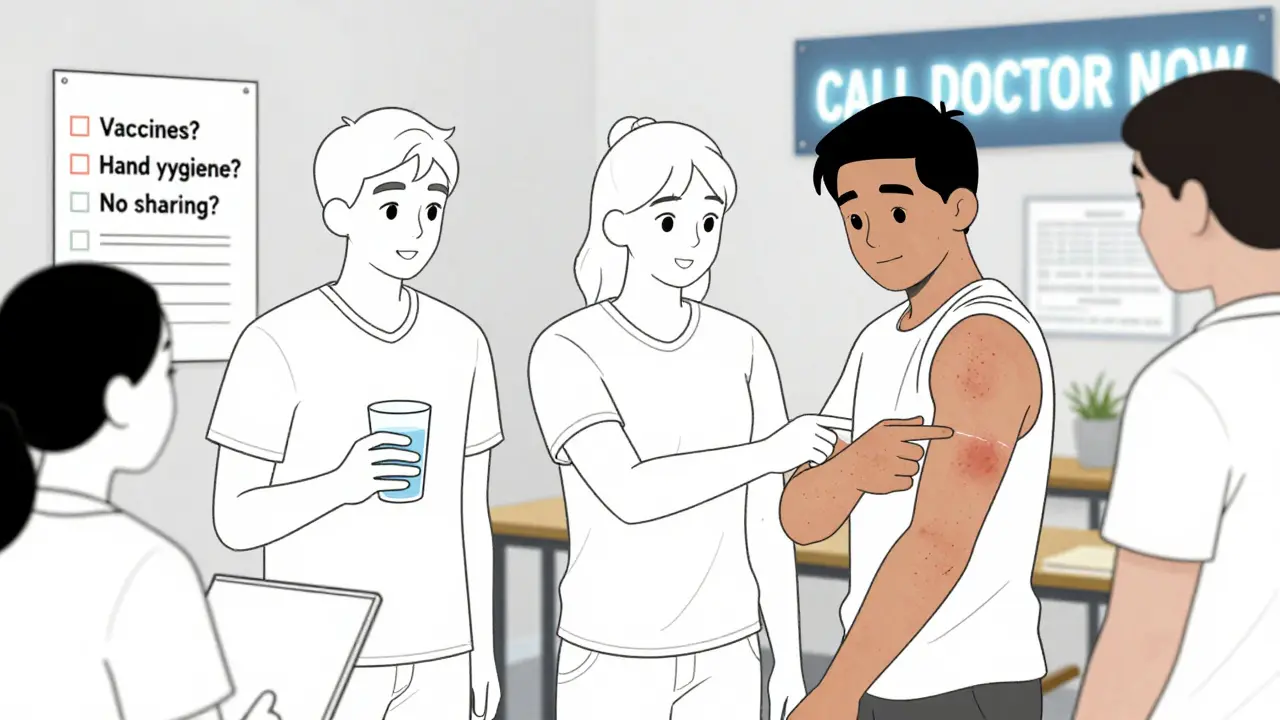
For bacterial meningitis, especially from meningococcus, there’s one critical warning sign: a rash. It starts as tiny red or purple spots that don’t fade when you press a glass against them. This is a medical emergency. Don’t wait for it to spread-get help now.
Other physical signs doctors check for include Brudzinski’s sign (your legs bend automatically when you lift your head) and Kernig’s sign (pain when you try to straighten your leg while lying down). But these aren’t always present. That’s why skipping care because you “don’t have the rash” or “just feel tired” is dangerous.
One study found that 73% of doctors have seen patients who waited too long because they didn’t have the rash. And 42% of survivors in a 2023 survey said they were first told they had the flu or a migraine. That delay cost them time-and sometimes their health.
How Vaccines Stop Meningitis Before It Starts
Vaccines are the single most powerful tool we have against meningitis. In countries with strong immunization programs, some types have dropped by 99%.There are three main vaccines you need to know about:
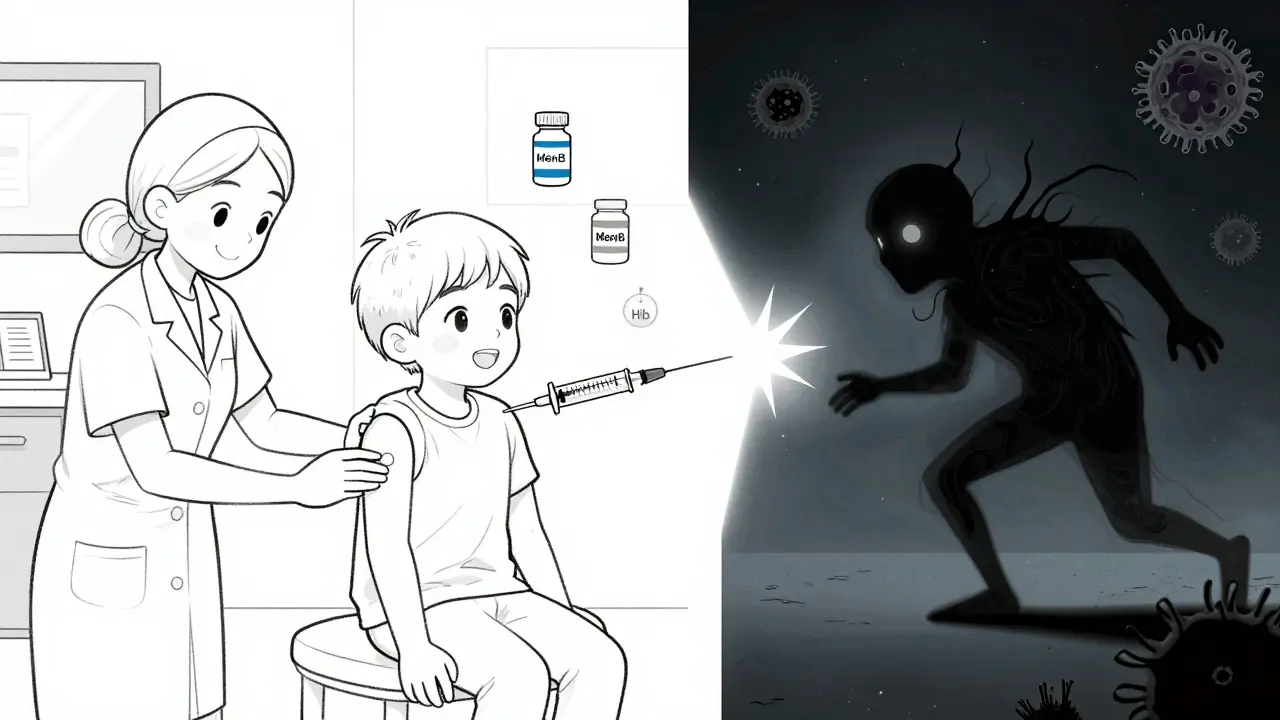
- MenACWY (Menveo, MenQuadfi): Protects against four strains (A, C, W, Y). Recommended for all kids at age 11-12, with a booster at 16. It’s 80-85% effective. In the U.S., this vaccine prevents about 700 cases a year.
- MenB (Bexsero, Trumenba): Targets serogroup B, which causes about 1 in 3 cases in teens and young adults. It’s recommended for teens 16-18, especially those living in dorms. College students are 3-5 times more likely to get it. The vaccine is 60-70% effective.
- PCV13 and Hib: These protect against pneumococcus and Hib. Kids get these as part of their routine shots. Hib meningitis was once common in children under 5-now it’s nearly gone in places with full vaccination.
The CDC updated its guidelines in February 2024 to recommend MenB for all adolescents, not just high-risk groups. Why? Because the cost of treating one case of meningitis-hospital stays, rehab, long-term care-can hit $500,000. The vaccine? Around $100-$150 per dose. It’s a no-brainer.
Since 2010, the MenA vaccine has nearly wiped out meningitis A outbreaks in Africa’s “meningitis belt,” preventing over 1.5 million cases. That’s the power of global vaccination.
What If You’ve Been Exposed?
If someone close to you-like a roommate, family member, or classmate-gets bacterial meningitis, you’re at risk. But you don’t have to wait for symptoms.Doctors give antibiotics like ciprofloxacin or rifampin to close contacts within 24 hours of exposure. This cuts the chance of you getting sick from 1-5% down to less than 0.1%. That’s a 99% reduction.
The problem? Most people don’t realize they’ve been exposed until it’s too late. A CDC study found only 65% of contacts get antibiotics in time. Why? Because it takes hours to confirm the diagnosis, and families don’t always know who counts as a “close contact.”
Close contacts include:
- People living in the same house
- Roommates in dorms or barracks
- Anyone who had direct contact with saliva (kissing, sharing drinks, utensils, toothbrushes)
Don’t wait for symptoms. If someone you’re close to is diagnosed, call your doctor immediately. Ask: “Do I need antibiotics?”
Other Ways to Lower Your Risk
Vaccines aren’t the only line of defense. Simple habits help too:- Wash your hands often-especially before eating or after using the bathroom. Hand hygiene cuts transmission by 30-50%.
- Don’t share drinks, food, lip balm, toothbrushes, or smoking devices. Saliva spreads meningococcus.
- If you’re pregnant, avoid unpasteurized milk and soft cheeses like brie or feta. Listeria can cause meningitis in newborns.
- Cook meat to 165°F (74°C). Undercooked food is a known source of listeria.
These steps won’t stop every case-but they reduce the chances. And when combined with vaccines, they make a huge difference.
Why Vaccination Rates Still Matter
Despite how effective vaccines are, gaps remain. In the U.S., only about 60% of teens got the MenB vaccine in 2023. That’s not enough. Outbreaks still happen on college campuses, especially where vaccination isn’t required.Forty-six U.S. states now require meningitis vaccines for college students. Schools with those rules see 75% fewer outbreaks. That’s not coincidence-it’s science.
But vaccines aren’t perfect. A phenomenon called “serogroup replacement” can happen: when one strain is controlled, another one fills the gap. That’s why scientists are working on a universal meningococcal vaccine. Early trials show 92% effectiveness against all strains. It’s not here yet-but it’s coming.
Another challenge? Cost. In the U.S., a MenB vaccine can cost $150 per dose. In low-income countries, it’s often unaffordable. But new vaccines like MenFive, priced at just $0.50 per dose, are being rolled out in Africa. That’s a game-changer.
And antibiotic resistance is rising. In 2010, 15% of pneumococcal meningitis cases were resistant to penicillin. By 2023, that number jumped to 32%. That means doctors have to use stronger, more expensive drugs from the start.
What You Can Do Today
You don’t need to be a doctor to save a life. Here’s what you can do right now:- Check your vaccine record. Do you have MenACWY? Do you have MenB? If you’re 16-23 and never got MenB, ask your doctor.
- If you’re a parent, make sure your child is up to date. Hib and PCV13 are part of the routine schedule-but sometimes they get missed.
- If you or someone you know has sudden fever, headache, stiff neck, or a rash that doesn’t fade, go to the ER. Don’t wait. Don’t call a nurse line. Go.
- If someone you live with or spend time with gets diagnosed, call your doctor immediately. Ask about antibiotics.
- Teach others. Share this info. Too many people think meningitis only happens to kids. It doesn’t. It hits teens, college students, and even healthy adults.
Meningitis isn’t a myth. It’s real. But it’s also preventable. The tools are here. The vaccines work. The science is clear. What’s missing is awareness-and action.
Can you get meningitis more than once?
Yes, but it’s rare. Most people who get bacterial meningitis develop immunity to that specific strain. However, since there are multiple strains-like A, B, C, W, Y-you can still get infected by a different one. That’s why vaccines cover multiple strains and why getting all recommended shots matters.
Is meningitis contagious?
Bacterial and viral meningitis can be contagious, but not as easily as the flu. It spreads through close contact with saliva-kissing, coughing, sharing drinks or utensils. Fungal, parasitic, and non-infectious types are not contagious. You can’t catch it just by being in the same room.
Do meningitis vaccines cause serious side effects?
No. Most people have no side effects. The most common are mild: sore arm, low fever, or tiredness for a day or two. In a study of 3.5 million children, only 2.3% reported minor side effects. No link has been found to autism, seizures, or long-term problems. The risk of the disease is far greater than the risk of the vaccine.
Can adults get meningitis vaccines?
Absolutely. While vaccines are often given in childhood, adults who missed them can still get them. Teens and young adults (16-23) are the top priority for MenB. Adults with certain health conditions-like spleen removal, HIV, or immune disorders-should also get vaccinated. Ask your doctor if you’re at risk.
What if I’m traveling abroad?
If you’re going to areas like sub-Saharan Africa (the meningitis belt), Saudi Arabia for Hajj, or parts of Asia, you may need additional vaccines. The MenACWY vaccine is required for pilgrims entering Saudi Arabia. Check with a travel clinic at least 4-6 weeks before departure.
How do I know if my child’s vaccine is up to date?
Check your child’s immunization card. They should have: Hib and PCV13 by age 15 months, MenACWY at age 11-12, and a booster at 16. MenB is recommended between 16-18. If you’re unsure, call your doctor or clinic. They can pull up your records in minutes.
What to Do Next
If you’re reading this, you’re already ahead of most people. Now take action:- Call your doctor or local health clinic and ask: “What meningitis vaccines do I or my child need?”
- Check your family’s vaccination records. Don’t assume-verify.
- If you’re a student, parent, or caregiver, share this information. One conversation could save a life.
Meningitis doesn’t care how healthy you are. But vaccines do. And so should you.

Comments
Adarsh Dubey
Meningitis is one of those diseases that flies under the radar until it’s too late. I grew up in Delhi where meningitis outbreaks were rare but terrifying when they happened. My cousin was misdiagnosed with flu for three days before ending up in ICU. The rash didn’t show up until his third day of fever. If someone had told us about the glass test back then, maybe things would’ve been different.
That’s why posts like this matter. Not everyone knows that viral meningitis is usually harmless, but bacterial can kill faster than a car crash. And vaccines? They’re not just for kids. Adults need them too, especially if they’re traveling or living in close quarters.
Also, the fact that MenB isn’t mandatory in most U.S. states is insane. College dorms are Petri dishes for this stuff. Why aren’t schools forcing it like they do with measles?
Georgia Brach
The statistics here are misleading. You cite 135,000 deaths annually from meningitis, but fail to mention that over 90% of those occur in low-income countries with no access to diagnostics or antibiotics. In the U.S., the mortality rate is under 5% with prompt treatment. This article weaponizes fear to push vaccines, but ignores systemic healthcare disparities.
Furthermore, the claim that vaccines are 80-85% effective is cherry-picked. Real-world effectiveness drops to 50-60% after two years due to serogroup replacement and waning immunity. The CDC’s own 2022 surveillance report acknowledges this. Why not mention that the MenB vaccine has only been in use since 2014, and long-term data is still limited?
Also, the $500,000 cost per case is inflated. It includes ICU stays, rehab, and lifelong care for rare complications. The average hospital bill for meningitis in the U.S. is $42,000 - not half a million. This is fearmongering dressed as public health.
Joe Jeter
Let’s be real - if you’re not a parent of a teenager, you don’t care about this. Everyone’s scared of meningitis because of that one movie from the 90s. The truth? Most people who get it survive. The real problem is doctors overtesting and overtreating.
I had a roommate in college who got viral meningitis. He was fine in five days. No antibiotics. No hospital. Just rest and ibuprofen. But the school freaked out and quarantined the whole floor. We were all forced to get the MenB shot even though none of us had symptoms or exposure.
And now they want to give it to everyone 16-23? Why not just tell people to stop sharing drinks? That’s the actual vector. Vaccines are just corporate profit disguised as prevention. I’ve had 12 vaccines in my life. I’m not getting another one unless it’s mandatory and free - and even then, I’ll Google the side effects first.
Sidra Khan
Okay but like… why is everyone acting like this is new information? I got my MenACWY in 7th grade and MenB in 11th. My school sent home a 12-page packet on meningitis. We had a nurse come in with a giant inflatable brain.
Meanwhile, my uncle in Nigeria still doesn’t know what a vaccine is. He thinks it’s a government plot. So yeah, maybe the real issue isn’t that people aren’t getting vaccinated - it’s that rich countries are screaming into the void while the rest of the world is left behind.
Also, I got the MenB shot and my arm hurt for two days. That’s it. No fever. No drama. I’m not gonna let a 0.0001% chance of side effects stop me from not dying in a college dorm.
Also, if you’re still sharing drinks with your roommate in 2024… maybe check your life choices. 🤦♀️
Lu Jelonek
As someone who works in global public health, I’ve seen firsthand how devastating meningitis can be - especially in regions with no cold chain or trained clinicians.
What’s often overlooked is that the MenA vaccine rollout in sub-Saharan Africa didn’t just reduce cases - it transformed communities. Before 2010, entire villages would be evacuated during outbreaks. Now, schools operate normally. Children walk to class without fear.
The $0.50-per-dose MenFive vaccine is a miracle. It’s not just about saving lives - it’s about restoring dignity. When you can send your child to school without worrying they’ll be taken by a silent killer, that’s not public health. That’s justice.
And yes, the vaccine hesitancy in the U.S. is frustrating. But let’s not forget: in some places, the problem isn’t refusal - it’s access. We need more funding for cold storage, not more memes about ‘anti-vaxxers.’
Ademola Madehin
Y’all ain’t even scared enough. I saw a guy in Lagos collapse in front of a bus stop - one minute laughing, next minute on the ground with purple dots all over his legs. They rushed him to the hospital and he was dead before they could get an IV in. His mom screamed so loud the whole street cried.
My cousin got the vaccine and still got meningitis. Said the shot was fake. Now he’s got a hearing aid and walks with a cane. I don’t trust no vaccine that don’t come from my village elder.
They say it’s from bacteria? Nah. I think it’s from 5G. Or the water. Or the government putting something in the sugar. I saw a TikTok. It’s all connected.
But hey - if you want to live, get the shot. I ain’t judging. I’m just saying… I lost my best friend. And now I don’t hug nobody. Not even my mama. 😭
siddharth tiwari
ok so i read this whole thing and im just sayin… what if vaccines are the problem? like i know this sounds crazy but what if the bacteria are mutating because of all the shots? like i heard on a forum that the CDC admits they changed the vaccine formula 3 times in 5 years because it stopped working. and why do they push it so hard? money. always money.
also my cousin in mumbai got meningitis after his shot. he was fine before. now he’s got seizures. and they say it’s coincidence. but i know better.
plus who even uses a glass to test a rash? that’s so old school. i just google symptoms. and if my head hurts i take tylenol and go back to scrolling. problem solved.
also why is this article so long? it’s like a textbook. who has time for this? i got tiktok to watch.
suhani mathur
Wow. Someone actually wrote a 2,000-word essay on meningitis and didn’t once mention that the real reason people skip vaccines is because they can’t afford to take a day off work to get one.
Also, the fact that this article assumes everyone has a doctor, insurance, or even a phone to read this is… rich.
My sister works two jobs and still can’t get her kid the MenB shot because the clinic only opens on Tuesdays from 3–5 PM and she’s at work until 6. So yeah - ‘just ask your doctor’ is not a solution. It’s a luxury.
And can we talk about how the whole ‘don’t share drinks’ advice sounds like something your mom says while you’re at a party? Like… I’m not gonna stop sharing a soda with my best friend because a 0.0002% chance of meningitis exists. That’s not prevention - that’s fear-based parenting.
But hey - if you can get the vaccine? Do it. If you can’t? Don’t be shamed. The system failed you. Not you.