
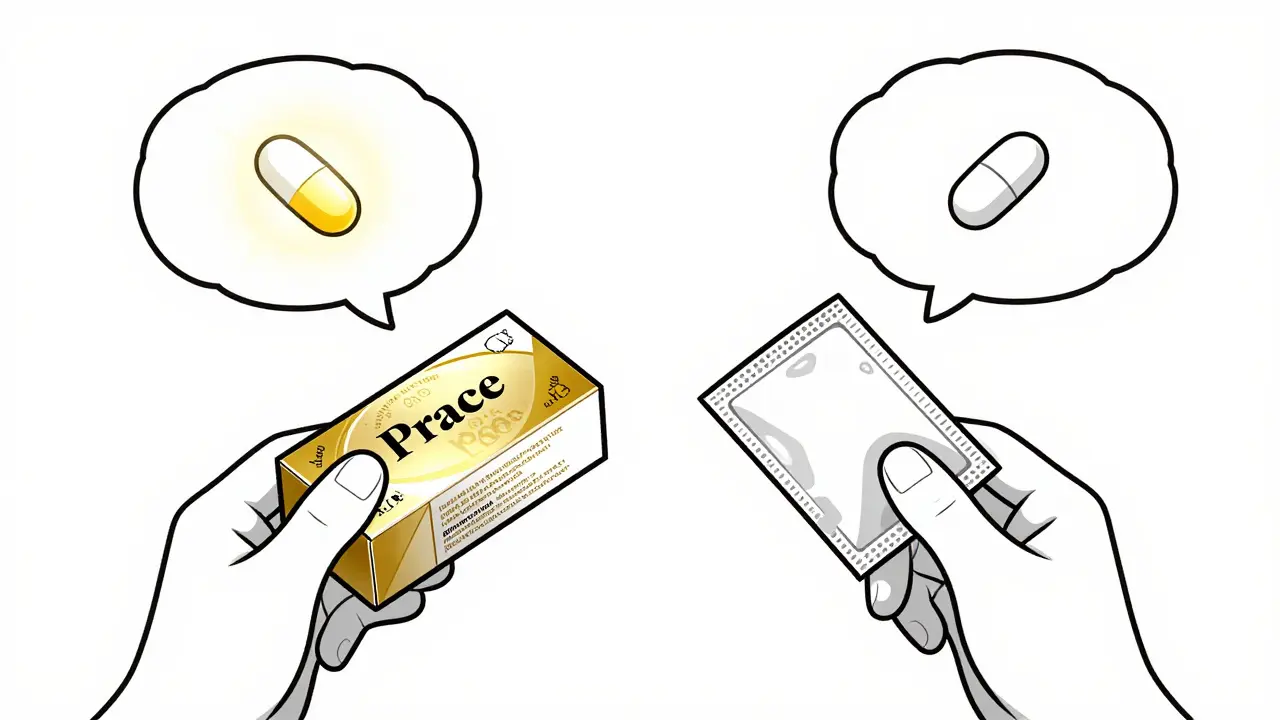
Ever taken a generic pill and thought, ‘This just doesn’t feel like it’s working’-even though your doctor swore it’s the same as the brand-name version? You’re not crazy. You’re not alone. And it’s not because the medicine is weaker.
The truth? Your brain is tricking you. And it’s happening because of something called the price-quality heuristic. That’s just a fancy way of saying: if it costs more, your mind assumes it must work better. It’s not logic. It’s psychology. And it’s shaping how you feel, even when the science says otherwise.
Same pill, different story
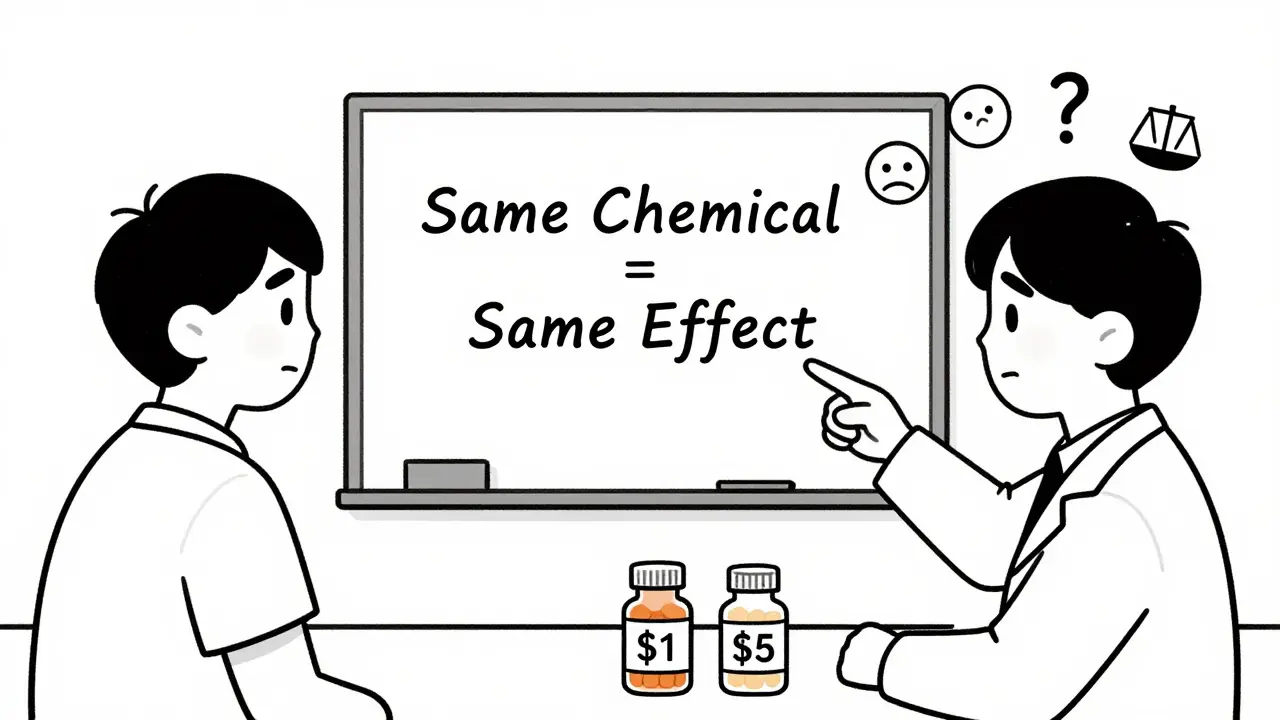
Take ibuprofen. The generic version and the brand-name version-say, Advil-contain exactly the same active ingredient. Same dosage. Same chemical structure. Same FDA approval. But if you’re told one costs $1 and the other $5, your brain starts rewriting the story. A study from the University of Auckland had people take two fake pills-one labeled as a branded ibuprofen, the other as a generic. Both were sugar pills. Yet those who took the ‘generic’ reported more pain, less relief, and even more side effects. Not because the pills did anything different. Because they believed they were different.
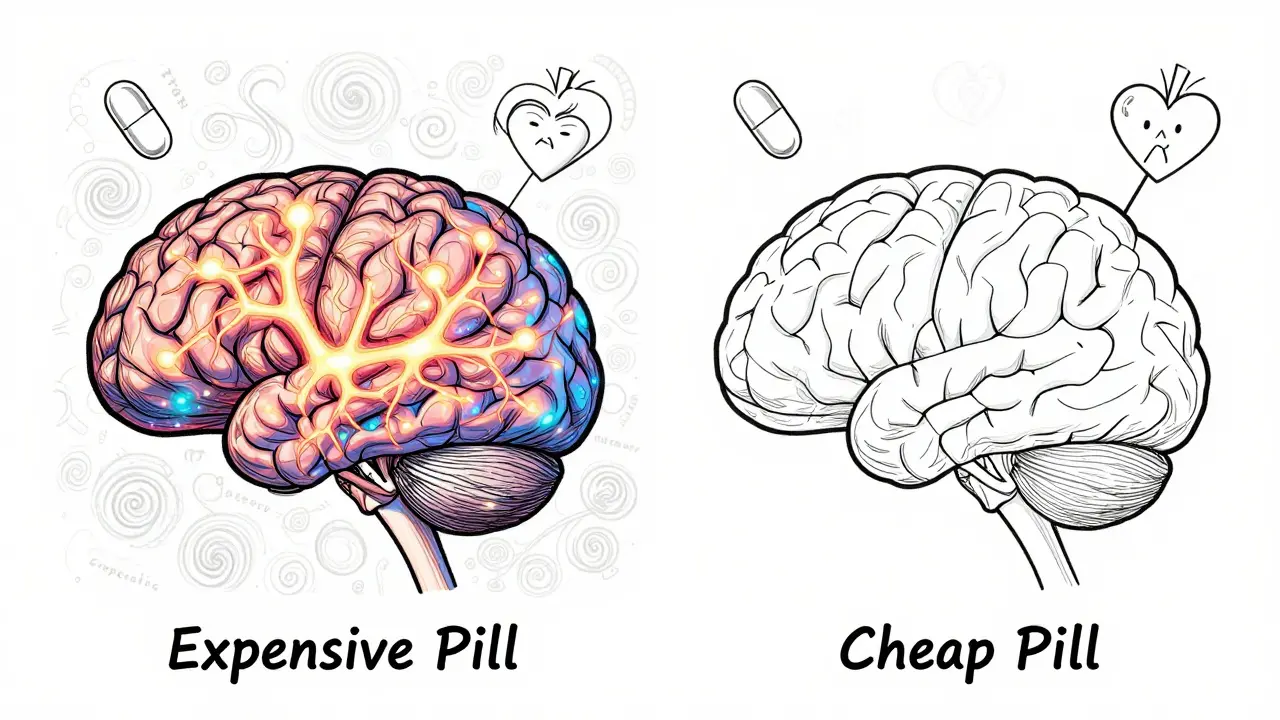
It’s not just about pain. In another experiment, 60 people were given a placebo drug and told it was either expensive or cheap. The same drug. Same dose. Same instructions. But those who thought they were taking the expensive version reported significantly better results-even though the drug had no active ingredients at all. The only variable? Price. Your expectations become your reality.
Why does this happen?
Your brain doesn’t have a built-in drug detector. It doesn’t know if a pill is $0.25 or $5. So it uses shortcuts. One of the biggest? Price = quality. It’s a rule of thumb that works in most areas of life: a $500 watch usually beats a $20 one. A $1,000 laptop usually outperforms a $200 one. So when you see a cheap pill, your brain says, ‘This must be inferior.’ And then it makes you feel it.
It’s not just about money. Appearance matters too. Brand-name pills often come with shiny coatings, smooth textures, and pleasant tastes. Generics? Sometimes they’re chalky, bitter, or oddly shaped. One pharmacist in San Francisco put it plainly: ‘People see a white, uncoated pill and think, ‘This looks like something they threw together.’’
And then there’s the memory trick. In the same study where people were told the drug was expensive or cheap, those who thought they were taking the pricey version remembered taking more doses. They weren’t lying. Their brains literally reconstructed the experience to match their belief. More pills = more effect. So even if they only took one, they swore they took three.
What do people really think?
Surveys show this isn’t just a few people. In the U.S., about 25% of patients believe generic drugs are less effective. Another 20% think they’re less safe. Nearly a third are unsure. That’s not ignorance-it’s deep-seated perception. In focus groups, patients said things like:
- ‘Generic medicine is less potent… other medicine is stronger.’
- ‘Not as good as the real medicine.’
- ‘Name brand is more powerful than the generic.’
These aren’t opinions based on science. They’re stories passed down-from friends, from TV ads, from the way the pills look on the shelf. And they stick.
The cost-saving trap
Here’s the irony: generic drugs save the U.S. healthcare system about $37 billion every year. They make up 90% of all prescriptions-but only 23% of total drug spending. That’s huge. But if people stop taking them because they ‘don’t feel right,’ those savings vanish. And so does access.
One study found that people who believed generics were just as effective were three times more likely to use discount programs for them. The rest? They stuck with the brand-even if it meant skipping doses, splitting pills, or going without.
And it’s not just about money. When patients don’t trust their meds, they’re less likely to take them as prescribed. That leads to worse health outcomes. Higher hospital rates. More emergency visits. The price of skepticism? It’s measured in lives.
Doctors know this. But they don’t talk about it.
Research shows that the single biggest factor in whether someone accepts a generic is not cost, not education, not even their own beliefs-it’s what their doctor says. If a doctor says, ‘This generic is identical to the brand,’ and explains why, patients are far more likely to use it. But too often, doctors don’t bring it up. They assume patients already know. Or they’re afraid of sounding like they’re cutting corners.
One study found that one-third of patients felt their doctor gave them insufficient information about generic substitution. That silence? It’s filled with doubt.
Education doesn’t fix perception
Here’s the twist: even when people learn the facts, it doesn’t always change how they feel. In one trial, participants were taught everything about bioequivalence, FDA standards, and active ingredients. Their knowledge went up. Their belief in generics improved. But when they actually took the pills, their experience didn’t change. The ‘cheap’ pill still felt weaker.
Why? Because perception isn’t just about facts. It’s about emotion. It’s about trust. It’s about the ritual of taking a pill you believe in. If you think it’s a second-rate version, your body responds like it’s a second-rate treatment.
What can you do?
If you’ve ever doubted a generic drug, you’re not wrong for feeling that way. You’re just human. But here’s what you can do:
- Ask your doctor to explain. Don’t just accept the switch. Ask: ‘Is this the same as the brand? How do you know?’
- Compare the pills. Look at the label. Check the active ingredient. You’ll see it’s identical. Write it down if it helps.
- Give it time. If you switch from brand to generic, wait a full cycle before judging. Your brain needs to reset its expectations.
- Don’t assume cheaper = worse. The FDA doesn’t approve generics based on price. They approve them based on science. If it’s on the shelf, it works.
And if you’re still not sure? Try this: take the generic for a week. Then, if you’re still uneasy, switch back. But do it with your doctor’s input-not your fear.
The bottom line
There’s no magic in the packaging. No hidden power in the brand name. The pill you get for $0.50 does the same job as the one that costs $5. The only difference is what your brain tells you.
That’s not a flaw in the system. It’s a flaw in how we think. And fixing it starts with one simple idea: price doesn’t change chemistry.
Next time you reach for a cheaper pill, remember: you’re not getting less medicine. You’re just getting the same medicine-without the marketing.

Comments
Amy Ehinger
Okay but like, I swear this happened to me with my anxiety meds. I switched from the brand to generic and for a week I was convinced it wasn’t working. I was jittery, irritable, the whole deal. Turned out I was just psyching myself out. My body didn’t care about the label, but my brain was screaming ‘THIS IS CHEAP’ like it was a bad Netflix show. Once I stopped overthinking it? Everything went back to normal. Weird how your mind does that.
RUTH DE OLIVEIRA ALVES
It is imperative to recognize that the phenomenon described herein is not merely anecdotal but is robustly corroborated by empirical psychological research. The price-quality heuristic, as elucidated in the referenced study from the University of Auckland, constitutes a well-documented cognitive bias rooted in evolutionary heuristics. The cognitive dissonance experienced by patients is not a failure of rationality but rather an adaptive mechanism misapplied in the context of pharmaceuticals.
Niki Van den Bossche
Let’s be real - this isn’t about pills. It’s about capitalism weaponizing your subconscious. The brand-name placebo isn’t just marketing - it’s a ritual. A sacred offering to the altar of consumerism. You don’t just buy medicine, you buy identity. The generic? It’s the proletariat’s version of healing. No shiny coating. No corporate sponsorship. No emotional tax. And that’s why it terrifies the system. They need you to believe in the myth of superiority. Otherwise… what’s left to sell?
Jami Reynolds
Did you know the FDA allows generics to differ by up to 20% in absorption rate? That’s not ‘same pill.’ That’s a gamble. And don’t even get me started on how many generics are manufactured in China with zero oversight. This isn’t psychology - it’s a public health time bomb. People are dying because they trust the system too much.
Jan Hess
I used to think generics were junk till my buddy told me his kid’s ADHD med was generic and he saved a grand a year. I switched my blood pressure pill and honestly? Same results. No magic. No drama. Just my body working the way it should. Stop overthinking it. The science is solid. Trust the chemistry not the sticker price
Iona Jane
They’re watching us. Every pill you take. Every time you choose cheap. They track it. The pharma giants, the insurance companies - they know you’re starting to wake up. That’s why they push the ‘brand is better’ lie so hard. You think this is about medicine? No. It’s about control. And the pills? Just the delivery system.
Jaspreet Kaur Chana
In India, we’ve been using generics for decades. My grandma took her blood pressure medicine for 30 years - all generic. Never once complained. She didn’t care about the brand. She cared about feeling better. And guess what? She did. The real issue isn’t the pill. It’s the colonial mindset that says Western packaging = better. We need to unlearn that. Power isn’t in the logo. It’s in the science.
ellen adamina
I’ve been on the same generic for years and I never thought twice about it. But I know someone who switched and swore it made her insomnia worse. She cried about it. I didn’t argue. I just listened. Sometimes the feeling is real even when the chemistry isn’t. That’s the human part we forget to talk about.
Gloria Montero Puertas
Wow. Just… wow. You’re telling me people are this gullible? That they’d pay $5 for a placebo because it has a fancy logo? This isn’t psychology - it’s societal collapse. The fact that this is even a discussion proves we’ve lost touch with reality. If you can’t tell the difference between a $0.50 pill and a $5 pill - maybe you shouldn’t be taking pills at all.
Tom Doan
Interesting. So your brain’s placebo effect is more powerful than clinical trials? That’s not a flaw in perception - that’s a flaw in medicine. If your belief can override biochemistry, then maybe we should be prescribing branding instead of drugs. At least then the placebo would come with a warranty.
Arjun Seth
People are fools. They believe ads. They believe logos. They believe everything except the truth. I’ve seen it in my village. People pay double for the same medicine just because it has a name on it. They think the doctor is lying to them. They think the government is cheating them. But the truth? The truth is simple. The pill is the pill. Stop being scared. Start being smart.
Ayush Pareek
Hey - if you're nervous about switching, that's okay. It's a big change. But don't let fear make the decision for you. Talk to your doc. Ask questions. Maybe even keep a little journal for a week. You might be surprised how your body reacts once your mind stops doubting. You've got this.
Crystel Ann
My mom used to say, ‘If it works, it works.’ She took generics for her diabetes for 15 years. Never had a problem. She didn’t read the studies. She didn’t care about the brand. She just cared about feeling okay. Sometimes the simplest truths are the ones we overlook.
Nat Young
So let me get this straight - you’re saying the only reason people think generics don’t work is because they’re told they’re cheaper? But what if the generics actually ARE worse? What if the FDA’s standards are a joke? What if the ‘same active ingredient’ is diluted with fillers from a factory in Bangladesh? You’re not debunking the myth - you’re ignoring the real problem.